Author: Subash

  • Incident Report Form: The 8 Fields Your Template Must Include

    Incident Report Form: The 8 Fields Your Template Must Include

    An incident report form is the blank template a guard fills in when something goes wrong on site: an injury, a theft, a trespass, a near miss, property damage. Before a word is written, the form itself decides how good the record can be. A template that prompts for the right fields, in the right order, produces a report an insurer or a court will accept. A blank box that just says “describe the incident” produces three vague lines and no evidence.

    This guide is about the form as a document: the eight fields your template must contain before you hand it to a guard, the mistakes that make a filled-in form worthless, and when a printable paper form is enough versus when you need a digital one. If what you need is how to write up the report once you have the form, that belongs in our security incident report format guide; this piece stays on the form itself.
    incident report form

    Why the incident report form matters

    The report is written in minutes but read for months. It is the document a claims adjuster uses to decide a payout, the record a lawyer reads before a liability case, and the evidence a client reviews when they ask what their security provider actually did. If a detail was not captured at the scene, it usually cannot be recovered later.

    A structured form matters because it removes the guesswork under pressure. A guard dealing with an injured person should not have to remember what a complete report needs; the form should ask. That is what separates a system that produces usable evidence from one that produces a pile of inconsistent notes.

    The 8 fields every incident report form must include

    1. Date and time of the incident – the actual time it happened, not the time the report was written.
    2. Location – the specific place on site, precise enough that someone who was not there can picture it.
    3. Reporter details – the name and role of the guard completing the form, so the account is attributable.
    4. People involved – names and roles of everyone present: victims, witnesses, staff, third parties.
    5. Description of what happened – a factual, chronological account, without opinion or blame.
    6. Action taken – what the guard did: first aid given, police called, area secured, supervisor notified.
    7. Evidence – photos, video or audio from the scene. AVES incident forms capture six-sided photo evidence (front, back, left, right, top, bottom) plus video and audio.
    8. Findings and follow-up – the outcome, any corrective action, and whether a police report or investigation was raised.

    Together these eight answer the questions every reader asks: what, when, where, who, what was done, and can you prove it.

    How a digital incident report form works

    A paper form relies on the guard remembering to fill every box and on the handwriting being legible weeks later. A digital incident report form removes both risks. The fields are mandatory where they need to be, so a report cannot be submitted half-finished. Photos, video and audio attach directly to the record rather than living on someone’s phone. The timestamp and the reporter are captured automatically.

    Because the report is data rather than paper, it is searchable and it routes to the right person for review the moment it is submitted. For the full workflow around logging, escalating and analysing incidents, see the AVES incident reporting software. If you need the specific layout conventions, the security incident report format guide covers structure.

    Common incident report form mistakes

    Opinion instead of fact. “The visitor was aggressive” is a judgement. “The visitor raised his voice and struck the counter” is an observation. Reports record observations.

    Missing the time of the incident. Recording only when the report was written loses the single most important timestamp.

    No evidence. A description with no photo is an assertion. A single photo of a wide area proves little. Capture the scene from multiple angles.

    Blame and speculation. A report that guesses at cause or assigns fault undermines its own credibility. Record what was seen; leave conclusions to the investigation.

    Gaps left blank. An empty field is a question left unanswered, and it is often the answer the reader needs most.

    Written hours later. Memory fades fast. A report completed at the scene is far more reliable than one reconstructed at the end of a shift.

    Incident report form checklist

    • Date and time of the incident recorded, separate from the report time.
    • Specific location captured.
    • Reporter named, with role.
    • All people involved listed with roles.
    • Factual, chronological description with no opinion.
    • Action taken recorded.
    • Evidence attached: photos from multiple angles, plus video or audio where relevant.
    • Findings and follow-up noted, including any police report.

    Frequently asked questions

    What is an incident report form?

    An incident report form is a structured document that records the details of an incident on site: what happened, when and where, who was involved, the action taken and the evidence captured. It is used for insurance, liability and investigation.

    What should an incident report form include?

    At a minimum: date and time of the incident, location, reporter, people involved, a factual description, action taken, evidence, and findings or follow-up.

    What is the difference between an incident report form and a witness statement?

    The incident report is the guard’s structured account of the event. A witness statement is a separate first-person account from someone who saw it. Both support the same case. See the AVES witness statement form.

    Should incident reports be written on paper or digitally?

    Digital is more reliable. Paper forms are prone to blank fields, illegible handwriting and lost evidence. A digital form enforces the required fields, attaches photo, video and audio directly to the record and timestamps it automatically.

    How soon should an incident report be completed?

    As close to the incident as possible, ideally at the scene. Memory and evidence both degrade quickly, so a report written hours later is weaker.

    Give your guards a form that captures real evidence

    If your incident reports still come in as a few handwritten lines, the evidence you need after an incident is not there. AVES incident forms prompt for every required field and capture six-sided photo evidence plus video and audio, so every report is complete and defensible.

    Book a 30-minute demo and we will show you the actual incident form and evidence-capture screens: Book a demo.

    Prefer to explore first? Start a free account.

    Follow AVES on Instagram.
  • Employee Training Tracker: What to Record and Why It Matters

    Employee Training Tracker: What to Record and Why It Matters

    An employee training tracker is a single record of every training a worker has been assigned, requested, completed or still owes, with the dates and status kept against each person so nothing lapses unnoticed.

    Most teams do not lose training records because people stop training. They lose them because the proof sits in five places at once: a signed attendance sheet in a drawer, a certificate photo on someone’s phone, a line in a spreadsheet that was last opened three months ago, and a memory that “I think Ravi did that course”. When an auditor, a client or an incident asks who was trained on what, and when, that scatter turns into a scramble.

    An employee training tracker fixes the scatter. It is not a course library and it is not a payroll system. It is the running answer to one question a security operation is asked constantly: is this person cleared to do this task today. This guide covers what a good tracker records, why each field earns its place, and a checklist you can use to build or buy one.

    employee training tracker

    Why a training tracker matters

    Training is only useful if you can prove it. A guard who completed fire-safety training two years ago may be well past a required refresher, and without a tracked expiry date nobody notices until the certificate is asked for. The gap between “we trained them” and “we can show we trained them, on this date, and it is still current” is exactly where compliance findings, failed client audits and disputed incidents live.

    An employee training tracker also protects the worker. When training is requested, accepted and recorded in one place, staff can see what they have been assigned and confirm they have done it, rather than being told after the fact that they missed something they were never clearly given. That accept-and-confirm trail matters as much for fairness as it does for the auditor.

    For a multi-site security team, the case for an employee training tracker climbs. A supervisor covering several posts cannot hold every guard’s training status in their head. The tracker becomes the shared source of truth that a site lead, an operations manager and a client can all read the same way.

    What an employee training tracker should record

    The value of an employee training tracker is in its fields. Record too little and it cannot answer the who-when-still-valid question. Record fabricated detail it cannot back up and it becomes noise. Keep it to the fields that carry weight. At minimum, a training tracker should hold:

    • The person — name and staff identifier, and the site or department they belong to, so records can be filtered by post.
    • The training — the course or topic name, taken from a defined catalogue rather than free text, so the same course is not logged five different ways.
    • Assignment and request — who the training was assigned to, and a record of the worker requesting or being enrolled, so there is a clear start point.
    • Acceptance and completion — confirmation that the worker accepted the assigned training and that it was completed, with the date, rather than an unverifiable “done”.
    • Status — a single readable state (assigned, requested, accepted, completed) so a supervisor can scan a list and see gaps at a glance.
    • Records and evidence — the supporting document or certificate held against the entry, so the proof lives with the record and not in someone’s phone gallery.

    If a course expires or needs periodic refreshers, an expiry or next-due marker turns the employee training tracker from a history into an early warning. That single field is the difference between finding a lapse in an audit and finding it a month before it happens.

    How an employee training tracker works in practice

    The mechanics of an employee training tracker are simpler than the spreadsheet version most teams outgrow. A training is defined once in a catalogue. It is then assigned to, or requested by, a worker. The worker accepts it, completes it, and the completion is recorded against their name with the date and any certificate attached. From that point the entry has a status anyone with access can read, and the record sits under that person permanently.

    In the AVES Security app, the Training module follows exactly this flow: workers browse and request trainings, assignments are accepted, and records are kept, with an admin catalogue defining what can be assigned. For a broader view of how this fits together, see our guide to a training management system for security guards. The point is that request, acceptance and the resulting record are one connected trail rather than three disconnected artefacts.

    Grounding the tracker in the same system your team already uses for shifts, patrols and reports also removes the second-system problem. It is the same principle behind a well-kept security guard logbook: the record is useful only when it sits alongside the daily work, not in a system nobody opens.

    Employee training tracker checklist

    Use this to build an employee training tracker from scratch or to judge a tool you are considering:

    • Every entry ties to a named person and a staff identifier, filterable by site or department.
    • Courses come from a defined catalogue, not free-typed text.
    • The tracker records the full path: assigned or requested, accepted, completed, with dates.
    • Each entry has a single readable status.
    • Supporting certificates or documents are attached to the record itself.
    • Expiring or recurring training carries a next-due or expiry marker.
    • The record is permanent and readable by supervisors and managers, not owned by one person’s device.

    If your current method fails more than one of these, it is a filing habit, not a tracker.

    Common mistakes to avoid

    The most common employee training tracker failure is the abandoned spreadsheet: accurate on the day it was made, silently wrong a month later because nobody updates it in real time. A tracker only works if the record is created as the training happens, not backfilled from memory.

    The second employee training tracker mistake is logging completion with no evidence and no status. “Trained” as a single word proves nothing and cannot survive an audit. Capture the date, the confirmation and the certificate.

    The third is treating training as a one-time event. Without an expiry or refresh marker, a completed course quietly becomes an expired one, and the tracker keeps showing green long after the training has lapsed.

    The fourth is scattering the record across systems. If the certificate is in email, the attendance is on paper and the status is in a chat message, you do not have a tracker. You have the same scatter you started with, in more places.

    Frequently asked questions

    What is an employee training tracker?

    An employee training tracker is a single, maintained record of every training each worker has been assigned, accepted, completed or still owes, with dates, status and supporting evidence held against each person so nothing lapses without being noticed.

    What should a training tracker include?

    At minimum: the person and their staff identifier, the course from a defined catalogue, the assignment and acceptance, the completion date, a readable status, and the attached certificate or record. Add an expiry or next-due marker for anything that needs refreshing.

    Is a spreadsheet enough to track employee training?

    It can start you off, but spreadsheets go stale because they rely on someone remembering to update them, they hold no attached evidence, and they do not signal upcoming expiries. Most teams outgrow them once training has to be provable rather than just noted.

    How is a training tracker different from a training course library?

    A course library is the catalogue of what can be taught, while an employee training tracker is the record of who did it. A tracker is the record of who was assigned it, who accepted and completed it, and when. You need both, but the tracker is what answers audit and compliance questions.

    Why keep training records at all?

    Because training that cannot be proven does not count when it matters, and an employee training tracker is what makes it provable. Kept records protect the organisation in audits and disputes, and protect the worker by showing clearly what they were assigned and confirmed.

    See it on the real screen

    Training only earns its keep when the request, acceptance and record live in one connected trail. Book a 30-minute demo and we will show you the actual AVES Training screen, using your own workflow, so you can see how assignments, acceptances and records stay in one place.

    Book a 30-minute demo →

    Prefer to explore first? Start a free AVES account →

    Follow AVES Security on Instagram.

  • What Is a Performance Development Plan? A Guide for Security Teams

    What Is a Performance Development Plan? A Guide for Security Teams

    A performance development plan is a written agreement between a manager and an employee that sets specific goals, the support needed to reach them and the dates those goals will be reviewed. For a security team it turns a vague “improve your patrols” conversation into a documented plan the guard has seen, understood and formally accepted. That accepted record is what protects both sides when performance is later disputed.

    Security operations run on shift work, spread across sites, with supervisors who rarely sit in the same room as the guards they manage. Development conversations happen verbally at a gatehouse and are forgotten by the next roster. A performance development plan fixes that gap by putting the goal, the timeline and the acknowledgement in one place.

    Why a performance development plan matters for security staff

    Guarding is measured on consistency: patrols completed, checkpoints scanned, handovers logged, incidents reported correctly. When a guard falls short, most teams either ignore it or jump straight to disciplinary action. A performance development plan is the missing middle step. It gives the guard a fair, recorded chance to improve before anything escalates.

    It matters for three reasons. It creates accountability, because the guard has accepted a specific goal rather than a general complaint. It creates a paper trail, so if the same issue recurs the escalation is defensible. And it supports retention, because good guards stay where they can see a path to a supervisor or site-lead role rather than being managed only by punishment.

    Without a documented plan, the common failure is disagreement about what was ever agreed. The guard says no target was set; the supervisor says it was discussed. Neither can prove it. A plan the guard has formally accepted removes that argument entirely.

    How a performance development plan works

    A good plan follows a simple loop: agree the goal, record the guard’s acknowledgement, set a review date, then review against the same written target. The strength of the process is that nothing depends on memory.

    In AVES the Performance Development Plan module holds the plan as a formal record and requires the employee to accept or decline it. That accept or decline response is the part paper forms never capture. When a guard accepts, you have proof they saw and agreed the goal. When a guard declines, you have an early signal that a conversation is needed before the review period even starts, not after it has failed.

    Because the plan lives in the same system as the guard’s operational records, the review is grounded in evidence rather than impression. Patrol completion, shift handover submissions and incident reports already sit in the platform, so a supervisor reviews the plan against what actually happened on shift instead of relying on a gut feeling about the guard.

    What to include in a performance development plan

    Keep it short enough that a guard reads it on a phone at the start of a shift. Every plan should cover:

    • The specific goal. Not “be more reliable” but “complete all scheduled patrol checkpoints on every shift” or “submit the shift handover before leaving the post”.
    • The current gap. A plain statement of where performance stands today, so the target is measured against a known starting point.
    • The support offered. Retraining, a mentor, a refresher on the app, or a revised checklist. A plan that only lists demands and no support is a warning, not a development plan.
    • The review date. A fixed date when manager and guard sit down against the same written goal.
    • The acknowledgement. The guard’s formal accept or decline, with the name, date and time recorded automatically.

    That acknowledgement is the difference between a plan and a note. Everything above it is intention; the accept or decline is the evidence.

    Common mistakes to avoid

    The most frequent error is writing goals a guard cannot control. Tying a plan to “reduce site incidents” punishes the guard for events outside their influence. Tie it instead to the behaviours they own: patrols scanned, handovers logged, reports filed correctly.

    The second mistake is no acknowledgement step. A plan the employee never formally accepted is worth little if performance is later challenged, because there is no proof the guard ever agreed to it. Always capture the accept or decline.

    The third is setting a plan and never returning to it. A review date that passes unactioned tells the guard the plan was never serious, and every future plan carries less weight. If you set a date, hold the review.

    The fourth is confusing development with discipline. A performance development plan is a chance to improve. A disciplinary or show-cause notice is a separate, later step for when improvement has not happened. Keeping the two distinct keeps the development plan constructive and keeps your escalation defensible.

    Frequently asked questions

    What is a performance development plan?

    A written agreement between a manager and an employee that sets specific goals, the support to reach them and a review date, with the employee’s formal acknowledgement recorded. For security staff it converts a verbal coaching chat into a documented, accepted plan.

    How is a performance development plan different from a performance improvement plan?

    A development plan is generally forward-looking and can apply to any guard growing toward a target, including strong performers. A performance improvement plan is usually the more formal, remedial step when performance is already below standard. In practice the structure, of goal, support, review and acknowledgement, is much the same.

    Who should sign off a performance development plan?

    The supervisor or site lead who set the goal and the employee it applies to. The employee’s accept or decline is the essential record; a plan without the employee’s acknowledgement is incomplete.

    How often should a performance development plan be reviewed?

    Set an explicit review date when the plan is created, commonly 30 to 90 days out depending on the goal. The key is that the review happens against the same written target the guard accepted.

    Can a performance development plan lead to disciplinary action?

    It can, if the agreed goal is not met after fair support and a proper review. Kept separate and documented, the development plan becomes the evidence that the guard was given a fair chance before any escalation.

    Set fair, trackable development plans for your guards

    AVES holds each performance development plan as a formal record with a built-in accept or decline step, and reviews it against the patrol, handover and reporting data your guards already generate, so every plan is fair, tracked and defensible.

    Book a 30-minute demo and we will show you the actual Performance Development Plan screen, including how the accept or decline acknowledgement is captured: book a demo.

    See how security teams put this into practice on our Instagram.

    Prefer to explore first? Start a free trial and set up your first development plan today.

  • Emergency Response Plan: What It Is, the Template, and How to Prove It Worked

    Emergency Response Plan: What It Is, the Template, and How to Prove It Worked

    An emergency response plan is a written procedure that tells everyone on a site exactly what to do the moment an emergency is declared — who takes command, which teams are called, which emergency services are contacted, and how each step is recorded. It turns a panic moment into a rehearsed, accountable sequence instead of a scramble.

    When an emergency is called on a guarded site — a fire, a medical collapse, an intruder, a bomb threat — the difference between a controlled response and chaos is almost never courage. It is whether an emergency response plan existed, whether the people on shift knew it, and whether anyone recorded what actually happened. This guide covers what an emergency response plan is, what belongs in the template, the codes that trigger it, and where the traditional paper process quietly fails.

    Why sites need an emergency response plan

    Emergencies are rare and high-stakes, which is the worst possible combination for improvised decisions. The guard on duty at 2am may never have handled a real fire evacuation. Under pressure, people forget steps, call the wrong number, or wait for someone else to take charge.

    An emergency response plan removes that guesswork. It pre-decides, in calm conditions, who does what: who declares the emergency, who takes command, which internal teams mobilise, which outside services are called, and who logs the timeline. On the night, nobody has to invent a process — they follow one.

    What is an emergency response plan?

    An emergency response plan is a formal, site-specific procedure for handling defined emergency scenarios. It is not a generic safety poster. A proper plan ties five things together:

    1. The triggers — the emergency codes or scenarios the plan covers.
    2. The command structure — who runs the response (the command centre) and who reports to whom.
    3. The teams — the emergency response team (ERT) and crisis management team (CMT), and who is on each.
    4. The external contacts — ambulance, police, and fire, and who calls them.
    5. The record — how each activation is logged, minute by minute, for the after-action review.

    Drop any one of those and the plan stops being operational and becomes a document nobody can act on.

    Emergency codes: the triggers that start the plan

    Many sites use colour or word codes so that an emergency can be declared quickly and consistently, without broadcasting alarming detail to the public. Codes vary by organisation and country, so the plan must define them for that site. Common examples include a code for fire, one for a medical emergency, one for an active threat or intruder, one for evacuation, and one for a bomb threat.

    The point of a code is speed and clarity: a single announced code should map to one specific, rehearsed response in the plan. If your team cannot say what each code means and what it triggers, the codes are decoration, not a system.

    The emergency response plan template

    A workable emergency response plan template covers, at minimum:

    • Scope and codes — which scenarios and codes the plan covers for this specific site.
    • Command centre — where response is coordinated from, and who leads it.
    • Response teams — the ERT and CMT rosters: names, roles, and contact details.
    • Notification sequence — who is informed internally, and in what order.
    • Emergency services — which services are called, by whom, and the arrival details recorded on the day.
    • Evacuation and assembly — routes, muster points, and roll-call responsibility.
    • The activation log — a running, timed narration of what happened, who did what, and when.
    • Stand-down and review — how the emergency is closed and what the after-action review must capture.

    Where the paper process breaks down

    The plan concept is sound. The paper version is where it fails when it matters most:

    • The plan is in a binder no one opens. A response plan filed on a shelf is not a plan the 2am guard has rehearsed.
    • No live activation record. During the event, nobody is writing down times; the timeline is reconstructed afterwards from memory, which auditors and insurers distrust.
    • Rosters go stale. The ERT list names people who left months ago, with old phone numbers.
    • No accountability trail. “When did we call the ambulance?” and “who took command?” too often end in a shrug.

    An emergency handled without a recorded activation is, when an investigator or insurer asks what happened, very hard to defend.

    Managing code activation digitally

    Related reading: keep the plan rehearsed with fire drill and safety drill management.

    This is where a digital workflow closes the gaps a binder leaves open. In AVES, a Code Activation report runs as a structured, tracked record rather than notes on a clipboard:

    • The activation is coordinated from a defined command centre, captured on the report.
    • The ERT and CMT rosters are recorded against the activation, so it is clear who was mobilised and in what role.
    • Emergency service arrivals — ambulance, police, and fire — are logged with their arrival details as the event unfolds.
    • A running narration captures the sequence of what happened and when, so the timeline is written during the response, not reconstructed from memory afterwards.

    The point isn’t software for its own sake. It’s that the accountability a serious incident demands — who took command, when each service arrived, what was done in what order — becomes a record you can actually produce, on demand, months later when someone asks.

    Common mistakes to avoid

    1. Writing the plan and never drilling it. A plan the team has never rehearsed will not survive first contact with a real emergency. Pair it with scheduled drills.
    2. Undefined or inconsistent codes. If different shifts read the same code differently, the code is a liability, not a shortcut.
    3. Stale rosters. An ERT list that names people who have left is worse than no list, because it wastes time on the night.
    4. No live log. Reconstructing the timeline after the fact is exactly what auditors and insurers distrust. Capture it as it happens.
    5. No after-action review. An activation with no review teaches the team nothing and repeats the same gaps next time.

    Frequently asked questions

    What is an emergency response plan?

    A written, site-specific procedure that defines what to do when an emergency is declared — who takes command, which teams mobilise, which emergency services are called, and how each step is recorded — so the response is rehearsed rather than improvised.

    What should an emergency response plan include?

    At minimum: the scenarios and codes it covers, the command structure, the ERT and CMT rosters, the emergency-service notification sequence, evacuation and assembly arrangements, and a timed activation log with an after-action review.

    What are emergency codes?

    Short colour or word codes used to declare a specific type of emergency quickly and consistently. Codes vary by organisation and country, so each site’s plan must define what every code means and the response it triggers.

    How often should an emergency response plan be reviewed?

    Whenever the site, team, or risks change, and after every drill or real activation. Rosters and contact details in particular should be checked regularly so they are current on the night.

    Do I need software for an emergency response plan?

    No — the requirement is the plan and the drills behind it, which can be done on paper. A digital record mainly helps during and after an activation, where capturing a timed log of command, teams, and emergency-service arrivals is hard to do reliably on a clipboard.

    Running guarded sites where an emergency could be called on any shift, and you cannot prove afterwards exactly what happened? See how AVES turns code activation into a tracked, auditable record — command centre, response-team rosters, and timed emergency-service arrivals. Book a 30-minute demo and we’ll walk you through the actual Code Activation screen — or start a free trial.

  • Shift Handover Software: Close the Gap Between Guard Shifts

    Shift Handover Software: Close the Gap Between Guard Shifts

    Here’s what nobody tells you when you’re shopping for shift handover software: the calendar was never your problem. If you run a security company, you already know the moment. A guard finishes a shift, hands things over in a rush and the next guard walks in half blind. Nobody’s sure which keys got passed on, what happened during the last two hours or whether that “minor incident” near the loading dock actually got written down anywhere.

    You’re not here for a definition of staff scheduling software. You’ve probably Googled that term ten times already. What you actually want to know is simpler and harder at the same time. Will staff scheduling software fix the chaos on your site or will it just hand your team a new tool to learn and ignore?

    That’s the real question. It deserves a real answer.

    Why Shift Handovers Quietly Break Security Operations

    Most security firms don’t lose money because of one big disaster. They lose it in small, boring ways that pile up.

    A guard forgets to mention a broken camera. The next shift has no idea a visitor badge never got returned. A key goes missing and nobody can say who had it last. None of this looks like a crisis on any given day. Give it a month, though, and it becomes a pattern your clients start noticing before you do.

    Paper logbooks and WhatsApp threads feel fast, but they’re fragile. They live in one person’s memory or one phone’s chat history. The moment that person takes leave, gets sick or just forgets, the information is gone with them. Closing that exact gap is what decent staff scheduling software is for.

    Here’s what most articles skip. Guards aren’t careless. Verbal handovers just depend entirely on human memory during the most rushed five minutes of a shift and memory is a terrible place to store operational data.

    What Shift Handover Software Is Actually Solving

    People talk about shift handover software like it’s just shift calendars and roster planning. Sure, that’s part of it. But that framing sells short what good staff scheduling software does for security operations specifically.

    A proper shift scheduling app earns its keep in three ways.

    It tells you who’s supposed to be where and when. It builds a clean digital record of what actually happened on each shift. And it forces the outgoing and incoming teams to talk to each other instead of assuming the other person already knows.

    That third piece is where most staff scheduling software quietly fails. Plenty of tools nail the calendar side. Almost none build a structured handover process that fits how security teams actually work on the ground. If you’re evaluating staff scheduling software for a guarding or patrol business, check this feature first, not last.

    The Mistake Most Buyers Make First

    Here’s something you won’t find in most comparison articles. The biggest mistake first-time buyers make is picking staff scheduling software based on the calendar alone and treating shift handovers as an afterthought.

    That backfires fast. A calendar tells you who was on duty. It doesn’t tell you what they handed over, whether the keys came back or whether that 3 a.m. incident ever made it into the morning briefing.

    If your team works in physical security, guarding, patrolling or facility management, the handover is where the real risk lives. Picking staff scheduling software without checking how it handles this part is like buying a car and skipping the test drive on the brakes.

    What a Digital Shift Handover Should Actually Look Like

    Easier to show than explain. Here’s what a structured handover looks like inside shift handover software built for security teams, using Aves as the working example.

    When a guard finishes a shift, they open Create Handover and get prompted to fill in the specifics. Date, outgoing shift, incoming shift are already structured fields, so nothing gets left to memory.

    From there, the form asks for the details that actually matter on the ground. Keys handed over, listed one by one. Equipment handed over, so nothing quietly disappears between shifts. Related incidents, linked directly instead of buried in a separate chat somewhere. Remarks, for the context that doesn’t fit into a checkbox. Attachments, so a photo of damage or a signed slip lives on record instead of getting lost in someone’s camera roll.

    Once submitted, the handover doesn’t just vanish into a folder. It sits under My Handovers, tracked by status. You can see what’s Submitted and what’s been Acknowledged, which gives you a clear digital trail showing the incoming officer actually reviewed it. Not just that a form got filled out somewhere.

    That closes the exact gap paper logs and group chats leave wide open. There’s no ambiguity anymore about whether the next shift knew about the broken lock or the visitor who never checked out.

    The Honest Trade-Offs Nobody Mentions

    Digital shift handovers aren’t magic. shift handover software is only as good as the habit sitting behind it.

    If your guards fill in the form carelessly just to move on, you end up with a digital version of the exact same problem you had on paper. Software gives you structure. It doesn’t give you discipline. That still has to come from how you train your team and how your supervisors follow up.

    Expect a short adjustment period too. Guards used to scribbling a quick note need a week or two to get comfortable with a structured form. That’s normal. Most teams settle into new staff scheduling software faster than owners expect, especially when the form itself is short and specific instead of a long questionnaire nobody wants to fill out.

    Then there’s cost, the part nobody wants to talk about honestly. Staff scheduling software with real shift handover features isn’t free and you shouldn’t judge it against doing nothing. Judge it against what a single missed incident report or a disputed missing-equipment claim already costs you in client trust.

    What This Actually Fixes for a Growing Security Company

    Once you’re managing more than a handful of guards across even one or two sites, verbal handovers stop scaling almost immediately. This is usually the exact moment teams start searching for staff scheduling software in the first place.

    A structured system fixes three things that quietly hurt security operations more than anything else.

    Accountability stops being assumed and starts being visible. You can see exactly who submitted a handover and who acknowledged it, which matters the second a client asks what happened during a specific shift.

    Incident history stops living in someone’s head. Related incidents attached to a handover build a searchable record over time instead of a story that shifts slightly every time someone retells it.

    Client trust improves without you doing much extra. Pull up a clean digital record showing keys, equipment and incidents tracked shift by shift and it signals a level of operational maturity paper logs simply can’t fake.

    Choosing the Right Shift Handover Software Without Overthinking It

    You don’t need the shift handover software with the longest feature list. You need the one that matches how your team actually works on site.

    Look for security guard scheduling that fits real shift patterns, not a generic weekly calendar borrowed from an office job. Look for a digital shift handover process built specifically for security work, covering keys, equipment and incidents, not a notes field lifted from some HR tool. And look for a clear acknowledgment trail, so you’re never left guessing whether the next shift actually saw what got handed to them.

    Find one piece of shift handover software that covers scheduling and handovers together and your team stops juggling two or three separate apps just to run a single shift properly.

    Where to Go From Here

    You don’t need to overhaul your whole operation overnight. Start with one site or one team. Run shift handovers digitally for two weeks and compare what you see against your old paper logs or chat messages.

    Most owners describe the same reaction once they watch staff scheduling software work the way it should. It’s not that the software does anything dramatic. It’s that the gaps they’d gotten used to living with simply stop happening.

    If you want to see how this looks for a team your size, Aves Security’s staff scheduling software walks through exactly this workflow, built specifically for guard operations instead of adapted from generic office software.

    CONTACT US

    Website : https://www.avessecurity.com

    Linkedin: https://www.linkedin.com/company/aves-security-management-system/

    Instagram: https://www.instagram.com/avessecurity/

  • Witness Statement Form: Smart Steps for Security Operations

    Witness Statement Form: Smart Steps for Security Operations

    Most witness statement forms are useless the moment something actually happens.

    Not because the witness statement form is missing fields. Because it was built by someone sitting at a desk with plenty of time, for a guard who’s going to fill it out with none. A theft. A fight. A fall. An argument that got physical fast. Three people talking over each other and somewhere behind you, a manager already calling asking where the report is.

    If the witness statement form falls apart in that moment, everything built on top of it falls apart too. Names get missed. Nobody notes the time. The handwriting is a mess. Six months later, someone challenges the statement in a disciplinary hearing or in court and half the required fields are just blank.

    You already know this. You’re not here for a definition of what a witness statement is. You want a form that survives contact with a real incident and still holds up when someone comes asking for proof months down the line.

    Why Most Witness Statement Forms Fail Before the Incident Even Happens

    Here’s the thing nobody tells you. A witness statement form doesn’t fail during the incident. It fails long before that, sitting in a folder, looking fine.

    Wide open text boxes. No real structure. Looks tidy on a screen. Falls apart the second a guard is standing in a car park at 11pm trying to remember which detail goes where.

    Most people treat a witness statement form as paperwork. That’s the mistake. Paperwork gets filed and forgotten. Evidence gets scrutinized, picked apart, questioned. If your witness statement form can’t survive that kind of scrutiny, it was never doing its job in the first place.

    You don’t fix a weak witness statement form by adding more fields. You fix it with structure. Every single field on that form should exist because someone, at some point, badly needed that exact piece of information and didn’t have it.

    What the Form Actually Needs to Capture

    A real witness statement form covers two things. Who’s giving the statement and what actually happened.

    Start with identity and background:

    • Full name and alias if applicable
    • NRIC or national ID number
    • Date of birth and age
    • Nationality and race
    • Gender
    • Department and designation
    • Employment number
    • Phone number and address
    • Join date
    • Language spoken and whether an interpreter was used

    That last one matters more than most people think. Say part of your workforce isn’t fluent in the language the report is written in and no interpreter gets logged. That statement can get challenged later on the simple grounds that the person didn’t fully understand what they signed. If you’re running security in Singapore or Malaysia, this isn’t an edge case. Multilingual crews are the default, not the exception.

    Then the incident-specific side:

    • Date and time of incident
    • Type of incident
    • Location
    • Full details of the incident
    • Head of department sign-off
    • Case status, open or closed
    • Assigned team
    • Completion marker

    Notice what most witness statement form templates skip. A structured incident type field. Without it, every report turns into a wall of free text nobody can search or filter or compare six months later. Your management asks how many altercations happened at a site last quarter and you want that answer in seconds. Not a week spent digging through old PDFs.

    The Mistake That Actually Costs Guards Credibility

    Most articles won’t say this plainly, so here it is. The biggest threat to a witness statement form isn’t a missing field. It’s a delayed one.

    Memory fades fast, faster than people want to admit. Eyewitness recall studies show accuracy drops sharply within the first few hours after something happens. A guard filling out the form the next morning, working from memory, isn’t giving you a witness statement anymore. That’s a reconstruction wearing a witness statement’s clothes.

    Think of it like a photograph versus a painting done from memory. The photo isn’t always flattering. It’s accurate though. The painting might look sharper and more composed, but every time it gets redrawn, details shift a little more.

    The fix is boring and practical. The witness statement form has to be fast enough to fill out on the spot. On a phone or a tablet, right after the incident, while the details are still sharp in someone’s head.

    Common Objections and Why They Don’t Hold Up

    If you’re the one deciding whether to overhaul your process, you’re probably running a few worries through your head right now.

    “Our guards aren’t comfortable with digital tools.”

    Fair concern and it used to carry more weight than it does now. Most guards already run their lives off smartphones. A well-built witness statement form with dropdowns and structured fields is easier to fill out under pressure than a blank paper template, because it tells you what comes next instead of leaving you to remember the order yourself.

    “Paper feels safer for legal purposes.”

    It’s actually the opposite. A paper witness statement form can get lost, damaged or quietly altered with zero trace. A digital record with a timestamp and a locked submission is harder to dispute, not easier. If your process still ends in a filing cabinet, that cabinet is your biggest liability. Not your safeguard.

    “We already have a generic incident report. Why bother with a separate witness statement form?”

    An incident report is the site supervisor’s conclusion about what happened. A witness statement is one specific person’s account, in their own words, tied to their identity. Courts, HR panels and insurance adjusters treat these two documents very differently. Merge them into one and you weaken both.

    What Good Witness Statement Form Implementation Looks Like

    Rolling out a proper witness statement form isn’t some massive project. It comes down to a handful of honest decisions.

    Decide who can actually create a statement. In a well-run setup, that’s the reporting guard or the shift supervisor, not just management sitting in an office. The record gets captured in the moment, not reconstructed after the fact.

    Lock the case status field behind real sign-off. A statement moves from open to closed only after a head of department has reviewed it. That one step alone stops the common problem of cases sitting unresolved for weeks with nobody owning them.

    Make interpreter use mandatory to log. Not optional. If someone needed one, that fact needs to sit on the record permanently.

    Keep the details of incident field generous but guided. Give guards room to write freely, but back that freeform text up with the structured fields above so it isn’t floating on its own with nothing to support it.

    The Hidden Costs Nobody Sees Coming

    Two things tend to blindside teams after they’ve been running a weak process for years.

    First is retrieval time. An insurance claim or legal dispute lands months after the fact and now someone has to dig up the original witness statement form. Buried in a paper archive or scattered across old email attachments, that search alone can eat days. A structured digital system with searchable fields turns the same job into a two-minute lookup.

    Second is inconsistency across sites. Without a standard witness statement form, every site supervisor ends up building their own version over time. Fields drift. Some sites capture NRIC, some don’t. Run an audit across multiple locations and this is the first thing that gets flagged.

    Where This Fits Into the Bigger Picture

    A witness statement form doesn’t work in isolation. It’s strongest when it connects to your shift handover records, your incident reporting system and your guard performance data. Keep these pieces separate and someone has to manually cross-reference them by hand, usually under deadline pressure, which is exactly where mistakes creep in.

    That’s the gap AVES Security Management System was built to close. Instead of a standalone paper witness statement form disconnected from everything else, statements live inside the same system as shift logs, incident reports and guard records. A supervisor pulls up an incident and sees the full picture in one place. No chasing four different documents.

    Getting Started Without Blowing Up Your Whole Process

    You don’t need to replace everything overnight. Start with the witness statement form itself. Get the fields right, make interpreter and language capture mandatory, require sign-off before a case can close.

    Once that foundation is solid, connecting it to a broader digital guard management system stops feeling like a leap and starts feeling like the obvious next move.

    Want to see what a properly structured witness statement form looks like inside a real guard management platform? AVES Security walks through exactly this setup, built around the same fields real security operations actually rely on. Head over to avessecurity.com and see how it fits into a complete paperless guard management workflow.

    Frequently Asked Questions

    What is a witness statement form used for in security operations?

    It captures one person’s account of an incident, in their own words, tied to their identity. Used as evidence in hearings, claims and investigations.

    How is a witness statement form different from an incident report?

    An incident report is the supervisor’s summary. A witness statement form is one individual’s direct account, treated as separate evidence.

    What fields should a witness statement form include?

    Identity details like name, NRIC and language spoken, plus incident details like date, time, location, full account and sign-off.

    Why does the interpreter field matter on a witness statement form?

    Without it logged, a statement can be challenged later if the person wasn’t fluent in the language it was written in.

    How soon after an incident should a witness statement form be filled out?

    Right away, ideally on the spot. Memory accuracy drops fast within hours, so next-day statements are closer to guesswork.

    Can a digital witness statement form hold up legally compared to paper?

    Yes, often better. A timestamped digital record is harder to dispute than paper, which can be lost or altered.

    Does AVES include a witness statement form?

    Yes. It sits inside the same platform as shift logs, incident reports and guard records for a full incident picture in one place.

    You don’t need to replace everything overnight. Start with the witness statement form itself. Get the fields right, make interpreter and language capture mandatory, require sign-off before a case can close.

    Once that foundation is solid, connecting it to a broader digital guard management system stops feeling like a leap and starts feeling like the obvious next move.

    Want to see what a properly structured witness statement form looks like inside a real guard management platform? AVES Security walks through exactly this setup, built around the same fields real security operations actually rely on. Head over to avessecurity.com and see how it fits into a complete paperless guard management workflow.

    CONTACT US

    Website : https://www.avessecurity.com

    Linkedin: https://www.linkedin.com/company/aves-security-management-system/

    Instagram: https://www.instagram.com/avessecurity/

  • Supplier Management Guide for Companies

    Supplier Management Guide for Companies

    A truck pulls up at the gate. Driver hands over a box, gets a signature, drives off. Nobody writes down what arrived, when or who signed for it. Feels like nothing. Barely worth pausing the shift for.

    Three weeks later a client calls asking where their shipment went. And you realize… nothing was ever actually tracked. Just a chain of handoffs that nobody wrote down.

    If that’s why you’re reading this, you’re not alone and you’re definitely not behind. Most security companies find this gap the same way after something’s already gone wrong, when it’s too late to fix that one incident but not too late to fix everything after it.

    So let’s get into what real supplier management looks like for a security operation, why the gap matters more than people assume and how you close it without dumping extra work on your guards.

    Why Supplier Management Gets Overlooked Until It’s a Problem

    Most security teams treat access control and incident reports as the “real” job. Deliveries? That’s the side task. The thing that gets handled, not managed.

    Understandable, honestly. A driver shows up, drops something, leaves. Doesn’t feel like the kind of moment that needs paperwork the way an incident does.

    But here’s the thing an unlogged delivery is the same gap as an unrecorded key handover. Same gap as an unrecorded shift. If a client disputes what arrived, if something goes missing between the gate and its final stop or an invoice doesn’t line up with what actually showed up, your only defense is a timestamped record with a name on it. Nothing else holds up.

    This is exactly why supplier management deserves to be a real priority, not something bolted on later. Sites with strict receiving windows. Offices that won’t take deliveries outside business hours. Facilities where weekend or holiday drop-offs need extra eyes. These places feel the gap hardest. No system and you’re leaning on a guard’s memory and a driver’s word, months after it happened.

    What You’re Probably Worried About Right Now

    First time looking into supplier management? A few worries are probably sitting in the back of your head, even if you haven’t said them out loud.

    Will this slow my guards down. Is this yet another system to learn. Will people actually use it or will it end up like every other form filled out halfway, then forgotten.

    Fair worries. They deserve real answers, not just reassurance. Doing this right doesn’t mean more work. It means the same handoff your guards already do, just captured in a way that actually holds up months later.

    How Supplier Management Actually Works in Practice

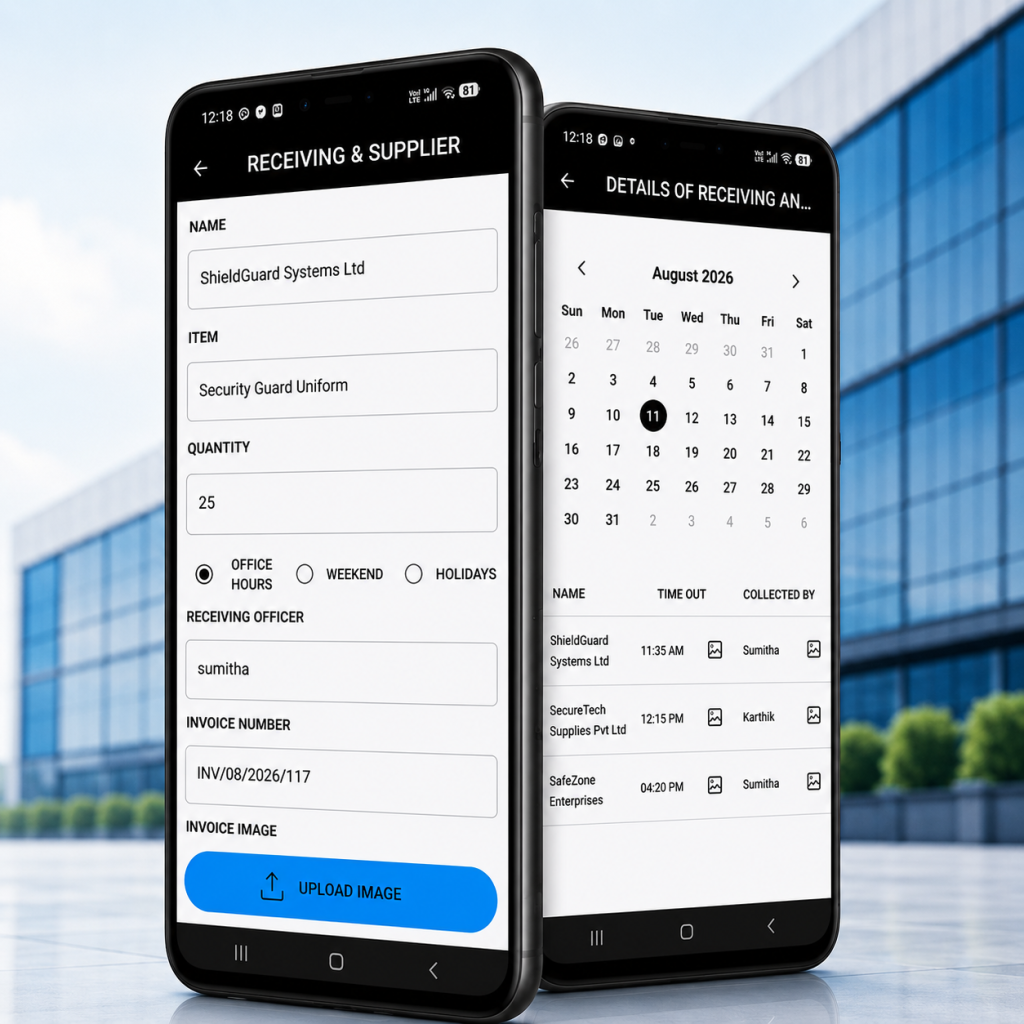
    In AVES, this sits under a module called Receiving Supplier. Two actions, that’s it: Create and Records.

    Create is where a guard logs a delivery as it happens name of the person or company delivering, the item, the quantity and a time-window selector (Office Hours, Weekend, Holidays) so anything unusual gets flagged right away instead of slipping through. The Receiving Officer field fills itself in based on who’s logged into the app, so there’s no guessing later about who actually took the delivery. Add an Invoice Number field and the option to snap a photo of the invoice and that’s the record.

    Records is basically a calendar. Pick a date, see whatever got logged that day. Nothing there? It tells you straight up no data available for the selected date instead of leaving you wondering if the app just broke.

    Think about the difference between a guard’s memory and an actual paper trail. Memory shifts. It softens details, fills gaps without meaning to, changes a little every time it gets retold. A dated record with a name, an invoice number and a photo attached doesn’t do any of that. It just sits there, exactly as it was.

    What Good Supplier Management Doesn’t Include and Why That’s Fine

    Let’s be straight about this, because overselling helps nobody. This is a receiving and delivery log. Not a full vendor management system. No contracts, no purchase orders, no approved supplier lists living in here.

    You won’t find fields for ongoing vendor relationships, payment terms or supplier performance reviews. If your business needs that level of procurement machinery, what you’re getting here is the physical receiving side of things. Not the contractual side.

    Knowing that going in saves you from expecting something that was never meant to be there. Good supplier management, for a security company, means proof of what happened at the gate. Not running your whole purchasing department.

    The Mistakes That Undermine Supplier Management Even When the Tool Is Right

    Having the right tool doesn’t automatically mean good supplier management. The habits around it matter just as much, maybe more.

    Logging the delivery late is probably the most common one. Records pull by date, so an entry made hours later or the next morning, quietly misrepresents when the thing actually showed up. This only works as evidence if the timestamp is real.

    Skipping the invoice photo when there’s one available. Takes a few extra seconds and it’s the first thing that gets dropped when people are busy. Funny enough, it’s also usually the exact piece of paper a dispute ends up hinging on.

    Treating small deliveries like they don’t count. An envelope feels too tiny to log, until it’s the one thing someone’s asking about three weeks from now. Consistency means logging everything. Not just the stuff that feels important at the time.

    Not checking the receiving officer field. It auto-fills based on whoever’s logged in, which sounds convenient until a shared device or a borrowed login quietly puts the wrong name on a delivery.

    And then there’s the big one: treating a verbal handoff like it counts as a record. It doesn’t. If it never made it into the system, as far as your process is concerned, it never happened. Doesn’t matter how well everyone remembers it.

    Building Confidence Before You Commit

    Still on the fence about formalizing this? Here’s the honest trade-off. A little discipline now, a few extra seconds per delivery, buys you real protection later. Almost always a good trade.

    The cost of skipping supplier management shows up when you least expect it. Most weeks, nothing happens and the whole thing feels like overkill. Then one dispute, one missing item, one client asking pointed questions and suddenly the entire investment pays for itself in a single conversation.

    You don’t need to rebuild your whole operation to get here. You need one habit: log the delivery the second it happens. And a system simple enough that your guards actually keep doing it.

    Frequently Asked Questions

    What is supplier management for security companies?


    It means tracking deliveries, vendors and goods received on-site creating a record of what arrived, when and who accepted it, instead of relying on informal handoffs at the gate.

    How does AVES handle supplier management and deliveries?


    Through a Receiving Supplier module with two views: Create, where a guard logs delivery details like item, quantity, time window and invoice and Records, a calendar showing everything logged for a given date.

    Can I attach an invoice to a supplier management record in AVES?


    Yes. The Create form has an Invoice Number field plus the option to upload a photo of the invoice, so the documentation lives right there with the record.

    Does supplier management in AVES flag deliveries outside normal hours?


    Yes the Create form includes a time-window selector for Office Hours, Weekend or Holidays, so your team can categorize and later review anything outside standard hours.

    Is this a full vendor management system?


    No. It logs physical deliveries and receiving details. No contract management, no purchase orders, no ongoing vendor relationship tracking.

    How do I check what was received on a specific day?


    Head to Records. It’s a calendar pick a date and it shows what was logged or tells you plainly if nothing was recorded.

    What to Expect in the First Few Weeks

    Rolling out supplier management for the first time usually goes through a predictable pattern, and knowing it in advance removes a lot of the anxiety.

    Week one feels awkward. Guards forget to log a delivery here and there, not out of resistance, just because it’s a new habit competing with everything else they’re already tracking. This is normal, and it doesn’t mean the system has failed.

    By week three, most teams settle into a rhythm where logging becomes automatic, the same way checking a badge or signing a visitor in became automatic once. The friction that felt real in week one fades once supplier management stops being a new task and becomes just part of how deliveries happen.

    The companies that struggle long-term are usually the ones that gave up in week one, right when the habit was still forming. If you commit to the first month, consistent supplier management tends to take care of itself after that.

    Where This Leaves You

    Supplier management doesn’t have to be complicated and it shouldn’t slow your team down. It just needs to be consistent and it needs to produce a record that actually holds up the day someone questions it.

    AVES keeps it in the same system your guards already use for shifts, incidents and attendance so a delivery record is something you pull up in seconds, invoice photo included, instead of trying to piece it together from a driver’s word weeks later.

    Want to see how AVES handles supplier management and delivery records in practice? You can explore the platform and request a demo at avessecurity.com.

    CONTACT US

    Website : https://www.avessecurity.com

    Linkedin: https://www.linkedin.com/company/aves-security-management-system/

    Instagram: https://www.instagram.com/avessecurity/

  • End of Shift, Start of Proof: The Security Daily Activity Report

    End of Shift, Start of Proof: The Security Daily Activity Report

    You already know the feeling

    A client calls asking what happened at the loading dock last Tuesday night.

    You pull the daily activity report. The handwriting is rushed. The times look rounded. Half the details you need were never written down at all.

    Now you are reconstructing a shift from memory, three weeks late, with a client waiting on the other end of the phone.

    If you run a security company or manage guard operations, this is not a hypothetical. It is the exact moment that separates teams who look competent under pressure from teams who look like they are guessing.

    This guide exists to fix that moment before it happens again.

    What a security daily activity report actually is

    A daily activity report, often shortened to DAR, is the document a guard completes at the end of a shift covering everything that happened on site.

    It is different from the two documents people usually confuse it with.

    • Daily briefing happens before the shift starts. It is forward looking. What to watch for today.
    • Occurrence log or incident report captures a specific event the moment it happens. It is narrow by design.
    • Daily activity report is written at the end of the shift and covers the whole picture. Patrols completed. Visitor and gate activity. Equipment condition. Incidents referenced. Site status at handover.

    A shift with zero incidents still needs a complete daily activity report, because the report is not only for when something goes wrong. It is the record that nothing did, which is exactly what a paying client wants confirmed.

    Why most daily activity reports fail before they are even read

    Here is what almost nobody tells you when you start standardizing this process.

    The failure point is rarely the format of the form. It is when the form gets filled out.

    A guard who writes the daily activity report from memory at the end of a twelve hour shift is not lying. They are compressing eight hours of small details into ten rushed minutes and details get smoothed over without anyone intending it.

    That creates three problems you will eventually run into if you have not already.

    Problem one: inconsistent handwriting and formatting. A daily activity report from one guard is unreadable next to a daily activity report from another. The moment a client asks you to compare coverage across a week, you are translating five different handwriting styles into one story.

    Problem two: no proof of when it was written. A supervisor cannot tell if a report was logged in real time or backfilled the next morning right before you asked for it.

    Problem three: a missed round is invisible until it matters. If a patrol never happened and nobody wrote it down, the paper looks identical to a shift where everything went right.

    None of this means the daily activity report is a broken idea. It means paper was never built to prove anything. It was only ever built to record.

    The five sections every security daily activity report actually needs

    Strip away the site specific extras and a usable daily activity report breaks into five parts, in the order a shift naturally happens.

    1. Shift and post details

    Guard name, date, shift hours, post or account assigned. This ties the report to a specific roster entry so nobody has to guess who was where.

    2. Equipment and inventory

    Radio, keys, access cards issued and returned. Vehicle condition if applicable. Any equipment fault noted at the start or end of the shift.

    3. Activity timeline

    Patrols run and when. Gate and visitor movements. Deliveries received. Logged as it happens, not reconstructed at the end.

    4. Incidents and exceptions

    A reference to anything already logged in the incident report or occurrence log during the shift, so the two documents tell the same story instead of two different ones.

    5. Handover status

    Site condition at the end of shift. Anything flagged for the incoming guard. Keys and equipment counted back in.

    If you are building your own format from scratch, resist the urge to make it exhaustive. A one page report that gets filled in consistently every single time beats a three page one that gets rushed in the last ten minutes of a shift.

    The mistake most security companies make here

    Most teams try to fix the daily activity report problem by making the checklist stricter. More boxes. More signatures. More rules about penmanship.

    That almost never works. Here is the part nobody tells you upfront.

    A stricter form does not change when a guard sits down to fill it out. It just makes the rushed version longer.

    The actual fix is changing where the information comes from in the first place.

    If your patrols are already being logged with a timestamp. If your incident reports already capture photos and video the moment something happens. If your shift handover is already recorded digitally. Then the daily activity report stops being something a guard writes from memory. It becomes something that gets assembled from data that already exists.

    That is the shift worth making. It is a smaller change than most operators expect.

    What this looks like in practice

    This is where AVES fits into the daily activity report picture. I want to be direct about what it does and does not do, because vague claims help nobody.

    AVES is cloud based security management software used across residential, corporate, healthcare, manufacturing and warehousing sites. Guards use the mobile app to log activity as the shift happens rather than at the end of it.

    The checklist module timestamps every entry automatically, so a completed round and a skipped one no longer look the same on paper.

    The reports module lets guards submit incident reports in real time with photos and video attached, instead of a written description pieced together hours later.

    The shift module handles shift handover and shift requests digitally, so the handover step, the one guards skip first under pressure, has a record either way.

    Every action is timestamped and stored, which is what makes an audit ready PDF report possible on demand instead of a scramble through binders when a client calls.

    Worth knowing before you commit to any platform, including this one. AVES offers limited offline capability, meaning core field actions sync once connectivity returns, but full functionality needs an internet connection. If your sites have serious connectivity gaps, ask any vendor directly how they handle that, not just AVES.

    That kind of honesty is exactly what should decide which platform you trust, not which one has the flashiest demo.

    The real cost of getting this wrong

    Consider the actual math for a moment.

    A mid sized security team spends roughly eight to twelve hours a week on paperwork tasks that a proper system finishes in minutes, based on what similar operators report. At a modest hourly rate, that is real money spent shuffling paper instead of managing risk.

    Now add the cost you cannot put a number on. The client who loses confidence in your security daily activity report because your reporting looked disorganized during an audit. The insurance claim that gets questioned because your incident timeline does not match your daily activity report.

    Paper feels free until the day it costs you a contract.

    How to actually start

    You do not need to overhaul your entire operation this week.

    Start with the five sections above and pick one week to run them consistently across every guard, on paper or digitally, whichever you are using now.

    Then look for the gaps. Missing timestamps. Inconsistent handwriting. Reports that read suspiciously similar every single day, which usually means they are being filled in from habit rather than from what actually happened.

    Once you see exactly where paper is failing you, the decision to move to a digital system stops being a leap of faith. It becomes the obvious next step, because you will already know precisely what problem you are solving.

    If you want to see how AVES handles daily activity reporting alongside patrols, incidents and shift handover in one platform, you can request a demo at avessecurity.com and walk through it with your own sites in mind.

    Frequently Asked Questions

    Does every shift need a full security daily activity report, even a quiet one?

    Yes. A quiet shift with a complete daily activity report is proof nothing went wrong. A quiet shift with no daily activity report is just an assumption.

    How is a security daily activity report different from an occurrence log?

    The occurrence log only captures specific incidents as they happen. The daily activity report covers the entire shift, including the fact that nothing unusual occurred. It should reference any occurrence log entries rather than repeat them.

    Who should read the security daily activity report besides the supervisor?

    Clients often want daily activity reports on a weekly or monthly basis for their own compliance records. Insurers may request them directly after an incident. Treat every daily activity report as something a stranger might eventually read with no other context.

    What is the biggest mistake first time operators make with daily activity reports?

    Making the form longer instead of fixing when it gets filled out. A guard rushing through a five page report at the end of a twelve hour shift will produce worse data than a guard filling out one page as the shift happens.

    CONTACT US

    Website : https://www.avessecurity.com

    Linkedin: https://www.linkedin.com/company/aves-security-management-system/

    Instagram: https://www.instagram.com/avessecurity/

  • Security Guard Performance Management Guide

    Security Guard Performance Management Guide

    A security guard performance review is not supposed to feel like a trip to the dentist. But that’s exactly how most security company owners run it. They dig up a dusty generic template, scribble a couple of half-hearted notes, sign the bottom and shove it in a filing cabinet for the next twelve months. That lazy habit is the actual reason your turnover keeps climbing.

    Here’s what that officer actually deals with. Twelve hours alone at a client site. Aggressive visitors at the gate. Access control. A 2 a.m. alarm going off with nobody around to back them up. And then you hand them a review that says “good job.” That’s it. That tells them nobody’s watching, nobody cares. Good guards pick up on that fast and they don’t stick around, they go find a company that treats them like it matters. If you want a security guard performance review process that actually works, forget the corporate HR playbook. Look at what the job really involves.

    Why traditional appraisals fail security teams

    Most evaluation templates were built for someone sitting at a desk under office lights. It’s a bit like scoring a race car driver on typing speed, the metrics just don’t apply. A perimeter fence or a lobby desk doesn’t behave like a cubicle. Judge a mobile patrol officer with corporate benchmarks and the whole security guard performance review feels fake before you’ve even asked the first question.

    Guards know within a minute whether you understand their job. If you don’t, they check out mentally right there and good luck getting honest engagement after that. It kills your credibility as a manager instantly. A strong security guard performance review keeps good people, because it’s built around what the work actually looks like, not what a handbook says it should look like.

    Most managers just inherited whatever system was already in place. Annual check-ins, because that’s tradition. But security isn’t an industry where you can afford to wait a year. One missed patrol turns into a break-in or a client walking away entirely. By the time the annual review comes around, bad habits are already baked in and your best officers have already mentally quit.

    The core framework of a security guard performance review

    A real security guard performance review or security guard evaluation, sticks to objective, observable behavior. You can’t grade someone’s vibe or general attitude. You grade what they actually did. A solid framework captures daily reliability and how someone handles a crisis, in equal measure.

    Start with operational reliability: punctuality at shift handover and how strictly someone follows post relief protocol. A guard who shows up ten minutes late forces the outgoing officer to stay late too and that quietly poisons morale across the whole roster. Let tardiness slide long enough and it becomes the norm and your most reliable people start to resent it.

    Next comes tour execution. Are your guards actually hitting checkpoint scans on schedule or are they pencil-whipping the log from inside the guard shack? Patrol integrity is what your client contract is built on. Skip checkpoints and the client is paying for protection they’re not getting.

    You also need to look at incident documentation, meaning how fast and how accurately reports get filed. A report riddled with spelling errors and missing timestamps can wreck your legal standing the moment a case goes to court. Round out your security guard performance review with professional conduct: uniform, grooming and how officers actually talk to clients and visitors.

    Tracking the guard performance metrics that matter

    A real security guard performance review runs on numbers you can actually track week over week, not vague advice about working harder. One of the most important security guard KPIs to start with is tour completion rate. Anything below ninety-five percent on scheduled checkpoint scans and you’ve got a problem worth investigating.

    Incident response time matters too. How long does it take an officer to acknowledge an alarm or check out something suspicious on the property? When someone unauthorized is already inside, minutes are the whole ballgame.

    Report accuracy is another one worth watching, specifically how often a supervisor sends a report back for corrections. If your supervisor’s spending half their morning rewriting other people’s paperwork, that’s not a discipline issue, that’s a training gap that needs fixing.

    Numbers strip out the bias. Nobody can argue with a system showing they missed twelve checkpoints last Tuesday, that’s just what happened. It turns what used to be a tense, emotional conversation into a coaching session grounded in fact. Officers trust a security guard performance review built on data a lot more than one built on whatever mood their supervisor happened to be in.

    Ditching the paper trail for digital tracking

    Paperwork slows everything down and eventually something gets lost. Try running a security guard performance review across dozens of officers using logbooks and scattered spreadsheets and watch how fast the whole system collapses. A dedicated platform removes that headache entirely. Every hour spent digging through last month’s attendance sheet is an hour that should’ve gone toward training or client calls.

    Paper gets coffee stains. It gets left in a glove compartment. It disappears into a filing cabinet somewhere and never resurfaces. Digital tracking keeps everything tied to the right officer’s profile from day one, no exceptions. Cutting the physical logbook out of the process turns admin work from a scavenger hunt into something manageable.

    Walk through the life cycle of a typical paper incident report. An officer scrawls it on a clipboard mid-shift. Hands it to the supervisor at change of shift. It gets tossed into a folder in the back of a patrol car. Weeks go by. Eventually it lands on someone’s desk back at the office and now an assistant’s squinting at bad handwriting trying to figure out what actually happened. By the time management sees it, the incident’s already two weeks old. A digital system just deletes that whole broken chain.

    How AVES Security Management changes the game

    Bring everything into one place and the whole equation changes. AVES Security Management System builds your security guard performance review process, scheduling and incident reporting into a single platform. Inside the performance module, managers log employee periods and departments in a matter of seconds. Pick the name, set the development period, that’s it. No spreadsheet juggling required.

    Supervisors get a structured space to log development goals and flag concerns instead of hunting through a filing cabinet for last month’s notes. You set an agreed improvement action and a clear success measure directly inside the app. Reviews stop being that once-a-year panic because the notes are already there, logged continuously as the year goes on.

    Once daily activity connects directly to long-term development tracking, the culture around here starts to shift. With a proper security guard performance review system in place, supervisors aren’t guessing what happened three months ago anymore. They open the profile, look at real completion numbers and have an honest conversation backed by actual data instead of fuzzy memory.

    Setting goals that actually change behavior

    A security officer performance plan without a deadline attached to each goal is just a wish. Target start and end dates give remedial training or a promotion track, an actual timeline to work against. The AVES calendar lets you set exact dates for any goal in a couple of taps. Officer struggling with report writing? Give them thirty days and pair it with focused training in the app.

    Measurable success criteria tell you, plainly, whether the error rate actually dropped over that window. Continuous feedback, tracked through the calendar, means notes get logged as things happen rather than everyone scrambling to remember details once a year. Real growth comes from small, steady corrections, not one giant overhaul once every twelve months.

    Tell someone to “be more professional” and you’ve told them nothing useful. Tell them “complete every checkpoint scan within ten minutes for the next thirty days” and now there’s an actual target. That’s the difference between vague advice and something a person can actually act on.

    Overcoming pushback from field supervisors

    Roll out a new security guard performance review system and somebody’s going to push back, usually a supervisor claiming they don’t have time for more paperwork. Fair enough, honestly, paperwork pulls them away from the site. Moving to digital cuts that friction down to almost nothing since entry takes seconds, not an afternoon. Officer skepticism around the review process fades too once it’s tied to metrics instead of whatever mood a supervisor’s in that day.

    Trust in the security guard performance review process comes from transparency.. When officers see their completion rate connecting directly to actual career growth, accountability just becomes part of how things work, not a rule being forced on them. Supervisors stop acting like enforcers and start acting like mentors who actually want their people to do well.

    Getting veteran supervisors on board really comes down to showing them the upside. Once they realize a review takes five minutes on a phone instead of a weekend buried in paper, most of the resistance just disappears on its own.

    Your next move

    A proper security guard performance review process turns your security team from a line-item cost into your biggest asset. Pair clear expectations with digital tracking and the administrative mess across your organization starts to clear up on its own. Stop relying on messy paperwork and habits that were never built for this job in the first place. Streamline your performance tracking and build a stronger team with the AVES Security Management System.

    CONTACT US

    Website : https://www.avessecurity.com

    Linkedin: https://www.linkedin.com/company/aves-security-management-system/

    Instagram: https://www.instagram.com/avessecurity/

  • Medical Incident Reporting Software: What Actually Matters

    Medical Incident Reporting Software: What Actually Matters

    You’re probably here because a paper form failed you. A worker got hurt, maybe, and the incident report took three days to land on the right desk. Or a hospitalization case got logged with half the details missing.

    Medical incident reporting software exists to close exactly that gap. But before you spend money on a platform, you need to know what actually separates a real system from a glorified digital form.

    Call it a medical incident report, an injury report, or medical incident reporting software, the underlying problem doesn’t change. That gap has a name. Medical incident reporting software, and most sites still don’t have it. That’s what this guide covers, no sales pitch attached.

    Why Paper Still Fails Even When Everyone Tries Hard

    Nobody sets out to lose an incident report. It happens because paper depends on someone remembering to fill it out completely, then physically carrying it to the right desk.

    A guard writes down that someone got injured. Forgets the injured body part. Forgets whether the person was hospitalized. Three weeks later, someone asks for the medical clearance date, and nobody can find it.

    Not a training problem. A structural one. Paper has no required fields, no timestamps, no way to flag a case as still open. That’s the exact gap medical incident reporting is supposed to close, and it’s the failure point medical incident reporting software was built to eliminate.

    What Real Medical Incident Reporting Software Actually Tracks

    Here’s where most buyers get surprised. Proper incident reporting software doesn’t just capture “what happened.” It captures the entire medical and legal trail around an injury.

    Personal details. Who was involved, their role, their department. Sounds basic. It’s also the first thing that goes missing on a rushed paper form. Healthcare incident reporting software should never let this field go blank.

    Incident details. What happened, when, where. Specific enough that someone reading it six months later understands the full picture without guessing. This is where medical incident reporting software actually earns its keep.

    Observance data. Condition of the scene, whether the person appeared intoxicated, what they were wearing, their movement at the time, any witnesses present. Most software skips this section entirely, and it’s often the first thing lawyers ask about. Most cheap medical incident reporting software skips it too.

    Personal injury classification. A checklist covering exact injury types, bruises and lacerations through concussions and chemical burns, mapped to a front and back body diagram showing exactly where the injury occurred. A body diagram like that is the clearest sign you’re looking at real medical incident reporting software.

    Hospitalization and case tracking. Whether the person was hospitalized, how many medical certificate days got issued, which hospital or clinic treated them, the date they returned to work, the ambulance or transport number used. Non-negotiable, in any serious medical incident reporting software.

    Accountability fields. Who was in charge at the time, whether that person got notified, whether the case is still open, whether a police report was filed. Medical incident reporting software without accountability tracking is only half a system.

    Skip any one of these six and you’re not looking at real healthcare incident reporting software. You’re looking at a form builder wearing a healthcare label.

    The Fear You Are Not Saying Out Loud

    You’re probably worried this is going to be complicated to roll out. Your team already resists paperwork, and you’re picturing another system nobody actually uses.

    That fear is reasonable. Most failed rollouts happen because the tool asks guards or staff to enter data in a format that doesn’t match how the incident actually unfolded in real life.

    The fix isn’t more training. It’s choosing software structured the way an actual incident happens. Scene first. Injury second. Medical outcome third. Not one giant form with fifty fields dumped onto a single screen. Good medical incident reporting software is built to prevent exactly that rollout failure.

    What Beginners Get Wrong When Choosing a Platform

    The most common mistake: picking software based on how clean the incident form looks in a demo, without checking whether it captures hospitalization and return-to-work data at all. Honestly, this is the single biggest mistake buyers make when shopping for medical incident reporting software.

    A close second: assuming any generic incident reporting software will work for medical cases. Generic tools usually skip the personal injury body diagram, the intoxication field, the police report status, because those are healthcare and workplace-safety specific, not general security fields. Generic tools rebranded as medical incident reporting software rarely hold up under real use.

    Third mistake, and a sneaky one: not checking whether photos attach directly to the injury record. If your incident reporting software makes you email photos separately, you’ve already lost your single source of truth. Photo attachment is a baseline requirement in medical incident reporting software, not a bonus feature.

    Fourth mistake, and people usually only discover this one after something’s already gone wrong: not checking whether the software tracks case status over time. An injury doesn’t end the moment the form gets submitted. Someone needs to know if the case is still open, if the person’s returned to work, if a police report is still pending weeks later. A tool that only captures the initial report and nothing after is solving half the problem. Ongoing case tracking is what separates real medical incident reporting software from a one-time form.

    What This Looks Like in AVES

    AVES is a working example of healthcare incident reporting software built around how real incidents actually unfold, through its Medical Report module.

    An officer opens the Medical Report screen and works through five sections in order: Report, Personal Details, Incident Details, Observance, Personal Injury. Each section expands only when needed, so the form never feels overwhelming.

    The Personal Injury section uses a front and back body diagram. Tap the injured area, select the injury type from a checklist covering everything from abrasions to electrocution, add a written reason if needed.

    Hospitalization gets its own dedicated fields. Hospital or clinic name, number of medical certificate days, date of return to work, ambulance or transport number. Nothing buried inside a generic notes field.

    Accountability’s built in too. In-charge name, whether that person got notified, current case status, whether a police report exists, all sitting as clear yes-or-no fields instead of something someone has to remember to mention out loud.

    Photos attach directly through an upload button, so evidence stays tied to the exact case it belongs to instead of floating in a separate folder somewhere.

    What Good Actually Looks Like Once This Is Running

    This is the actual payoff of switching to real medical incident reporting software. A site running it properly doesn’t feel more complicated day to day. It feels calmer, because nobody’s chasing paperwork after the fact.

    Supervisors stop reconstructing incidents from memory weeks later. HR stops asking guards to recall details from a shift that happened a month ago. Legal teams get a clean, timestamped record instead of a stack of inconsistent notes.

    That’s the real return on switching to medical incident reporting software. Not fewer incidents. Zero incidents quietly disappearing from the record because nobody logged them properly the first time.

    Frequently Asked Questions

    What is medical incident reporting software?


    A digital system, sometimes called medical incident reporting software, that captures the full details of a workplace injury or medical incident, personal details, incident details, injury classification, hospitalization status, and accountability information, all in one searchable record.

    How is it different from general incident reporting software?


    General incident reporting software usually covers security events like theft or trespassing. Medical incident reporting software adds medical-specific fields, injured body part diagrams, hospitalization tracking, medical certificate days, police report status.

    What information should a medical incident report always include?


    At minimum, personal details of the injured person, incident details, scene observance, injury classification, hospitalization and treatment information, plus accountability fields like in-charge notification and case status.

    Can photos be attached to a medical incident report?


    Yes. A proper system lets you upload photos directly into the report record, so visual evidence stays attached to the exact case it documents.

    Is this only useful for large organizations?


    No. Even a small team benefits, because the alternative, relying on memory and scattered paper notes, fails regardless of company size the moment a case gets questioned later.

    Where This Leaves You

    You don’t need to overhaul your entire operation to fix this. You need one piece of medical incident reporting software that captures an incident the way it actually happens: scene, injury, treatment, accountability, in that order.

    Get that in place and you stop losing details to memory. You stop scrambling when a case gets questioned months later. And you finally have a record you can actually stand behind. That’s what proper medical incident reporting software gives you. Nothing more, nothing less.

    If you want to see how AVES handles medical incident reporting, injury tracking, and case accountability in one dashboard visit AVES security and request a demo https://master.avessecurity.com/book-demo.

    CONTACT US

    Website : https://www.avessecurity.com

    Linkedin: https://www.linkedin.com/company/aves-security-management-system/

    Instagram: https://www.instagram.com/avessecurity/