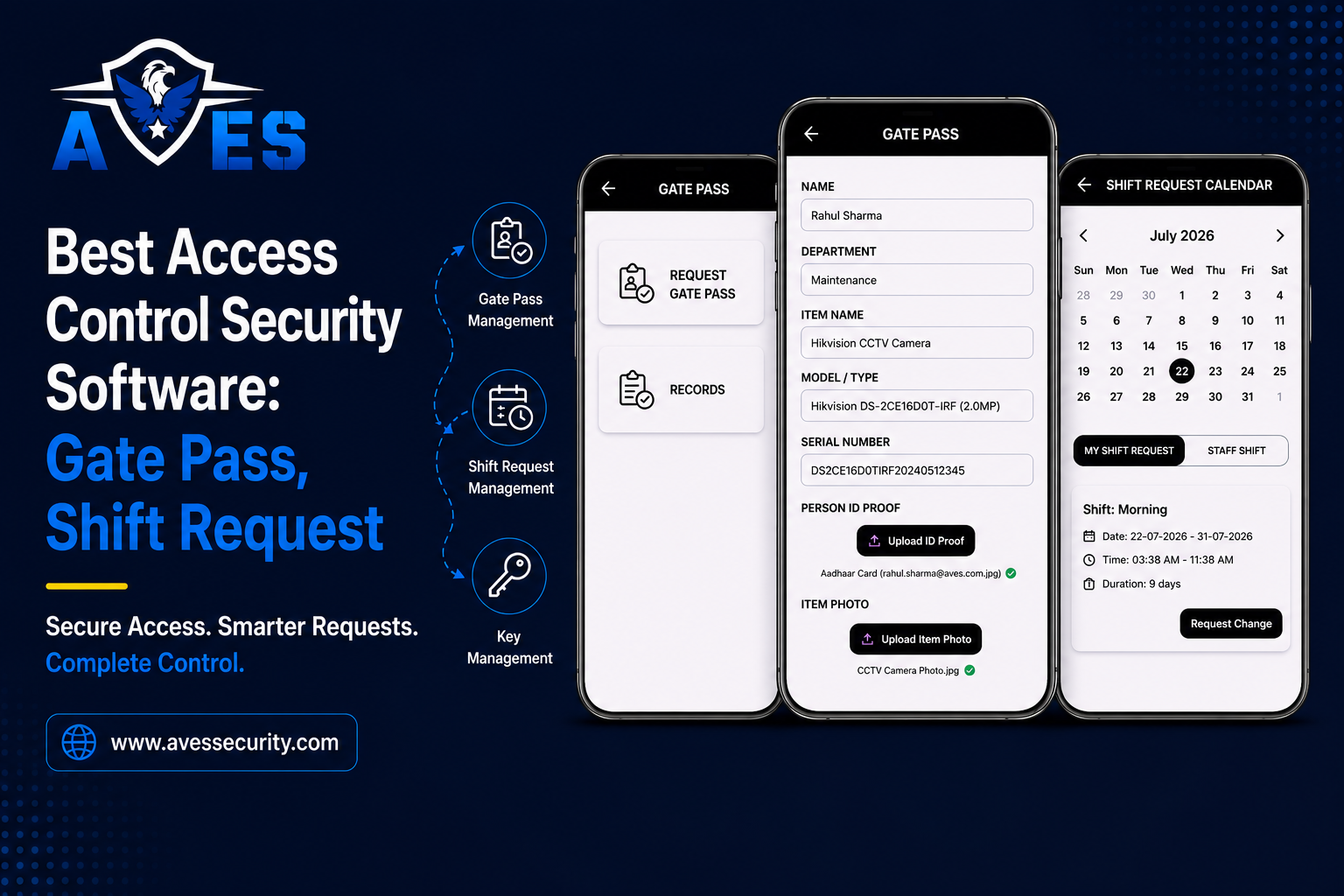
Category: Guides

Foundational guides and explainers on security management.

  • Best Access Control Security Software:Gate Pass,Shift Request

    Best Access Control Security Software:Gate Pass,Shift Request

    Here’s the truth. You’re not searching for access control software because you’re curious. You’re searching because something already went wrong.

    A visitor walked in without a pass. A guard couldn’t find a key. A shift request got buried in a chat and nobody covered the gate. Sound familiar? That’s usually how this starts. Not curiosity. A problem that just exposed how much of your operation runs on spreadsheets and good intentions.

    And if you’re hunting for the best access control software for a real security operation, you’ve probably got a few nagging worries too. Will this be too complicated for guards who barely have time to read a manual, let alone a training deck? Will it actually fix gate passes and keys or just add another login nobody bothers opening? Will you spend money on access control software and end up right back here in six months, typing the same search into Google?

    Fair questions. All of them. So let’s answer them properly, using what actually matters when you’re evaluating access control software for a working security team, not some polished demo environment built to impress.

    What Access Control Software Actually Needs to Do

    Most access control software gets marketed around badges and doors. That’s only part of the job. Treat it as the whole job and you’ll find out the hard way that it isn’t.

    For a security company running multiple sites, access control software has to juggle three things at once: who’s allowed where, who requested access and when and who’s holding the physical keys that open everything else. Miss one of those and the other two barely matter. Picture a three-legged stool. Two solid legs and one missing and it still tips over the moment someone leans on it.

    That’s exactly why so many buyers feel burned after picking access control software that looked sharp on a sales call. Badges? Handled. Gate passes, key custody, request approvals? Never really touched.

    Software for Access Control Should Cover the Gate, Not Just the Door

    Here’s something most product pages conveniently leave out. Software for access control that only manages internal doors leaves your biggest exposure point wide open: the gate.

    Think about it. Visitors, delivery drivers, contractors, vendors, they all pass through a gate before they ever reach a door. If your software for access control skips a proper gate pass management system, you’re still tracking that traffic on a clipboard or worse, a WhatsApp message to whichever guard happens to be on duty.

    A real gate pass management system lets a guard issue, verify and log a visitor pass in seconds, straight from a phone, no phone calls, no waiting on approval. That one change kills the single most common complaint clients raise about security vendors: “why did it take fifteen minutes just to let my delivery in?”

    Gate Pass Management System: What Buyers Discover Too Late

    Most people evaluating a gate pass management system assume it’s basically a digital sign-in sheet. It’s not, and assuming otherwise is a mistake you’ll only notice later, during an audit or a furious client call, exactly when you can least afford it. For the full breakdown of pass types, approval chains and audit reporting, see our dedicated gate pass management guide.

    A proper gate pass management system should:

    • Log entry and exit times automatically, not from memory
    • Attach a photo or ID scan to each visitor record
    • Flag expired or unauthorised passes before a guard waves someone through
    • Give supervisors a searchable record across every site, not just one

    Skip this and you’re stuck reconstructing what happened after an incident, instead of pulling up a report that already has the answer sitting there. That gap? That’s exactly where client trust quietly erodes, one delayed answer at a time.

    Request Management System: Why Shift Chaos Usually Starts Here

    A request management system sounds small. Boring, even. Until you’re the one covering a shift nobody assigned you, because a swap request got lost somewhere in a text thread.

    Here’s what beginners tend to miss. Guard shortages rarely happen because there aren’t enough guards. They happen because a request management system or the lack of one, fails to route a simple leave or swap request to the right supervisor in time.

    The best access control software treats requests the same way it treats access itself, as something that needs approval, a timestamp and a record. A working request management system, like the one inside AVES’s scheduling module, lets a guard submit a leave or shift-swap request from their phone and get an answer the same day, with a supervisor approving or rejecting it in one tap.

    Call it a minor convenience if you like. It’s really the difference between a site running short-staffed and a site staying fully covered.

    Key Management Solutions: The Gap Almost Nobody Talks About

    Search for access control software today and most results talk about badges and cameras. Almost nobody talks about the keys.

    That’s a genuine blind spot. Key management solutions matter because physical keys are still how most buildings actually get opened, long after the badge system has already logged someone in and moved on.

    Without proper key management solutions, you’re relying on a logbook or worse, someone’s memory, to know who’s holding a master key overnight. That’s a liability every security company eventually has to explain to a client, usually right after something’s gone missing.

    Good key management solutions track who checked out which key, when it’s due back and fire off an alert the moment it’s overdue. Sounds simple, doesn’t it? But it closes a gap spreadsheets have never actually closed.

    What to Look for Before You Buy Access Control Software

    Skip the vendor with the longest feature list on their homepage. Look past the marketing and focus on whether the platform actually covers the full picture.

    When comparing access control software, check for:

    • A gate pass management system built in, not bolted on as an afterthought
    • A request management system guards can genuinely use from their phone
    • Key management solutions that log custody, not just issue a key once and forget it
    • One dashboard across every site, not five separate logins
    • Reports that are ready for a client or auditor without extra formatting

    Missing more than one of these? You’re not buying access control software. You’re buying a badge reader with a nicer interface, nothing more.

    Why AVES Was Built Around This Exact Gap

    AVES Security Management System came out of watching the same pattern repeat, over and over, across growing security companies. Gate passes handled on paper. Keys tracked in someone’s head. Shift requests lost in a group chat nobody checks after hours.

    AVES brings gate pass management, key management and request management into one platform instead of several disconnected tools. A guard logs a visitor at the gate, checks out a key or submits a shift request, all from the same app and a supervisor sees every bit of it from one dashboard.

    That’s the real difference between access control software that looks complete on a sales page and software that actually holds up on a Tuesday night when three things go wrong at once.

    Making the Decision With Confidence

    You don’t need to overhaul everything overnight. Start by mapping out where your process actually breaks down most, whether that’s the gate, the key cabinet or shift coverage.

    Once you know that, choosing between access control software options gets a lot simpler. You stop comparing feature lists. You start checking whether a platform actually closes the specific gap costing you time and trust right now.

    If gate passes, keys and requests are still the parts of your operation running on paper or good faith, AVES was built to close exactly that gap. You can see how it works on a real site with a short demo, no long-term commitment needed to take a look.

    Frequently Asked Questions (FAQ)

    What makes access control software “the best” instead of just adequate?

    The best option covers gates, keys and requests together, not badges alone. If a platform only handles one of those, it’s a partial fix, not a complete one.

    Is access control software difficult for guards to learn?

    Not if it’s built correctly. A good platform should take a guard less than a day to learn, since most of the work happens through simple taps, not manual data entry.

    Does this kind of platform replace physical security guards?

    No. It supports guards by removing paperwork and guesswork. It doesn’t replace the judgment a trained guard brings to a gate or a checkpoint.

    How is a gate pass management system different from a normal visitor log?

    A gate pass management system automates verification and flags problems in real time. A paper visitor log only records what happened after the fact, with no way to catch an issue before it becomes one.

    CONTACT US

    Website: https://avessecurity.com/

    Linkedin: https://www.linkedin.com/company/aves-security-management-system/posts/?feedView=all

    Instagram: https://www.instagram.com/avessecurity/
  • Key Control Software: Who Holds Which Key, and When It Comes Back

    Key Control Software: Who Holds Which Key, and When It Comes Back

    Key control software records who holds which physical key, when they took it, and whether it came back. It replaces the key cabinet logbook with a searchable custody trail, so the question “who has the master key tonight” has an answer that does not depend on anyone remembering.

    Most access-control conversations are about badges, readers and doors. Meanwhile the plant room, the riser cupboard, the server cage, the fuel store and the roof hatch are all still opened with a metal key hanging on a hook in a cabinet, signed out in a book nobody has audited in two years.

    That gap is not an oversight. Keys survive because they work, they need no power, and replacing every mechanical lock on a site costs more than most security budgets hold. The realistic control is not to eliminate keys. It is to know where they are. That record belongs with the rest of the shift, which is why key custody sits inside the AVES security guard management system rather than in a book of its own.

    What Key Control Software Actually Does

    Four things, and the fourth is the one that earns the money.

    • Records the key set. Every key, what it opens, how many copies exist, and which sit on a ring rather than loose.
    • Issues and returns. A named person takes a named key at a recorded time, and the record stays open until it is back.
    • Routes the request. Higher-risk keys need an approver, not just a signature.
    • Surfaces what is outstanding. An ageing list of keys still out, by person and by duration. This is what a logbook structurally cannot provide.

    A paper key register does the first two adequately and the last two not at all. That is the whole argument, and it is worth being precise about it rather than claiming paper does nothing.

    This is not cryptographic key management

    Worth stating early, because the phrase is overloaded. Search “key management system” and half the results cover encryption keys, KMS platforms and certificate lifecycles. That is a different discipline entirely. This page is about physical keys: brass, cut, hanging on a hook, opening a door.

    Why Keys Outlive Every Access-Control Upgrade

    Sites install badge readers on the doors people use every day. The doors people rarely use stay mechanical, and those are disproportionately the sensitive ones: switch rooms, chemical stores, comms cabinets, archive rooms, the gate to the yard.

    So the pattern on a mature site is an electronic system covering high-traffic, low-risk doors and a key cabinet covering low-traffic, high-risk ones. The reporting ends up inverted against the risk. Badge access produces a clean audit trail for the front door and nothing at all for the room with the switchgear in it.

    There is a second reason keys persist. Contractors. Handing a visiting engineer a badge means enrolling him, assigning permissions and remembering to revoke them. Handing him a key takes four seconds. The path of least resistance wins on a busy morning, every time.

    The Three Workflows That Matter

    Strip the category down and physical key custody is three moments. Get these right and the rest is reporting.

    1. The key checklist

    The standing inventory: every key held, what it opens, how many duplicates exist, and where it lives when it is not issued. This sounds like housekeeping and it is the foundation, because you cannot report on custody of a key you never recorded owning.

    The check worth running today: ask for a list of every key on site and how many copies of each exist. If that takes longer than a minute, or comes back as a number nobody will stand behind, the register is not current.

    2. The key request

    Someone needs a key. The request names the key, the person, the reason and the expected return, and it goes to whoever is entitled to approve that key rather than whoever happens to be at the desk.

    The reason field is not bureaucracy. Six weeks later, “maintenance” tells a reviewer nothing, while “replacing the failed pump in plant room 2, work order 4471” tells them everything. The cost of capturing it is one line, at the moment the person actually knows the answer.

    3. The key return

    The record closes when the key is physically back, recorded by whoever received it. Until then the key is out, and it appears on a list somebody owns.

    This is where paper fails completely, and the reason is structural rather than a matter of diligence: nothing in a paper process triggers a reminder. The line is written, the key leaves, the page turns. No report would surface the key still missing three months later, because producing that report means reading the whole book by hand.

    Shift Handover: Where Custody Actually Breaks

    If key control fails on your site, it will fail at 6am when the night team leaves.

    The night supervisor holds a set. The day supervisor arrives. In a well-run operation the two count the cabinet together and sign. In a normal operation, one of them is dealing with something else, the count is skipped once, and the exception becomes the routine within a fortnight.

    What makes this the critical moment is that a key lost at handover has no owner. Lose a key during a shift and that shift is accountable. Lose it across a handover nobody recorded and the loss belongs to a gap between two people who each reasonably believe the other had it.

    The fix is unglamorous and it works: a handover count that is itself a record, with both names and a timestamp, and any discrepancy captured at that moment rather than discovered at the next audit. The point is not to catch anyone. It is to close the interval in which a key can disappear without anyone becoming responsible.

    The Overdue Key, and What a Book Cannot Tell You

    An ageing list of outstanding keys is frequently the entire business case, for the same reason it is on the material side of a gate pass management system: a returnable item with no follow-up is a loss with better paperwork.

    • Expected return is mandatory, not optional. A key issued with no return date is a key given away politely.
    • Ageing beats a yes or no. Forty minutes overdue is a phone call. Six weeks overdue is an investigation and possibly a re-key. A binary flag collapses the two.
    • Somebody owns the list. Usually the shift supervisor for same-day items and the security manager for anything past a week. A report with no owner is decoration.
    • Overdue by person, not just by key. One key outstanding is an oversight. One person with nine outstanding is a pattern, and it stays invisible if you only ever sort by key.

    Master Keys Need a Different Rule

    A master opens everything, so it carries the combined risk of every door it covers, and it should not be governed by the same policy as the key to a stationery cupboard.

    • A named approver, always, with no delegation to a duty role. “The duty manager can approve it” means in practice that whoever is on shift can approve it.
    • Issued for a defined window, not for a shift. “For tonight” quietly becomes permanent possession.
    • A loss triggers a decision, not a note. When a master goes missing somebody has to decide whether to re-key, and that decision needs a name against it. Recording the loss and moving on is how a site ends up with an unknown number of live masters in circulation.

    The uncomfortable question worth asking at your own site: how many master keys exist right now, and can you name the holder of each? Most operations discover, asking it, that the honest answer is an estimate.

    What a Client or Auditor Asks After a Loss

    Stock goes missing from a locked store. Nobody forced the door. The questions arrive in a predictable order, and they are all custody questions:

    • Who held the key to that room in the relevant window?
    • Who authorised them to hold it, and for what stated reason?
    • Was it returned, and who received it back?
    • How many copies of that key exist, and where are the others?
    • When was the key set last reconciled against the register?

    A digital custody trail answers all five in about a minute. A logbook answers the first badly and the rest not at all. That difference is the product, and it is worth being honest that it does not prevent the loss. It establishes what happened, which is what determines whether an insurance claim, a client relationship or a disciplinary process survives contact with the facts.

    For sites working to a formal standard, this record is part of demonstrating the control is real rather than nominal. ISO 18788 sets out management-system requirements for private security operations, including the documentation and continuous-improvement expectations a paper key book struggles to satisfy.

    Cabinets or Software: What You Are Actually Choosing

    This is the fork most buyers hit, and vendor pages rarely put it plainly because most vendors sell only one side of it.

    An electronic key cabinet is hardware. Keys are physically locked to a board and released by PIN, card or biometric, so the cabinet itself enforces custody. Nobody takes a key without the system knowing, because the steel will not allow it. That is a genuinely stronger control and it costs what hardware costs, per cabinet, per site.

    Key control software is a record. It knows what should have happened and depends on people using it. It cannot stop a key being lifted off a hook by someone who does not scan it. What it does provide is custody history, approval trails, overdue reporting and reconciliation across every site, at software cost, sitting next to the patrol, incident and visitor records from the same shift.

    The honest guidance: if you have one high-consequence cabinet in a single location, hardware is the stronger answer. If keys are spread across many sites and the real failure is that nobody knows what is outstanding or who approved it, the record is what you are missing, and a cabinet on one site will not fix the other twelve.

    Choosing a System: What to Test in a Demo

    Demos are built to go well. These questions make them informative.

    • Show me every key currently outstanding, aged. If this needs an export and a spreadsheet, overdue tracking is not really supported.
    • Show me the full custody history of one key over a year. This is the post-loss question. It should take seconds.
    • Filter by holder, not by key. Tests whether you can see the person with nine keys out.
    • Can a key be issued and approved by the same person, and what does the record look like afterwards? You are testing whether separation of duties is enforceable or merely encouraged.
    • Show me a shift handover count. Frequently unsupported, and it is where custody actually breaks.
    • What happens when a key is reported lost? Watch whether it becomes a tracked decision or a text note.
    • How does this sit next to patrol and incident records? A key system that is an island produces a fourth login and a fourth version of the truth.

    Roles and Permissions

    Key control implementations fail on permissions more often than on features, usually because the model was designed by someone who has never worked a cabinet at shift change.

    • Requester. Anyone who legitimately needs a key. Should be frictionless, because a requester who finds the form painful will just ask the guard directly, and you are back to the book.
    • Approver. Bounded by key class rather than granted wholesale. Approving a cupboard key and approving a master are not the same authority.
    • Custodian. Issues and receives, and records what actually happened including discrepancies, without being able to alter an approval. Custodians report reality; they do not edit history.
    • Auditor. Read-only across everything including the change log. A genuinely read-only role is what makes the record credible to anyone outside the operation.

    The mistake to avoid is collapsing approver and custodian on small sites for convenience. It is understandable and it removes the control entirely, because the person handing over the key is the person who authorised it. If headcount will not allow separation, at least make the combination visible in reporting so it is an accepted risk rather than an invisible one.

    Implementation Sequence

    Key control rollouts fail in a predictable way: every key at every site on day one, the cabinet gets slower, and within a fortnight the book is running alongside the system “just for now”.

    • Reconcile one cabinet first. Physically count it against the register before anything is digitised. You will find discrepancies, and finding them now is the point. Digitising an inaccurate register produces an accurate record of the wrong thing.
    • Start with high-risk keys only. Masters, plant, comms, cash areas. Perhaps thirty keys rather than three hundred.
    • Run parallel with an end date. Keep the book for the pilot and set the date it stops. Parallel running with no end date becomes permanent, and a duplicated process is worse than either alone.
    • Add the handover count second. Once issue and return are habitual, close the interval where custody actually breaks.
    • Turn on overdue reporting last, and name its owner first. This is where the system starts finding things. Switching it on before somebody owns the list produces a report nobody reads.
    • Review the approval matrix after ninety days. The limits you set at the start will be wrong in specific, discoverable ways: usually too tight somewhere causing daily escalations, and too loose somewhere nobody noticed.

    Honest Limitations

    Software records custody. It does not physically restrain a key. Someone with cabinet access and no scruples can still take one. What changes is that doing so leaves either an approval with a name on it or a gap that shows up on reconciliation. Both are detectable on review, which is not the same as prevented.

    It also cannot fix an unknown key population. If the site has been re-keyed twice and nobody knows how many copies of the old master are in circulation, no software resolves that. A physical reconciliation, and probably a re-key, has to happen first.

    And it does not survive an approver who signs off whatever is put in front of them. The system will faithfully record well-documented losses. Reviewing approvals by approver is the mitigation, and it only works if somebody reads it.

    Where AVES Fits

    AVES covers key management as part of the wider guard platform: a key checklist for the standing inventory, key requests with approval, and key returns closing the custody record. It sits alongside patrol tracking, incident reporting, visitor and gate pass records, shift scheduling and equipment inventory in the same system.

    The practical consequence is that key custody is not a standalone document. A question about a specific night is answered from one place: who was on shift, what patrol ran, what incidents were logged, who came through the gate and who held which key. That is a different quality of answer than three systems each holding a fragment.

    AVES is software rather than a key cabinet, which is a real distinction and worth weighing against the section above before you decide.

    Explore AVES Plans or request a demo. The demo questions above are the right ones to bring.

    Related reading: gate pass management for material and vehicle movement across the boundary, inventory management for uniforms and equipment custody, the security guard logbook for the shift record, and the AVES security guard management system guide for how the modules fit together.

    Frequently Asked Questions

    What is key control software?

    Software that records which physical keys exist, who holds each one, who approved the issue and whether it has been returned. It replaces the key cabinet logbook with a searchable custody trail and an ageing list of outstanding keys.

    Is this the same as cryptographic key management?

    No. Cryptographic key management covers encryption keys and certificates. This is physical key custody: metal keys, cabinets, hooks and doors. The phrase is shared and the disciplines are unrelated.

    What is the difference between key control software and an electronic key cabinet?

    A cabinet is hardware that physically restrains keys and releases them on authentication, so custody is enforced by the steel. Software is a record that depends on people using it, but it covers many sites at software cost and sits alongside patrol, incident and visitor data. One critical cabinet in one location is usually a hardware problem; keys spread across many sites is usually a record problem.

    Why do keys still matter when we have badge access?

    Because badge readers usually cover high-traffic doors while plant rooms, comms cabinets, stores and yard gates stay mechanical. The reporting ends up inverted against the risk: a clean audit trail for the front door and nothing for the switch room.

    Who should approve a master key?

    A named individual rather than a duty role, with the key issued for a defined window rather than for a shift. Master keys carry the combined risk of every door they open and should not sit under the same policy as a cupboard key.

    What should happen when a key goes missing?

    It should trigger a recorded decision about whether to re-key, with a name against that decision, rather than a note in a book. Sites that only record the loss accumulate an unknown number of live keys in circulation.

    How often should keys be reconciled against the register?

    Often enough that a discrepancy is traceable to a period rather than to a year. Monthly for the full set is common, with a handover count on high-risk keys every shift, since handover is where custody most often breaks.

    Can key control work if the guard post has no internet?

    It depends on the system. AVES captures core field actions offline and syncs when connectivity returns, with full functionality requiring internet. Because key cabinets often sit in poorly connected parts of a building, offline behaviour is worth testing directly in a demo rather than taking on description.

    Does key control software stop keys being stolen?

    No. It records custody; it does not physically restrain anything. What changes is that taking a key without authorisation now leaves either a named approval or a reconciliation gap, both of which are detectable on review.

  • From Chaos to Proof: Building an Investigation Timeline Investigators Can Trust

    From Chaos to Proof: Building an Investigation Timeline Investigators Can Trust

    Here’s what nobody tells you when an investigation stalls out: the proof usually existed somewhere. It just never made it into anything an investigator could actually use.

    An investigation opens. Someone needs the photos, the video, the timeline, proof that a patrol actually happened before the incident occurred. What you actually have is a phone gallery, a paper log at another site and a shift note somebody half-remembers writing.

    By the time you piece it together, the deadline’s closer and confidence has dropped through the floor. Sound familiar? It should. This happens constantly and it’s rarely because guards are careless.

    Why investigation management turns into chaos so fast

    Nobody sets out to lose evidence. It happens through a hundred small habits that each made sense at the time. A guard snaps a photo on his own phone because that’s what’s in his pocket. Another writes an incident note on paper that never gets transcribed. A third site keeps its own log because that’s just how it’s always been done there.

    None of that is malicious. Stack it up across a few sites and a few shifts, though and building a clean investigation becomes nearly impossible.

    Here’s what that mess looks like once you actually go digging: incident photos and video scattered across whoever’s personal device was closest. No proof a patrol was actually completed before or during the incident, just someone’s word for it. Paper logs that get lost, water-damaged or never make it back to the office. Separate sites keeping separate records with zero shared visibility between them. Reports reaching investigators hours or days later, by which point memory has already started to fade.

    Any one of these can weaken a case on its own. Most investigation management setups have three or four running simultaneously and don’t realise it until an investigation actually opens and someone goes looking.

    What this actually costs you

    A missing incident photo or a patrol nobody can verify isn’t just annoying. It’s a lost insurance claim. A failed audit. A liability case that could’ve closed clean if the documentation had existed properly in the first place.

    Property managers and legal teams burn hours, sometimes days, trying to reconstruct what happened during an incident that should’ve taken ten minutes to document correctly the first time around.

    Investigators feel this from a different angle. A report without solid evidence and a verified patrol history stops being a resolution and becomes a liability sitting on someone’s desk instead.

    The cost nobody puts a number on is trust. The first time a client, an insurer or an internal audit starts wondering whether an investigation actually holds up, every report after that gets picked apart. Even the good ones.

    The real reason investigation management keeps breaking down

    Most articles on this topic miss the actual root cause.

    Investigations don’t fail because guards are careless. They fail because nobody has one system connecting patrols, incidents and reporting into a single continuous, provable timeline.

    Think of it like a relay race where nobody agreed on where the baton changes hands. A guard owns the walkthrough. A supervisor owns the shift report. An investigator owns the request when it eventually shows up. Nobody owns the full chain running from the moment something happens to the moment it needs to be proven in front of someone who’s skeptical by default.

    That gap is exactly where photos disappear, checkpoints go unverified and reports arrive too late to actually matter.

    Fixing this isn’t about handing out new cameras. This is the after-the-fact reconstruction problem; for logging routine events as they happen, see occurrence reporting software. It’s about closing that ownership gap with a system built to manage the investigation from the first checkpoint scan to the final report.

    Step 1: Get every patrol and incident into one investigation-ready system

    AVES starts by pulling every checkpoint scan, patrol record and incident report, whether it’s one site or fifty, into a single cloud-based dashboard.

    Fragmentation is where most investigation chaos starts. One site logs everything on paper. Another uses a spreadsheet nobody else can access. Nobody can see across both, let alone build an actual investigation out of either one.

    Centralizing through AVES gets you one dashboard to monitor patrol activity and incidents across every site. Checkpoint scanning produces a timestamped record confirming a round was actually walked, not just claimed — the mechanics are covered in the guard tour system guide. Officers submit incident reports in real time straight from the AVES mobile app, using the field set covered in our security incident report format guide. Photos and video attach directly to the report itself as evidence, no more digging through someone’s camera roll three weeks later.

    That alone kills the biggest reason an investigator can’t get a straight answer about what happened and when. Nobody’s guessing which guard or which site holds the answer anymore. It’s already sitting in one place, ready to feed straight into an investigation.

    Step 2: Build a timeline investigators can actually trust

    Most manual security operations skip this step completely and it’s usually the one that matters most once an investigation actually opens.

    A patrol nobody can verify and an incident report nobody can date are both easy targets and both weaken an investigation before it even gets moving.

    AVES builds accountability into investigation record itself instead of treating it like paperwork tacked on afterward. Every action gets timestamped and digitally recorded the instant it happens. Supervisors get notified immediately when an incident comes in, not at the end of a shift when it’s already old news. Checkpoint verification ties directly to the guard, the time and the location. The whole timeline exists digitally, so it doesn’t depend on someone remembering to write it down later.

    Worth saying plainly: no system replaces good field discipline entirely. What this does is make the correct habit the easy one, so the timeline holds up even when the shift itself was chaotic.

    Step 3: Make investigation retrieval faster than the deadline

    The last piece solves the problem everyone feels but almost nobody names directly. Even a strong timeline is useless if it takes forever to find and hand over once an investigation is underway.

    Audits, claims and investigations don’t wait around while someone manually digs through weeks of paper logs.

    AVES generates audit-ready PDF reports, so historical records pull up fast during an investigation instead of turning into a multi-day scramble. Records are searchable by date, site, guard and incident type. Reports export instantly in formats ready for investigators, clients or auditors. Multi-site retrieval doesn’t require logging into five separate systems. Dashboards and performance analytics cover guard activity, incidents and compliance in one view.

    When retrieval stops eating your time, your team spends that time actually supporting the investigation instead of hunting for proof the work got done.

    What changes once your investigation management follows these three steps

    People assume the payoff is speed. Speed’s real, but it’s not the biggest shift.

    The biggest shift is confidence.

    Once patrols, incidents and reports live in one verified system with a clean timestamped timeline and fast retrieval, your team stops second-guessing whether the investigation will actually hold up. That confidence changes how supervisors manage shifts, how legal teams respond to claims and how quickly an investigation moves from open question to closed resolution.

    You stop reacting to documentation gaps and start treating your investigation record as an actual strength.

    Investigation mistakes to avoid even after you fix this

    Don’t assume centralizing everything means guards stop needing training. The app makes reporting easy, sure, but staff still need to understand what and how to document for an investigation to actually hold up later.

    Don’t treat timestamped records as automatic proof of quality. A checkpoint scan confirms someone showed up. It doesn’t confirm they did a thorough job. Supervisors still need to review patrol quality on top of the record itself.

    Don’t wait for a real investigation to test your retrieval speed. Pull a sample report before you actually need one for a claim or audit.

    None of these are big changes. They’re the difference between a system that looks good on paper and one that actually holds up under real investigative pressure.

    Where this leaves your investigation management

    Investigation chaos rarely comes down to bad cameras or careless guards. It comes from fragmented logs, patrols nobody can verify and reporting that was never built with real deadlines in mind.

    AVES fixes that by centralising every patrol and incident, building a verified timestamped timeline automatically and making retrieval fast enough to actually meet the moment when an investigation depends on it.

    If a weak investigation record has ever cost your team time, credibility or an outcome you should’ve controlled outright, this is probably the fix you’ve been missing. Talk to AVES about your current setup and see exactly where your investigation records are exposed and what it looks like once they aren’t.

    Contact Us: avessecurity.com

    Why does incident evidence fall apart in the first place?

    It is almost never one missing document. It is fragmentation. Photos, shift notes and reports end up scattered across personal phones, paper logs and separate site systems with nobody owning the handoff between them. By the time you need everything pulled together, half of it is missing or unverifiable.

    How does AVES actually centralise patrol and incident records?

    AVES pulls every checkpoint scan, patrol record and incident report into a single cloud-based dashboard, regardless of which site or device it came from. Photos and video attach directly to the incident report itself, so nothing lives on a random personal phone waiting to get lost.

    What does “chain of custody” actually mean for investigation and why does it matter so much?

    Chain of custody is the documented proof that a record has not been altered between the moment it was captured and the moment it is submitted as evidence. Without it, a lawyer or auditor can challenge whether the record is legitimate, and that challenge alone can get it set aside regardless of what it shows.

    How fast can we retrieve an incident report once it is in AVES?

    Minutes instead of days. Records are searchable by time, location, site, guard and incident type and exports come out in formats courts, insurers and auditors already accept. No digging through file folders or chasing three sites for the same answer.

    What happens to the paper logs we already have?

    That depends on your setup, but the point of centralising going forward is to stop the bleeding first. Talk to AVES directly about migrating historical records. Every organisation’s starting mess looks a little different.

  • Occurrence Reporting Software: Stop Errors, Build 100% Accountability

    Occurrence Reporting Software: Stop Errors, Build 100% Accountability

    Your paperwork is losing you clients. Not your guards. Not your patrols. Your paperwork.

    Picture this. A client calls asking what happened at their site three weeks ago. You go digging and find a stack of handwritten logbooks, half of them scrawled in handwriting nobody can read anymore. Sound familiar? It should. Almost every security company hits this exact wall before they finally switch to occurrence reporting software. The formal, severity-tiered write-up is a different document — that is covered in our security incident report software guide.

    If you’re reading this, you don’t need someone explaining what occurrence reporting software is. You already know what it does. What you actually want answered is harder than a definition.

    Will this actually fix the problem. Is the switch worth the hassle. Will your guards even bother using it. And will you regret the decision in six months?

    Let’s skip the sales pitch and get into what occurrence reporting software actually needs to do for you.

    Why This Problem Is Bigger Than It Looks

    On paper (pun intended), occurrence recording sounds like a minor operational detail. A guard notices something, jots it down, moves on with the shift.

    In reality, it’s one of the biggest hidden liabilities in the security industry and it is exactly the gap this kind of system was built to close.

    Here’s what most owners don’t figure out until it costs them a contract: clients rarely leave because of one big incident. They leave because they lose confidence in your reporting. Ask a client to imagine calling their bank for a transaction record and getting a shrug instead of an answer. That’s exactly how they feel when they ask you for proof of what happened and get a vague, slow response. They don’t blame the guard on the ground. They blame the system behind him and they start quietly shopping around.

    That shift, from a nice-to-have feature to a retention tool, is why occurrence reporting software has moved up everyone’s priority list.

    What Actually Keeps You Up at Night

    Let’s name the real fear instead of dancing around it.

    You’re not worried about the software itself. You’re worried about three specific outcomes: losing a contract because you couldn’t produce clean records fast enough, facing a liability claim with nothing solid to defend your team or watching your guards ignore a new system because it felt like busywork bolted onto an already full shift.

    All three fears are legitimate. Most systems fail not because the technology is bad, but because nobody built it around what a guard’s actual shift looks like. That distinction matters more than any feature list a vendor hands you.

    What Paper Logs Are Really Costing You

    Paper occurrence books feel free — they are the same artefact as the security guard logbook, with the same weaknesses. They’re not. They just hide the cost somewhere you’re not looking and it’s the exact cost that a digital record eliminates.

    Supervisors burn hours transcribing or hunting through handwriting instead of running the operation. Clients open a photocopied notebook and quietly conclude you’re behind the times, even if your guards are sharp. And in a legal dispute, paper works against you rather than for you, because anyone can alter an entry after the fact and there’s no timestamp proving when it was actually written.

    Then there’s the quiet one nobody talks about: pattern blindness. If the same issue keeps popping up at a site, paper logs almost never reveal it, because nobody has the time to cross-reference months of handwriting against itself.

    None of this shows up as a line item on a budget sheet, which is exactly why so many owners underestimate what the record is worth. That’s exactly why it gets ignored until a client complaint or a lawsuit forces the issue into the open and by then the case has already made itself.

    What Modern Occurrence Recording Actually Changes

    This is where event logging software for security teams earns its keep, though not for the reason most product pages claim.

    Going paperless isn’t the real win. Removing ambiguity is and that is the whole point of doing this properly.

    Think of it the way a bank handles a transaction. Every entry gets locked to a timestamp, a location and a guard identity the second it’s created. Nobody edits it quietly after the fact. Nobody claims it never happened. That one structural change solves most of the fears listed above in one move.

    It Protects Your Guards, Not Just Your Business

    Here’s something most articles skip completely.

    Digital occurrence records don’t just protect the company. They protect the individual guard standing at the gate. If a dispute comes up about whether a checkpoint got covered or an event got reported, the guard has proof he did his job right. That kills the blame game and builds actual trust between the team and management, instead of the usual “he said, she said” that follows an incident.

    Guards who know the record backs them up tend to take reporting more seriously. Not less. This is the part vendors rarely put on the front page, but it is often the reason these systems get adopted so fast once guards actually try it.

    How Occurrence Recording Turns Small Notes Into Real Data

    One occurrence entry, by itself, doesn’t tell you much. A pattern of them tells you everything.

    With searchable occurrence book software, you filter by site, guard, date range or occurrence type in seconds. Patterns that used to hide inside a notebook suddenly stand out. A flickering light reported three times in two weeks isn’t a coincidence, it’s a maintenance issue waiting to become a liability claim. Paper buries that signal. A searchable record surfaces it before it becomes expensive.

    It Connects the Full Picture

    Occurrences rarely happen in isolation. They tie back to a patrol route, a key checkout, an incident nearby — which is why the guard tour system record and the occurrence log need to sit in the same place.

    A solid security event recording system links all of that together instead of stacking it into separate silos that never talk to each other. That connection is often the difference between handing a client a vague explanation and handing them a documented, defensible story of exactly what happened. A good system is built around that connection, not around a single form.

    The Mistake Most Companies Make During Rollout

    Here’s the part nobody tells you upfront: the software is rarely why a rollout fails. The rollout process is.

    Companies buy a platform, hand it to guards with zero context, then act surprised when entries come in inconsistent or missing altogether. What actually works is treating the first two weeks as a habit-building phase, not a software launch.

    Show guards exactly how logging an occurrence protects them personally. Keep entry time under 30 seconds for common event types. Have supervisors review entries daily for those first two weeks, not monthly. And recognise consistent logging the same way you’d recognise solid patrol coverage.

    Skip this and even the best platform underperforms. Respect it and adoption becomes automatic within a month.

    What to Look For Before You Buy

    Not every platform solves the same problems, so check for these specifically before signing anything.

    Offline capability matters more than most buyers realise. Plenty of sites have poor connectivity and if the app can’t log entries offline and sync later, you lose data exactly when you need it most. Entry speed matters too. If logging an occurrence takes longer than writing it on paper, guards will quietly stop bothering. Photo attachments carry more weight than a paragraph of text ever will. A picture of a broken lock or a suspicious vehicle says more in one frame than three sentences.

    You also want tight integration with patrol and incident modules, so occurrence data connects to the rest of your security guard management software instead of living in its own bubble. And you want client-facing reports that take seconds to generate, because that’s often what actually wins a contract renewal.

    If a vendor can’t give you a straight answer on these five things when you ask about their platform, take that as your signal.

    What Success Actually Looks Like

    Six months in, here’s the realistic outcome, not the hype.

    Supervisors stop hunting for information and start actually managing operations. Clients get clean, professional reports without asking twice. Guards stop treating documentation like an afterthought because the process finally respects their time. And when a dispute or claim shows up, you’re not scrambling. You already have the proof sitting there, generated automatically by the system running quietly in the background.

    That’s what accountability looks like in practice, not as a buzzword on a sales page, but as a habit built into every shift once it becomes part of the routine.

    Your Next Step

    You don’t need to overhaul the whole operation overnight.

    Start by mapping how occurrences currently get logged and lost at one site. Just one. That single audit usually shows you exactly how much time and risk your current process is quietly costing you and exactly what switching would save.

    Once that number is sitting in front of you, switching stops feeling like a leap of faith. It starts feeling like the obvious next move.

    And that’s the point where most operators end up saying the same thing about the switch: “I wish I’d done this sooner.”

    Contact Us: avessecurity.com

    Linked In ID: https://www.linkedin.com/company/aves-security-management-system/posts/?feedView=all

    Instagram: https://www.instagram.com/avessecurity/

    FREQUENTLY ASKED QUESTION (FAQ)

    What is occurrence reporting software?

    It is a system that security guards use to log events, incidents and observations during their shift. They do not have to write these things in a paper logbook. Every time a guard makes an entry the system automatically adds a timestamp, a location and the guards identity. This way it is clear when something happened and who reported it.

    How is this different from an incident report system?

    Incident reports usually cover things like theft, injury and break-ins. Occurrence reporting covers everything like a light that is not working a door that is not closed or a car that is not supposed to be in the parking lot. These small things can help show a pattern before it becomes a problem.

    Will my security guards actually use this system. Will they go back to using paper

    It depends on how we introduce the system to them. If it is easy to use and only takes a second to log an entry and if their supervisors check the entries every day for the first two weeks then the guards will likely keep using it. If we just give it to them without explaining it they will probably go back to using paper.

    Can our clients see the reports directly?

    Most systems allow us to generate an easy-to-read report for our clients in just a few seconds. We can filter the report by location, date or type of occurrence. This is often the reason why companies switch to this type of system. Giving a client a photocopy of a note is not as professional as giving them a neat and organised report.

  • Security Incident Report Format: The Critical Guide to What Every Report Must Record (2026)

    Security Incident Report Format: The Critical Guide to What Every Report Must Record (2026)

    I’ve sat in rooms where a security incident report format got picked apart by a lawyer, line by line. That’s when you learn how a badly written report stops being paperwork and starts being the thing that sinks your case.

    A security incident report format isn’t something you scribble out at the end of a shift to check a box. It’s the document that decides whether your company looks sharp or careless the moment something goes wrong. A vague security incident report format — missing timestamps, no real sequence of events, no record of who was told — protects nobody. It hands the other side more questions than answers.

    “Suspicious person near loading dock, resolved.” Three weeks later, when a client asks what happened, that tells you nothing. Who was this person? And “resolved” how? Who got called, and when?

    That last question sinks a security incident report format most often. The report says “management informed” — not which manager, at what time, or whether they responded — and the guard who wrote it has since left.

    Why It Matters

    Most guards never think about this until it’s too late: a security incident report format isn’t just internal record-keeping. It’s what your company hands over when a client, an insurer, or a lawyer asks “prove it.” The system side of that is covered in our security incident report software guide; this piece is about the fields themselves.

    a report that cannot answer basic questions doesn’t just look sloppy — it creates legal exposure. If it can’t establish what happened, who was involved, and who was notified, you’re not defending your company in a dispute. You’re handing the other side ammunition.

    The notification chain quietly makes or breaks an otherwise solid report. A detailed timeline means little if “management was informed” replaces a named person and a timestamp. The hardest question — did anyone respond in time — stays unanswered.

    Step-by-Step: Filing a Report the Right Way

    Here’s how this works in AVES, field by field.

    Step 1: File the report from the app, on site

    Case title is the only required field, so a guard can start the record while the incident is live and fill in the rest as facts settle. Date, time, place, description, and location/department are optional at capture.

    Step 2: Record the people involved as structured fields, not prose

    Victim name, age, gender, witness and affiliation, and a casualties flag sit in named fields rather than a paragraph, which is what makes the record searchable later — you can answer “how many incidents involved casualties this quarter” without reading fifty reports.

    Step 3: Fill in the notification chain

    This section earns its place in any incident report: person in charge, whether notified, department head, and duty manager, all by name. “Who was told, and when” is the first thing disputed after a serious incident, and here it’s filled in while it’s happening, not reconstructed weeks later.

    Step 4: Attach evidence to the report itself

    An incident accepts photos from six named angles — front, back, left, right, top, bottom — up to five images each, plus three videos and three audio files, at 50 MB per file. Accepted formats are JPEG, PNG, GIF, MP4, MOV, MP3, WAV, and OGG.

    Six named angles instead of a random photo pile makes two reports of the same incident type comparable months later. Files can be attached during submission or uploaded first and referenced afterward.

    Step 5: Close the loop with findings and recommendations

    Beyond what happened, a complete report carries findings, action taken, recommendation, estimated value, and whether the item was insured — the difference between a log entry and a document you can hand to a client.

    Step 6: Let supervisors see it the moment it’s filed

    New incidents and edits broadcast to the dashboard in real time, carrying case number and status. The dashboard tracks open incidents and folds them into an “action required” count.

    The incident list filters by case title, number, location, date range, and open/closed status, sorted newest-first. Guards also get a dedicated view of reports they filed themselves.

    Step 7: Export as PDF — one case or a filtered batch

    Any incident generates a PDF titled with its case number, carrying the full field set and status. A filtered set — a date range, one location, all open cases — exports as a batch report in a single action. Images embedded in the PDF resolve without the reader needing a login, so a report you send a client shows its photos, not broken image icons.

    Step 8: The record protects itself at the edges

    The report records which user filed it and in what role, automatically. Deletes are soft, so a removed record is flagged rather than destroyed.

    Settings Explained

    Incident permissions, split four ways. View, create, update, and delete are separate, so “can file a report” doesn’t imply “can erase one.”

    “My incidents” scope. Guards see only the reports they filed, useful for completing a write-up across a shift.

    Open/closed status. Status is binary — open or closed — and drives the dashboard’s open count. Formal investigation trails with severity levels belong in a separate module.

    Location and department tagging. Both are free text, with dropdowns generated from values already entered. Agree on site wording up front, since “Loading Bay” and “loading bay 1” won’t group together.

    Upload limits. 50 MB per file, five images per angle, three videos and three audio files per incident. On sites with poor connectivity, brief guards to submit the report first and attach video afterward.

    Best Practices / Benchmarks

    Fill the notification chain every time, even when it feels redundant — the person-in-charge and duty-manager fields are skipped on quiet incidents and needed most on loud ones.

    Set your own time-to-close baseline for closing reports, then hold to it. Open versus closed counts establish what normal looks like across your sites, more useful than an industry figure.

    Review open incidents weekly, not monthly. An incident open for six weeks is rarely still under investigation — it’s usually finished work nobody closed.

    Use the six angles as a checklist for every report. A single wide photo answers one question; six answer the ones you don’t know to ask yet.

    Standardise location wording per site. A short agreed vocabulary, posted where guards can see it, is what makes location filtering useful at quarter-end.

    Common Mistakes That Undermine Otherwise Good Reports

    Writing conclusions instead of observations. “Theft occurred” is a conclusion. “Inventory count showed three units missing from shelf B4 during the 10 PM count” is an observation. A strong report always uses the second.

    Filling reports out from memory. The same failure the security guard logbook has always had. Details slip away faster than expected — which is why case title is the only required field to start the record.

    Leaving the notification chain vague. “Management informed” answers nothing. Name the person in charge, department head, and duty manager, and when each was notified.

    Skipping the photo angles. Patrol evidence has the same problem — see the guard tour system guide. One convenient photo tells you less than you think. Six named angles make a scene comparable months later.

    Letting open incidents sit. An incident with no severity tier can quietly rot if nobody reviews the open list.

    Frequently Asked Questions

    What is a security incident report format? A structured record capturing incident details, the people involved, the notification chain, supporting evidence, and findings and actions taken — built so the event can be reconstructed without relying on memory.

    What should a security incident report format include? Case title and details, structured fields for victim/witness/casualties, a notification chain naming who was told and when, photo/video/audio evidence, and a findings-and-recommendation section that closes the loop.

    Is incident severity classified in this system? No — status is binary. Severity tiers and staged escalation live in a separate module, not a general security incident report format.

    Why does the notification chain matter so much? Because “who was told, and when” is the first thing disputed after a serious incident, and it’s most often reconstructed from memory instead of recorded in the moment.

    What makes a security incident report format legally usable? It sticks to observable facts, records exactly who was notified and when, attaches evidence directly to the case, and can’t be silently altered — deletes are soft, and every field is tied to the user and role that filed it.

    How is a security incident report format different from a general incident report? Both share the same field set here. Formal investigation tracking, with severity levels and staged status, is handled by a separate module.

    Related Features

    Dashboard reporting — real-time counts for every report, filterable by location, date range, and status.

    Batch PDF export — a filtered set of cases exports as a single report.

    Role-based permissions — view, create, update, and delete as independently assignable permissions.

    CTA

    A good format tells your guards what to write down. It doesn’t guarantee that report survives getting questioned later, unless the system behind it records who was notified and protects the record from silent edits.

    If you want to see how AVES turns a report into evidence you can stand behind, explore the platform and request a demo at avessecurity.com.

  • Inventory Management Software for Security Companies: The Complete Guide (2026)

    Inventory Management Software for Security Companies: The Complete Guide (2026)

    Inventory management software helps security companies stop losing track of uniforms, equipment and supplies. See how it actually works, what it costs and what to check before you buy.

    You are probably reading this at the exact moment someone asks you where a piece of equipment went.

    Maybe it is a missing radio. Maybe it is a first aid kit that turned out to be empty during an inspection. Maybe it is a guard standing at a site without a proper uniform and a client who wants to know why.

    You already know the honest answer. Nobody was really tracking it. It was a spreadsheet somebody forgot to update or a notebook in a drawer or just memory and good intentions.

    You are not looking for a lecture on why tracking matters. You already know that. You are looking for something that actually works without becoming another system nobody uses after week two.

    That is what this guide is for.

    What Inventory Management Software Actually Means

    Forget the version of “inventory management” built for warehouses and retail chains. That is not what you need and buying into that version is one of the first expensive mistakes companies make in this space.

    For a security operation, inventory usually means a short, specific list, and it sits alongside the rest of the operation rather than apart from it — see the AVES security guard management system guide for how the modules fit together. Uniforms. Radios. Torches. First aid supplies. ID cards. Sometimes keys or vehicles. Anything crossing the site boundary rather than being issued to a guard belongs on a gate pass format instead.

    The problem was never that these items are complicated to track individually. The problem is that nobody had one place to see all of them at once, updated in real time, by more than one person.

    Inventory management software solves that specific problem. Nothing more and nothing less. If a system tries to sell you far more than that, it is probably built for an industry that is not yours.

    Why You Need Inventory Management Software Instead of Spreadsheets

    Spreadsheets are not a bad idea. They are actually fine for a while.

    The trouble starts the moment more than one person is supposed to update the same file. Someone forgets. Someone overwrites someone else’s row. Someone opens an old version by accident and nobody notices for three weeks.

    By the time you have five or six sites, the spreadsheet is not really tracking your inventory anymore. It is tracking whoever last remembered to open it.

    This is the moment most security companies start looking for something better. Not because a spreadsheet is a bad tool, but because it was never built to be shared, real time and accurate at the same time.

    The Real Fear Behind Choosing Inventory Management Software

    Here is the part most guides skip.

    You are probably worried this will turn into another system your team resists. You have seen it before. Something gets rolled out with good intentions and within a month, half the team is back to texting requests because the new tool felt like extra work.

    That fear is valid. Most inventory tools fail not because the tracking is wrong, but because using them takes longer than not using them.

    The real test of any inventory system is not whether it can track stock. Almost all of them can. The real test is whether a guard in the field will actually use it without being told twice.

    How Inventory Management Software Works for Guards in the Field

    This is the part that gets left out of most product pages.

    A guard does not care about dashboards or analytics — they care about the same three-tap experience the security guard app has to get right everywhere else. A guard cares about one thing. They need a torch or a replacement radio or notice the first aid kit is running low and they need to get that resolved without chasing three different people.

    A system that lets a guard raise a request directly, from wherever they are and have it approved and logged automatically, is solving the actual problem. Everything else is a feature list.

    If the system you are evaluating cannot answer “can a guard request an item from the field in under a minute,” it is not really solving your problem yet.

    Common Mistakes When Choosing Inventory Management Software

    The most common mistake is choosing based on features instead of daily reality.

    A system with barcode scanning, supplier integration and automated reordering sounds impressive in a demo. For most security operations, none of that gets used. It sits there, unused, while the team quietly goes back to old habits because the core workflow was too heavy.

    The second mistake is assuming inventory needs to live in a separate tool from everything else. Every extra login is one more place data can go stale and one more reason your team stops checking it.

    The safest approach is choosing the smallest system that actually solves your real problem, connected to the tools your team already opens every day.

    What Good Inventory Management Software Should Include

    Strip away the marketing and there is a short, honest list that matters.

    Categories and sub-categories, so stock does not turn into one long unsearchable list as it grows.

    A simple way to add or update stock, without needing someone technical involved every time.

    A request and approval flow, so guards are not stuck calling someone to get equipment they need.

    A record of who requested, approved and issued each item, so disputes have an actual answer instead of a guess.

    A status field for active and inactive items, so retired stock does not clutter the current view while history is still preserved.

    Anything beyond this list is optional, depending on how large your operation actually is. It is not a requirement for most guard operations and paying extra for it rarely pays off.

    Inventory Management Software Inside AVES

    Inside AVES, inventory sits as its own section in the same dashboard your team already uses for scheduling, patrols and incidents.

    Items are organised by category and sub-category, so stock stays structured even as the list grows. Guards can raise a request for something they need directly from the app and it moves through an approval step before anything gets issued.

    Every request is logged automatically. Nobody needs to remember who asked for what, because the system already has the answer.

    There is no separate login and no separate spreadsheet running alongside everything else. It is one part of the same operational picture, not a bolt-on tool your team has to remember to check.

    “You can also follow AVES on LinkedIn to see how other security teams are handling this in practice.”

    Do You Really Need Inventory Management Software? A One Minute Test

    Try answering this question right now, without calling anyone or checking three different files.

    How many first aid kits are currently below minimum stock, across all your sites, at this exact moment.

    If you cannot answer that in under a minute, your inventory process is running on memory and good intentions rather than an actual system. That is usually the exact point where fixing it stops being optional.

    Life After Inventory Management Software

    The outcome is quieter than most people expect. There is no dramatic transformation moment.

    What actually happens is smaller and more useful. A guard requests a torch and has it within the hour instead of two days. A first aid kit gets restocked before an inspection, not after a client complains. A client asks for proof of equipment issued at a site and you have the answer in a minute instead of an afternoon of searching.

    That is the real return. Fewer small fires and fewer moments where you are caught explaining a gap you did not know existed.

    Inventory Management Software: Common Questions

    What items do security companies typically track with inventory software.

    Mostly uniforms, radios, torches, first aid supplies, ID cards and sometimes keys or vehicles. Anything issued to guards or kept available at a site.

    Can guards request equipment directly or does it have to go through an admin.

    In AVES, guards can raise a request themselves, which then goes through an approval step before the item is issued. Either way, it is logged automatically.

    Is this useful for a small security company or only large multi site operations.

    It helps at any size, but it becomes close to essential once you are managing more than a handful of sites, since that is usually the point where a shared spreadsheet stops being reliable.

    Does inventory management replace physical stock checks entirely.

    No. It makes physical checks faster and less frequent by giving you an accurate starting point, but occasional manual verification is still worth doing.

    Is inventory connected to incident or patrol records in AVES.

    Yes. Since it lives in the same platform, inventory, incidents, patrols and guard profiles are all part of one connected system instead of separate tools.

    Getting Started with Inventory Management Software

    You did not come here because you enjoy reading about inventory systems. You came here because something went missing or something ran out at the wrong time and you are tired of finding out after the fact.

    AVES was built around that exact moment. Not a warehouse system pretending to fit security operations, but a straightforward way to know what you have, where it is and who is asking for it, without adding another tool your team has to remember to open.

    If that sounds like the thing you have actually been looking for, a demo through avessecurity.com is the natural next step, not a sales pitch.

  • Guard Duty Verification: Patrol, Pocket Book and Occurrence Records

    Guard Duty Verification: Patrol, Pocket Book and Occurrence Records

    The Problem

    Ask ten site managers to define security guard duties and you’ll get ten overlapping but slightly different answers. Patrol the perimeter. Log activity. Report anything unusual. Respond to incidents. Every one of these falls under the same umbrella. For what those duties actually are by site type, see security guard duties and responsibilities; this piece is about proving they happened.

    Here’s the part most people miss. The duties themselves are not the hard part. Proving they happened is.

    A guard who walked the full route, checked every gate and noted a broken light on the way has done real work. But if none of it got written down, that work is invisible from the client’s side, indistinguishable from work skipped entirely. That gap between “the work happened” and “the work is provable” is where most client disputes, missed maintenance and liability exposure come from.

    This is the exact problem worth solving before it costs you a contract.

    Why It Matters

    Security contracts are won and renewed on evidence, not effort. A guard company that can hand a client a timestamped account of exactly which duties were carried out, where and when has a fundamentally different conversation than one that says “trust us, they were there.”

    This changes how you should evaluate any security guard management system in this space.

    Contract defensibility. A verified record answers “what happened at 2 a.m.” in seconds. A paper trail answers in days, if at all.

    Guard accountability. Digitising the record reveals the difference between a thorough guard and one cutting corners, data invisible in a handwritten log.

    Liability protection. A documented occurrence report or Pocket Book entry is often the only thing standing between a security company and a disputed claim.

    None of this is about catching guards doing something wrong. It’s about giving everyone, guards included, a record that protects them when a shift gets questioned later.

    Step-by-Step: How Core Duties Get Verified in AVES

    You don’t have to take this on faith. Here is exactly how duty verification works across a shift.

    Duty verification inside AVES runs through patrol verification, a random selfie check, the Pocket Book, daily occurrence reporting and a live supervisor dashboard. Together, these cover a full shift’s worth of evidence.

    Step 1

    Patrol verification proves the route was walked and that the guard was actually there. The guard scans a waypoint’s QR code in the app. Before the scan counts, AVES checks the phone’s GPS against that waypoint’s stored coordinates and its configured radius, 50 meters by default. A scan from outside that radius gets rejected with the actual distance shown, for example “You are 180m away. Must be within 50m,” and duplicate scans of the same waypoint are rejected too.

    Every attempt, successful or not, gets written to a scan log with GPS and timestamp. A completed patrol isn’t a claim. It’s a GPS-validated, time-stamped record of the round, failed attempts included.

    Step 2

    Random selfie checks confirm it’s the assigned guard, not just the assigned phone. Waypoints can be flagged to always require a selfie and AVES also triggers one at random so the guard can’t predict which checkpoint will ask. That verifies the person on shift, not just a device in someone’s pocket.

    Step 3

    The Pocket Book, AVES’s electronic guard logbook, replaces the paper notebook. Instead of a pocketbook that lives in a drawer, guards log activity in the app as a free-text message with a date and time. Each entry also records who submitted it and when it was submitted, separately from the date and time the guard assigns to the event itself, so a note written at the end of shift about something that happened at 2:15 a.m. shows both timestamps clearly.

    The message field is deliberately open, with no categories or tags. Forcing routine shift notes into dropdowns is how you end up with a logbook where every entry just says “general.”

    Step 4

    Daily occurrence reporting captures the structured account. An occurrence record carries the recording date and time, the time the event actually occurred, location, who reported it, nature of incident, a description, action taken, whether follow-up is required and a supervisor name plus supervisor remark. This is the formal write-up, the document you hand to a client or pull up six months later with a supervisor’s sign-off already attached.

    Occurrences are filterable by date range, location, nature and reporting user and they roll into the Daily Occurrence report for export.

    Step 5

    Supervisors see patrol status without asking anyone. The admin dashboard breaks patrols into Pending, In Progress and Completed, alongside open incidents and charts daily incident and patrol counts across the last seven days. An “action required” count combines open incidents with pending and in-progress patrols in a single number.

    It updates live. Each waypoint scan pushes to the dashboard with a current completed-of-total count and the final scan pushes a completion event with total distance covered. Supervisors watch the shift happen in real time instead of reading about them afterward.

    Settings Explained

    Here’s what each setting controls and the real gap it exists to close.

    Patrol route setup. Admins build patrol templates as checkpoints and each checkpoint contains waypoints. Every waypoint carries its own coordinates, a GPS radius, a QR code and an optional “always require selfie” flag. Templates are then assigned to guards.

    Waypoint radius. This is the scan tolerance per waypoint, 50 meters by default. Tighten it for indoor checkpoints where GPS is naturally less precise and loosen it for large outdoor sites or unreliable-signal areas. Too tight and it rejects scans from guards genuinely standing at the checkpoint.

    Selfie-required waypoints. Flag the high-sensitivity checkpoints where you always want photo verification. Random selfie prompts still run regardless of this setting, so this only adds guaranteed checks on top of the random ones.

    Occurrence filters and export. Occurrences filter by date range, location, nature of incident and reporting user and export through the Daily Occurrence report. Nature of incident is free text, not a fixed category list, so agree on site wording up front. “Unusual activity” and “suspicious activity” won’t group together in a filter if half your guards type one and half type the other.

    Module permissions. Pocket Book, patrol and occurrence access are controlled per role.

    Best Practices and Benchmarks

    Set your own patrol completion baseline from your first month, then hold to it, using AVES’s Completed, Pending and In Progress counts plus the 7-day trend rather than an industry figure that may not fit your sites. If completion drops below your baseline, check route length against the shift window first. An incomplete patrol is usually a route that can’t be walked in the time available, not a guard cutting corners.

    Review rejected scans, not just completed patrols. The scan log records out-of-radius attempts with the measured distance. A waypoint that generates the same 60-meter rejection night after night usually has bad stored coordinates or a radius set too tight and the fix is a config change, not a conversation with the guard.

    Agree on occurrence wording per site. Because nature of incident is free text, a short, shared vocabulary posted where guards can see it is what makes the filter actually useful later. Without it, the field is searchable in theory and useless in practice.

    Let the Pocket Book stay unstructured, but escalate what shouldn’t be there. Routine notes belong in free text, but a recurring or worsening observation, like a repeated “flickering light” note, should graduate to a full occurrence report with action taken and a supervisor remark. Getting that escalation path right is what separates basic guard management software from a system built around how shifts actually run on site.

    Common Mistakes

    These look harmless at setup and turn into real problems a few months in.

    Treating the Pocket Book as a diary nobody reads. Digitizing a paper habit without anyone actually reviewing entries just moves the same problem online.

    Reusing one waypoint radius across every site. A radius set for a small indoor office and reused on a sprawling outdoor yard rejects scans from guards standing exactly where they should be, which trains everyone to distrust the system.

    Leaving occurrence wording inconsistent across guards. Free text is flexible by design, but with no shared vocabulary, filtering reports later becomes guesswork instead of a real search.

    Not connecting patrol, Pocket Book and occurrence data for supervisors. Reviewing these as three separate reports instead of one shift view makes it easy to miss the full picture of a guard shift.

    FAQ

    Do guards need three separate apps for patrol, the Pocket Book and occurrence recording?

    No. All of these live in the same AVES field app, accessible from the shift home screen, so the record never gets split across disconnected tools.

    Can Pocket Book entries be edited after submission?

    Original entries stay locked once submitted, which preserves an accurate audit trail for supervisors and clients. Guards can add follow-up notes rather than editing the original.

    What happens if a guard is somewhere without signal?

    Core field actions, including patrol scans, Pocket Book entries and occurrence notes, save locally and sync automatically once the device reconnects. AVES’s offline support covers these core actions, not the full platform.

    How is an occurrence different from an incident?

    An occurrence is the structured write-up, with nature of incident, description, action taken and supervisor remark. It sits above a quick Pocket Book note and can escalate into a full incident report when severity calls for it.

    Do all security guard services need this level of documentation?

    Any security guard services under a client contract benefit, but sites with strict compliance needs, like hospitals or industrial facilities, see the biggest drop in disputes once shifts are logged this way.

    Related Features

    These modules don’t work in isolation. Here’s where to look next.

    The Next Step

    You’ve now seen exactly how AVES turns a guard shift into a record that actually holds up when someone asks a question about it, using patrol verification, a random selfie check, the Pocket Book and daily occurrence reporting inside one security guard management system instead of scattered tools.

    Want to see patrol, Pocket Book and occurrence tracking working together on a real shift? Book a live walkthrough of AVES

    CONTACT US

    Website : https://avessecurity.com

    Linkedin: https://www.linkedin.com/company/aves-security-management-system/

    Instagram: https://www.instagram.com/avessecurity/
  • Security Guard Duties and Responsibilities: A Site-by-Site Breakdown

    Security Guard Duties and Responsibilities: A Site-by-Site Breakdown

    By Nithish kumar, AVES Security

    Security guard duties change completely depending on where a guard is standing. Ask five clients what a security guard is “supposed to do” and you’ll get five different answers. A warehouse manager wants someone watching the loading dock. A hospital administrator wants someone who can de-escalate an agitated visitor without ever raising their voice. A residential society just wants to know who’s coming and going after 10 PM. All of them are right, and none of them are describing the same job.

    That’s the part most generic “guard duties” lists miss — they read like they were written for no site in particular, which in practice means they’re not really useful for any site in particular either. This is an attempt to fix that: real security guard duties, broken down by the kind of site the guard is actually standing in.

    Why security guard duties aren’t on one list

    A post order — the document that actually tells a guard what to do at a specific post — looks nothing alike across site types, even though every version technically falls under “security guard duties.” An industrial site’s post order is heavy on access control and vehicle logging. A hospital is heavy on visitor management and behavioral de-escalation. Writing one generic duties list and handing it to both guards means neither one gets instructions that actually matter for where they’re standing.

    So instead of a single list, here’s what the core duties actually look like once you split them by site type.

    Industrial and manufacturing sites

    Security guard duties here center on access control and material movement, not general patrolling for its own sake.

    • Verifying gate passes for every vehicle and item leaving the premises — not just glancing at paperwork, but actually checking quantities against what’s declared
    • Logging contractor and vendor entries separately from employee movement, since these tend to have different approval chains
    • Patrolling perimeter fencing and checking for breach points, particularly around raw material storage
    • Monitoring for basic safety violations during rounds — blocked fire exits, unsecured chemical storage — even though the guard isn’t the safety officer, they’re often the first person to notice
    • Coordinating with the shift supervisor at handover so an incomplete gate pass or an open discrepancy doesn’t just fall through the cracks between shifts

    Commercial and office sites

    Security guard duties here shift toward people management more than material control.

    • Managing visitor registration and issuing passes, ideally cross-checked against a pre-approved visitor list rather than trusting whoever the visitor says they’re meeting
    • Monitoring lobby and entry points during business hours, when foot traffic is highest and impersonation risk is easiest to miss
    • Handling after-hours access for employees working late — this is a common gap, since after-hours protocols often get less attention than daytime ones
    • Responding to alarm triggers (fire, intrusion) as the first point of contact before emergency services arrive
    • Basic customer service — genuinely part of the job here, since the guard is often the first face a visitor or client sees

    Residential and gated communities

    Security guard duties here lean toward familiarity and consistency rather than strict procedure enforcement.

    • Verifying visitors against resident authorization, ideally with a call-ahead or app-based confirmation rather than just waving people through
    • Logging delivery and service personnel entries, which in most residential sites is actually the highest-volume category of gate traffic
    • Night patrols with a focus on parking areas and common spaces, where most residential incidents (theft from vehicles, break-ins) actually happen
    • Handling minor disputes at the gate calmly — a guard who escalates a parking disagreement into a confrontation causes more problems than the original issue

    Warehouse and logistics sites

    Security guard duties here stay close to industrial in some ways, but the volume of movement changes the job.

    • High-frequency vehicle and shipment verification — often dozens of trucks a day, which means the checking process has to be fast without becoming careless
    • Loading dock supervision, watching for unauthorized personnel near active loading zones
    • Inventory-adjacent checks — not counting stock, but flagging visible discrepancies between what a manifest says and what’s physically loaded
    • Coordinating tightly with logistics staff, since warehouse guards often work more directly alongside operations teams than guards at other site types

    Hospital and healthcare sites

    Arguably the most specialized set of security guard duties, because the priorities shift toward people, not property.

    • De-escalation with distressed patients, family members, or visitors — this is a core, trained skill here, not an occasional situation
    • Restricting access to sensitive areas (maternity, ICU, pharmacy) with a level of consistency that can’t have exceptions, even for someone who “looks fine”
    • Managing visiting hours and enforcing visitor limits per patient, which sounds simple until a guard is managing it during a busy visiting window
    • Responding to code situations (fire, security lockdown, infant abduction protocols) as part of a defined chain, not improvising
    • Working closely with hospital security and clinical staff, since a guard here is one part of a larger safety system, not operating independently

    How security guard duties actually get evidenced

    None of the above means much without a record showing it happened. Three things do most of the work here:

    Patrol logs — timestamped proof that rounds actually occurred at the intervals they were supposed to, not just a guard’s word for it after the fact.

    Incident reports — the record of anything that deviated from routine, however minor it seemed at the time. A near-miss that never gets written down has a habit of repeating itself.

    Attendance records — confirmation of who was actually on post, when, matched against the roster that said who was supposed to be there. Without this, “duties performed” is just a claim, not a fact.

    Together, these three turn a list of security guard duties into something an auditor, a client, or an insurer can actually verify — which is really the difference between a guard doing the job and a guard being able to prove they did.

    For the accountability and oversight side of managing guards day-to-day, see our AVES security guard management system guide. If patrol verification specifically is the gap you’re trying to close, the guard tour system covers how checkpoint-based patrols get logged and confirmed. And for the record-keeping side of daily duties — shift notes, incidents, handover details — our security guard logbook page covers that in full.


  • Security Guard Duty Roster: Shift Patterns, Rules and Formats (2026)

    Security Guard Duty Roster: Shift Patterns, Rules and Formats (2026)

    Nobody tells you this part. The spreadsheet was never really the problem with your security guard duty roster. What breaks it is simpler than that nobody touches it once the shift’s already moving.

    Officer calls in sick at 6 AM. Another site’s got a gap on nights out of nowhere. And somewhere in your inbox three versions of the same file all slightly different and honestly? Even you can’t say which one’s current anymore. Everyone running a crew has lived this exact morning.

    Doesn’t mean you’re bad at the job. Means you inherited a mess that most security operations just. never actually fix. It’s common. More common than anyone admits out loud.

    So this guide gets into the real stuff shift patterns that survive contact with reality rest rules that keep you out of legal trouble formats that hold up when a client or inspector wants to see one. Read through and you’ll know what an actual working roster looks like not the textbook version.

    What a Duty Roster Meaning Actually Covers

    Drop the idea that a duty roster is just names sitting next to time slots. It’s a lot heavier than that.

    It’s proof. Who was supposed to be where starting when for how long. Payroll runs off it. So does client billing. Your whole attendance record hangs on this one document being right every time.

    Most people file it under “scheduling admin.” Ask anyone who’s been burned before though they’ll tell you it’s a liability record first scheduling tool second. Both true at once. That’s exactly why a messy schedule costs way more down the line than new managers assume going in. The roster is the document; security guard scheduling software is the system that keeps it honest once shifts start moving.

    Kind of like a flight log if you think about it. Nobody looks twice at it on a quiet day. Then something goes wrong and it’s suddenly the only piece of paper anyone trusts. Same logic applies here someone asks “who was on site at 2 AM last Tuesday” and that document’s the first thing anyone reaches for. Doesn’t match what actually happened? Now you’re dealing with something a lot worse than a scheduling hiccup.

    Common Shift Patterns That Actually Work

    No single pattern’s “correct” for a staff duty roster. Comes down to site risk actual headcount how much fatigue your team can take before things start slipping.

    2-shift system (12-hour shifts)
    Two officers 24 hours split down the middle. Easy enough to manage — until the same person keeps pulling nights and fatigue quietly builds underneath everything.

    3-shift system (8-hour shifts)
    Three shifts shorter each. Officers stay sharper no argument there. But now you’re staffing up more and running handovers three times a day instead of two and every handover’s a chance for something to fall through.

    4-on-4-off
    Shows up a lot on bigger industrial or warehouse jobs. Four days on four off looks generous on paper. Then you check and those four “on” days are 12-hour shifts anyway so run the actual math before you commit.

    Rotating nights
    Rather than parking one guy on permanent nights until he burns out the schedule cycles who takes it. Spreads the wear across the whole team instead of one person quietly reaching their limit.

    Same mistake over and over with first-timers building this duty roster. Pick a pattern because it looks clean on paper skip checking if the headcount actually supports it. Four officers on a 3-shift setup? Works fine. Drop to three on that same pattern and somebody’s losing their rest day. Every time. No exceptions.

    Fatigue and Rest Rules Nobody Warns You About

    Most guides skip straight past this which is a mistake because it’s the part that actually gets companies fined or dragged into court.

    Security sits near the top for fatigue-linked incidents in low-wage work generally and it’s not really a mystery why. Shifts run long rest periods get shaved down quietly whenever there’s a gap to cover fast.

    Worth locking into any duty roster before you finalize it:

    • Minimum rest gap between shifts usually 8 to 11 hours depending where you are. Back-to-back 12-hour shifts with barely a gap break this rule constantly more than most managers realize until someone points it out.
    • Consecutive nights need a cap. Three sometimes four in a row that’s about where alertness starts dropping off measurably.
    • Weekly hour caps exist basically everywhere. Push past them and you need actual paperwork not just someone nodding along and saying sure go ahead.

    None of this reads as exciting fair enough. But that’s precisely why it gets ignored and why most companies only sort out this staff duty roster structure after an audit or incident forces the issue into the open.

    How Coverage Gaps Actually Happen

    Gaps in a duty roster rarely come from bad planning. They come from the plan not keeping up once reality shifted underneath it.

    Guard calls in sick at 6. Supervisor scrambles has someone in by 7 crisis handled right? Except the paper schedule or that spreadsheet sitting unopened somewhere still lists the original guy as on shift. Payroll processes the wrong hours. Client’s report shows a name that was never actually on site that night and now someone’s got questions.

    This right here is the biggest failure point in manual rostering full stop. Not the planning. The tracking of what changed after the plan was already locked in.

    From Roster to Payroll: Where Most Companies Lose Money

    A security duty roster isn’t just paperwork gathering dust. It’s the direct input into payroll and that’s precisely where manual systems bleed money without anyone noticing for months.

    Your schedule says full shift worked. Officer actually left two hours early nobody flagged it. Now either you’re overpaying that guy or your client’s getting billed for hours that never actually happened on site. Neither’s great. Both happen constantly everywhere spreadsheet-based systems are still running things.

    Fix isn’t “tell supervisors to pay more attention” that’s not a real fix that’s a hope. Real fix is closing the distance between what the duty roster says happened and what actually happened on the ground automatically without relying on someone’s memory three weeks later.

    Common Mistakes First-Time Roster Managers Make

    Building it once treating it as finished.
    It’s not finished ever. Should update the moment something changes not get quietly patched up once the pay period wraps.

    Ignoring rest rules until something forces the conversation.
    By the time fatigue causes a missed patrol or an actual injury that violation already happened repeatedly probably for weeks.

    Choosing a format that can’t be audited.
    Client wants three months of history tomorrow can your security duty roster actually produce it clean? Or are you piecing it together from memory and half-updated spreadsheets at midnight hoping nothing’s missing?

    Assuming Excel just scales.
    Fine for six guards one site. Add more locations more supervisors touching the same file and the whole thing starts cracking. Fast.

    What a Trustworthy Roster Format Actually Needs

    A duty roster for security guards built to survive real scrutiny needs at minimum:

    • Officer name and ID
    • Site and post assignment
    • Shift start and end time including approved overtime
    • Actual clock-in and clock-out not the planned times the real ones
    • Sign-off on any swap or last-minute change and who approved it
    • Timestamp trail showing when the duty roster was last touched and by who

    Can’t produce this on demand? That’s not a risk sitting somewhere down the road. That’s a gap you’re carrying right now.

    Where This Usually Breaks Down and What Actually Fixes It

    Most security companies don’t fail their duty roster out of laziness. They fail because they’re using a static document to manage something that’s live and changing constantly hour by hour.

    Spreadsheet-based setups won’t catch a late clock-in. Won’t flag a guard about to blow past a weekly hour cap either. And there’s zero chance it hands you an audit-ready report in thirty seconds when a client calls asking for proof of coverage from last month.

    That gap right there is what AVES Security Management Software exists to close. The roster is the plan; security guard scheduling software is what keeps that plan tied to what actually happened on shift. Shift schedules stay tied directly to real attendance not floating around in some separate file someone remembers to update eventually. Shift swaps get logged with a real approval trail instead of disappearing into a deleted text thread nobody saved. Someone asks for historical duty roster records you pull a timestamped report on the spot instead of reconstructing three files’ worth of memory at midnight.

    Don’t need to rebuild your whole operation for this. Just need the duty roster and what actually happened to finally be the same document.

    Tired of chasing down what really went on during last night’s shift? Worth a look at how AVES handles a security guard duty roster attendance and shift management in the real world request a demo at avessecurity.com.

    Related reading: Security guard scheduling software covers the shift-assignment and ghost-shift side of this, and geofence attendance covers how location-verified check-in produces the actual clock-in data a roster needs.

    Frequently asked questions ( FAQ )

    What is the meaning of a duty roster?


    A duty roster meaning, in security operations, is a formal schedule that records which officer is assigned to which post, for what hours, on any given day. It is not just a plan. Once shifts start, it also becomes the record of who was actually present, which is why it doubles as an attendance and payroll document.

    How is a staff duty roster different from a general work schedule?


    A staff duty roster is built around post coverage, not just individual convenience. Every slot on the roster has to be filled by someone qualified for that post, so gaps cannot be left open the way they might be on a regular office schedule. That is what makes staff duty rosters harder to manage manually once you have more than one site.

    What should a security duty roster include?


    A proper security duty roster needs officer name and ID, site and post assignment, planned shift timing, actual clock-in and clock-out and a record of who approved any last-minute change. Without the actual attendance data, a security duty roster is just a plan on paper, not a real operational record.

    How do you build a duty roster for security guards with multiple sites?


    A duty roster for security guards across multiple sites needs to show post coverage per site, not just names against time slots. Most managers start in a single spreadsheet, but it becomes hard to track once you are juggling several sites and shift patterns at once. Centralizing rosters by site, with attendance tied in, is usually what keeps multi-site coverage from slipping through the cracks.

    Is a duty roster in Excel good enough for a growing security team?


    A duty roster excel template works fine for a single site with a handful of guards. It starts to break down once you add more officers, more shifts or more than one supervisor editing the file, because there is no audit trail and no way to catch a discrepancy between planned and actual attendance in real time.

    What is a 3 shift duty roster and when should you use one?


    A 3 shift duty roster splits 24-hour coverage into three 8-hour blocks instead of two 12-hour ones. It reduces fatigue per officer but needs more staff and tighter shift handover discipline, since shift changes happen three times a day instead of two. It tends to suit sites with higher risk profiles where alertness matters more than staffing cost.

    How does AVES help with duty roster management?


    AVES Security Management Software keeps the duty roster tied to real attendance instead of a separate spreadsheet someone updates later. Shift assignments, clock-in and clock-out times and shift swap approvals all live in one system, so the roster reflects what actually happened on site, not just what was planned. When a client or auditor asks for coverage history, you can pull a timestamped, audit-ready report instead of piecing it together from old files

    CONTACT US

    Website : https://avessecurity.com

    Linkedin: https://www.linkedin.com/company/aves-security-management-system/

    Instagram: https://www.instagram.com/avessecurity/
  • Essential Gate Pass Format: Material, Vehicle and Returnable Pass Templates

    Essential Gate Pass Format: Material, Vehicle and Returnable Pass Templates

    By NITHISH KUMAR, AVES Security

    If you’ve ever stood at a gate trying to figure out whether a laptop bag leaving the building actually belongs to the person carrying it, you already know why gate pass formats matter more than people give them credit for. It’s not glamorous paperwork. It’s the difference between a security guard being able to make a confident call in ten seconds and one who has to wave someone through because the form in front of them doesn’t ask the right questions.

    Most gate pass templates you find online are either far too generic a single box that says “item description” and nothing else or borrowed from a completely different industry and never adjusted. What actually works is a handful of purpose-built gate pass formats, one for each kind of thing crossing the gate, because a laptop leaving for repair and a delivery truck leaving with raw material are not the same problem.

    This piece stays on the formats themselves. The approval workflow, digital logging and serial-number tracking behind them are covered in our gate pass management system guide. Here’s what each gate pass format actually needs to capture.

    Material Gate Pass Format

    This is the one guards use most often and the one that goes wrong most often too – usually because the form doesn’t force enough specificity.

    A material pass needs, at minimum: the item description (not “electronics,” but “Dell laptop, serial ending 4471”), quantity, the department or person releasing it, the destination and a clear returnable or non-returnable flag right at the top, not buried in a footnote. Add a column for the expected return date if it’s returnable and a signature block for both the releasing authority and the gate guard checking it out.

    Every pass a guard checks off should also be logged somewhere the shift can review later most sites already do this in their security guard logbook, so the gate pass and the logbook entry point back to the same event instead of living as two disconnected records.

    The detail that gets skipped most often is a place for the guard to note discrepancies. If the pass says three boxes and only two show up at the gate, there needs to be a spot to write that down before the vehicle leaves, not after someone notices it’s missing three days later.

    Vehicle Gate Pass

    Vehicle passes fail for a different reason – people treat a vehicle gate pass format like a material pass with a number plate bolted on. They need their own fields: vehicle number, driver name and ID proof type, purpose of visit, time in and time out and – this one’s easy to forget – odometer reading on entry and exit if the vehicle is carrying goods. That single field catches more discrepancies than any other on the form.

    If the vehicle is a regular vendor delivery, a separate “frequency” tick box (one-time vs. recurring) saves the gate from re-verifying the same transport contractor’s documents every single day.

    When the driver or occupants are also entering the premises rather than just dropping off goods at the gate, the vehicle pass should hand off to your regular visitor management process – the two shouldn’t be tracked as if they’re the same event.

    Returnable Gate Pass

    This is really a variant of the material gate pass format, but it deserves its own template because the failure mode is different. Returnable items – laptops for repair, tools sent out for servicing, equipment on loan to another site – get lost in the system because nobody’s tracking the “return” half of the transaction.

    A returnable pass needs everything a material pass has, plus a due-back date and ideally a simple log elsewhere (a register, a spreadsheet, whatever the site uses) that gets checked weekly for overdue items. The pass itself is only half the control. The other half is someone actually following up when an item doesn’t come back on time.

    Non-Returnable Gate Pass

    Simpler by design – this non-returnable gate pass format covers scrap, waste material or genuine gifts and donations leaving the site. The key fields here are approval authority (this usually needs sign-off one level higher than a routine material pass) and a clear statement that the item will not return, so nobody chases it later thinking it’s overdue.

    Gate Pass Format Checklist: What Every Type Should Get Right

    Serial numbers on the pass itself, not just the register. A pass without its own serial number is hard to trace back to a specific gate entry later, especially across shifts.

    Legible approval, not just a signature. A scrawled signature next to a printed name is worth far more at 11 p.m. when someone’s trying to verify who actually approved an exit.

    One pass, one purpose. Don’t let a material pass double as a vehicle pass because someone’s in a hurry. Combining fields to save paper usually means neither set of fields gets filled in properly.

    None of these gate pass formats need special software to implement – they work perfectly well as printed pads or simple digital forms. What matters is that the fields on the page actually match the questions a guard needs answered in the moment, rather than a generic template that technically has a box for everything and useful information for nothing.

    At AVES, our gate pass format was built around exactly this principle – separate fields for material, vehicle and returnable passes, rather than one generic form stretched to cover all three.

    For a deeper look at how gate pass approval workflows, digital logging and serial-number tracking work end-to-end, see our gate pass management system page – this piece deliberately stays at the template level, since that system already covers the process side in full.


    Frequently Asked Questions

    What is a gate pass format?

    At its core, a gate pass format is just the set of fields a guard uses to record what’s moving through a gate an item, a vehicle or a person along with who authorized it and whether it’s coming back. Get the fields wrong and the format stops doing its job the moment something unusual happens.

    What are the different types of gate pass formats?

    Four, in practice: material gate pass (items and equipment), vehicle gate pass (transport in and out), returnable gate pass (things expected to come back, like a laptop sent for repair) and non-returnable gate pass (scrap, waste, donations, anything leaving for good). Trying to squeeze all four into one generic form is usually where things start going wrong.

    What should a material gate pass format include?

    A specific item description not “electronics,” but the actual make and serial number quantity, who’s releasing it, where it’s going, a returnable/non-returnable flag and signatures from both the releasing authority and the gate guard. If it’s returnable, add an expected return date too.

    Is a returnable gate pass different from a non-returnable one?

    Yes and they fail differently if you mix them up. A returnable pass needs a due-back date and someone actually following up when it’s overdue. A non-returnable pass usually needs one level higher approval, since whatever’s leaving isn’t coming back.

    Do vehicle gate passes need their own format?

    They do. A vehicle number, driver ID, time in and out and an odometer reading, if goods are involved, none of that lives on a standard material pass, which is exactly why bolting a vehicle entry onto a material form tends to leave gaps.

    Can a gate pass system work on paper or do I need software?

    Paper works fine for a lot of sites a printed pad with the right fields will hold up. Software mostly earns its place when you need serial-number tracking across sites, automatic alerts on overdue returnable passes or a gate pass tied directly into visitor records and the shift logbook.

    For a deeper look at how gate pass approval workflows, digital logging and serial-number tracking work end-to-end, see our gate pass management system page. This piece deliberately stays at the template level, since that system already covers the process side in full.