
Every security manager remembers the moment it went wrong. A visitor walked out with a laptop that was never logged in. A contractor overstayed a pass by six hours and nobody noticed. A client asked for last month’s entry records and the answer was a shrug.
If you are researching a security pass management system right now, you already know this feeling. You are not looking for theory. You are looking for a way to stop the next incident before it happens.
This guide is written for exactly that. No fluff, no recycled definitions. Just what a security pass management system actually solves in 2026, what it costs to get wrong and how to choose one that works in the real world for a security team, not a corporate front desk.
What a Security Pass Management System Actually Means
A security pass management system is the process and the software behind creating, approving, tracking and revoking recurring, standing access for anyone who is not a permanent employee but who is on site repeatedly over days or weeks: long-term contractors, vendors on a service contract, agency staff and rotating temp workers. That is a different problem from a one-off visitor arriving for an afternoon, which our visitor management system guide covers, or a single load of material crossing the gate, which our gate pass management guide covers.
Worth being precise about this, because the three overlap in casual conversation. A visitor pass is issued once and expires the same day. A gate pass moves an asset or vehicle across the boundary. A standing security pass persists across many visits until someone actively revokes it, which is exactly why it is the one paper systems lose track of first.
Done on paper, it looks like a logbook at the gate. Done properly through a security pass management system, it is a live, searchable record of who entered, who approved them, how long they stayed and what they were allowed to access.
The gap between those two versions is where most security failures happen and clients in 2026 are asking about that gap more often than ever.
Why Paper-Based Pass Systems Quietly Fail
Most companies do not choose to fail here. They just never upgrade to a proper security pass management system after the business grows past what a logbook can handle.
Here is what nobody tells you until it is too late.
Handwriting is not evidence. When a client or auditor asks for proof of who was on site during a specific incident, an illegible paper trail is not proof. It is a liability.
Manual approvals create bottlenecks. Without a security pass management system, a supervisor has to physically sign off every pass and the front gate becomes the slowest part of your operation during peak hours.
Nobody tracks overstays. A pass meant to expire in two hours often sits open for the entire day because there is no automatic flag when time runs out.
Multi-site visibility does not exist. If you run more than one site, paper logs mean your head office has zero real-time view of who is where.
These are not edge cases. They are the default outcome of running visitor and contractor traffic without a security pass management system behind it.
The Real Cost of Getting This Wrong
Let’s talk numbers instead of fear.
A missed pass revocation can mean a former contractor still has building access weeks after their contract ended. A lost paper log can mean your team spends two full days manually reconstructing entry history for an insurance claim.
A client audit that fails because your gate pass management system cannot produce a clean report can cost you the entire contract, not just one site.
A security pass management system is not an administrative nice-to-have. It is risk management with a paper trail that either protects you or exposes you. Treat a weak security pass management system as a cost center and it will eventually prove you right.
What Buyers Get Wrong When Choosing a Solution in 2026
If you are comparing options, here is where most first-time buyers get stuck.
Mistake one: choosing based on price alone. The cheapest security pass management system often lacks approval workflows, audit trails, or mobile access, which means your team ends up doing manual work anyway.
Mistake two: assuming every security pass management system is built the same way. A generic front-desk visitor tool stops at check-in. A security-grade security pass management system covers visitors, contractors, employees and materials, with approval and revocation built in.
Mistake three: not checking multi-site support. If you manage several locations, a single-site tool will force you back into spreadsheets within six months.
Mistake four: ignoring offline reliability. Gates do not stop working when the internet drops. Your security pass management system should not either, even if only for core actions until the connection returns.
Knowing these four traps in advance puts you ahead of most buyers who learn them the hard way.
What a Properly Built System Looks Like
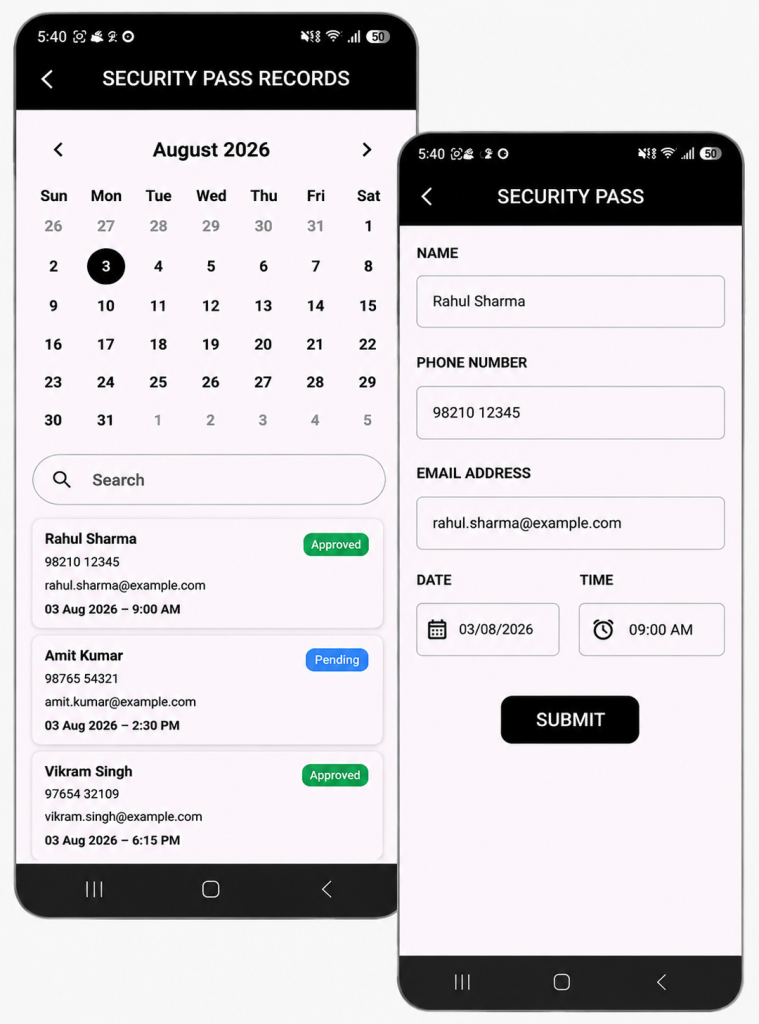
A modern security pass management system, like the pass and permit workflow built into AVES, handles the full lifecycle in one place.
- Create and issue passes for visitors, employees and workers from a single dashboard
- Route approval or rejection to the right supervisor automatically
- Timestamp every entry and exit for an audit-ready record
- Flag overstays before they become a liability
- Give head office real-time visibility across every site
This is not about replacing your guards. It is about giving them a tool that catches what a rushed handwritten log cannot.
Combine that with a connected gate pass management system for vehicles and materials and you close the two biggest gaps most sites carry today: who came in and what left with them.
Why This Fits Inside a Bigger Security Guard Management System
Passes rarely work well as an isolated tool. They need to sit inside a complete security guard management system, alongside patrol verification, incident reporting and shift scheduling.
Here is why that matters. A pass-related incident is rarely just a check-in problem. It usually involves a patrol log, an incident report and a shift record all at once. If those pieces live in separate tools, reconstructing the full picture after something goes wrong takes hours.
When your security pass management system, patrol tracking and incident reporting sit inside the same security guard management system, that reconstruction takes minutes and every record lines up automatically.
This is the same reason established guard management software providers, from GuardsPro to Novagems to SGMS, all build pass and permit handling directly into their core platform instead of selling a standalone front-desk tool. It is also why security guard services that take liability seriously ask about this feature before signing a contract, not after.
Honest Limitations to Expect
No system is magic and you deserve a straight answer here.
A digital system still needs a device at the gate and a guard trained to use it. It will not fix a team that refuses to follow process. It reduces friction and risk, but it does not remove the need for good supervision.
Offline coverage is usually limited to core actions, with full sync happening once connectivity returns. If your site has zero connectivity for extended periods, plan around that reality instead of assuming full offline functionality.
And migration takes a short adjustment period. Guards who have logged passes on paper for years will need a week or two to build the new habit. That is normal, not a sign your security pass management system rollout is wrong for you.
Making the Decision With Confidence in 2026
If you have read this far, you already understand more about choosing a security pass management system than most people evaluating one for the first time.
You know what it actually covers, where paper systems break down, what mistakes to avoid and what a properly built platform should include. You also know the honest limitations, which means nothing here will surprise you later.
The next step is simple. Look at how your current process handles a visitor or contractor pass from creation to expiry. If there is a gap anywhere in that chain, that is exactly where a real security pass management system, connected to your broader security guard management system, earns its place going into 2026.
You are not starting from zero. You are finally choosing the platform that matches the operation you are already running.
CONTACT US
Website : https://avessecurity.com
Linkedin: https://www.linkedin.com/company/aves-security-management-system/
Instagram: https://www.instagram.com/avessecurity/
What is a security pass management system, exactly?
Strip away the sales language and it’s the process and software behind creating, approving, tracking and revoking access for anyone who isn’t a permanent employee. Visitors, contractors, vendors, delivery staff, temporary workers. All of them fall under this umbrella.
How is security pass management different from a paper logbook?
A logbook is a static record chained to a desk at the gate. Security pass management is live and searchable. It shows who entered, who approved them, how long they stayed and what they were allowed to touch. That gap is where most security failures live.
What does it actually cost a company to skip security pass management?
A missed pass revocation means a former contractor still badges in weeks after his contract ended. A lost paper log means two full days rebuilding entry history by hand for an insurance claim. A failed client audit, because your gate pass management system can’t produce a clean report, can cost you the entire contract, not just one site.
What should a properly built security pass management system include?
It should let you create and issue passes from a single dashboard, route approvals automatically to the right supervisor, timestamp every entry and exit for an audit-ready record, flag overstays before they become a liability and give head office real-time visibility across every site.
Does security pass management work as a standalone tool?
Rarely and it shouldn’t have to. It works best sitting inside a full security guard management system, alongside patrol verification, incident reporting and shift scheduling. A visitor incident usually touches all three at once and keeping them separate turns reconstruction into hours of work instead of minutes.