
A safety committee minutes template is a fixed record format a security or facilities team uses to capture who attended a safety meeting, what hazards and agenda items were raised and which actions were assigned, to whom and with what status, so nothing discussed gets lost between one meeting and the next.
Search for a safety committee minutes template and most results are generic business meeting formats that were never built for a security site. There is no field for the hazard that was raised, no owner on the action that was meant to fix it and no way to prove the same issue was not simply carried over and quietly dropped. A security safety committee has a narrower job than a general staff meeting: raise what is unsafe, assign who fixes it and show that it got fixed. The template below is built around that job.
The problem: minutes that do not survive the gap between meetings
Most safety committees start out recording minutes in whatever is to hand: a shared document, a notebook passed between supervisors or a short email sent round after the meeting. That works for one meeting. It breaks down over several, because nobody is checking the new minutes against the old ones in a consistent way. An action raised in March shows up again in June with no note of what happened in between and nobody can say whether it was fixed, forgotten or simply never assigned to anyone in the first place.
The gap is rarely the meeting itself. Most sites do hold the meeting. The gap is the record: a format that does not force attendance, agenda items and actions into the same comparable shape every time, so the committee cannot see its own history.
Why it matters for a security company
A security contractor’s safety committee is not just an internal formality. If a client auditor, insurer or regulator ever asks for proof that hazards raised on site were tracked to closure, the minutes are the evidence. A folder of inconsistent notes, with no owner or status on half the entries, does not answer that question. A consistent safety committee minutes template does, because every entry carries the same fields: what was raised, who owns it and where it stands.
It matters for the committee too. An action with no named owner and no due date is an action nobody feels responsible for. A safety committee minutes template that forces both into every entry is what turns a safety committee from a box ticked once a month into a working part of how hazards actually get fixed.
Safety Committee Minutes Template: 8 Fields to Capture Every Meeting
- Meeting date, time and venue. The basic record of when and where the committee met.
- Attendees present, with apologies for anyone expected but absent noted separately.
- Previous minutes review. The status of every action carried over from the last meeting, not a fresh blank page.
- New hazards, near misses or safety concerns raised this meeting, in the words of whoever raised them.
- Incident or inspection review for the period since the last meeting, where relevant.
- New action items, each with a single named owner rather than “the team” or “management”.
- Due date for every action. Not an open ended “soon”.
- Status for every item, open, in progress or closed, reviewed again at the start of the next meeting.
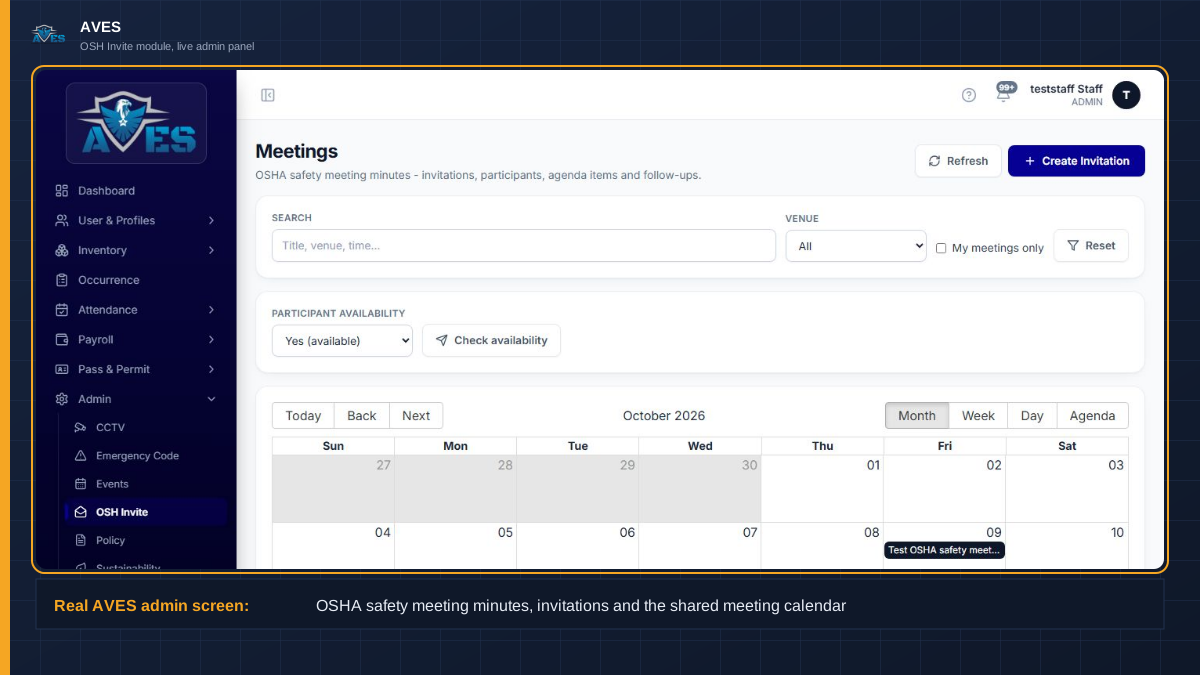
AVES runs this as a dedicated OSH Invite record rather than a document someone has to remember to update. A meeting is created as an invitation with a title, venue and time. Participant availability is checked before it goes out, so the committee is not scheduled around one chair’s personal diary. Every meeting sits on a shared calendar with month, week, day and agenda views, so the next chair can see what was scheduled and when without hunting through old files.
Inside the meeting record itself, the fields split the same way the template above does. A discussion item captures the topic and what was said about it. An action item captures who owns it and what its current status is. That split is what lets the committee open the next meeting by reviewing exactly what was still open from the last one, instead of starting from a blank page and hoping someone remembers.
Common mistakes with a safety committee minutes template
No fixed format. Without a safety committee minutes template, every meeting gets minuted differently and there is nothing consistent to compare one month against the next. Gaps in the record are easy to miss as a result.
Actions with no named owner. An action assigned to “the site team” or “management” is an action nobody is accountable for closing.
Minutes kept only on paper. A notebook in a site office is not available to the next chair, an auditor or anyone trying to check whether an old action was actually closed.
Previous actions never reviewed. A template that only captures what is new, with no section for reviewing what was carried over, lets open items drift for months without anyone noticing.
No link between an action and the hazard that raised it. An action item that does not reference what prompted it is hard to justify later if a client or regulator asks why it mattered.
How AVES handles it
AVES does not treat a safety committee minutes template as a document that lives outside the rest of the safety record. The OSH Invite module schedules the meeting, checks who can attend before the invitation is sent and keeps every past and upcoming meeting on one shared calendar. The discussion and action items captured during the meeting stay attached to that same record, so the status of last meeting’s actions is exactly where the committee left it, not buried in a separate file nobody opens between meetings.
Safety Committee Minutes Template FAQ
What should a safety committee minutes template include?
At minimum: the meeting date, time and venue, who attended, a review of actions carried over from last time, any new hazards or concerns raised and every new action with a named owner, a due date and a status.
How often should a security safety committee meet?
Monthly is common for an active site with daily guarding activity. The right cadence is whatever matches your client contract or the audit expectations your regulator sets, rather than a fixed universal rule.
Who should attend a safety committee meeting?
Typically the site supervisor or safety officer, a representative of the guards or staff working the site and, where the agenda calls for it, a client or management representative.
Is a template enough, or do I need software?
A safety committee minutes template works for a single site with one person keeping the record straight. It tends to break down once a company runs several sites or several shifts, because a paper or document based template has no shared view across them. A digital record solves that by keeping every meeting on one calendar that any authorised chair can open.
Does AVES include a safety committee minutes template?
AVES’s OSH Invite module is built around exactly this record: scheduling, attendance, discussion items and action items with an owner and a status, all attached to the same meeting. See the full guide to safety committee meetings for how the record works end to end.
Where this fits in your compliance record keeping
A safety committee minutes template is one piece of a wider compliance record. The same discipline, a named owner, a date and a status, applies to a fire drill record, a first aid checklist and whatever a site security audit checklist expects to see when an inspector asks for proof. Where a hazard raised in committee turns into a formal incident, the same record keeping standard carries through to an incident report form, so there is one consistent trail from the meeting where a concern was first raised to however it was eventually resolved. For the full explainer on running the meeting itself, start with safety committee meetings.
Book a 30 minute demo and we will show you how a safety committee meeting, its attendance, its discussion items and every action it raises stay on one record instead of a document nobody updates: book a demo. Prefer to explore first? Start a free trial.
Follow AVES on Instagram for more security operations tips.