Security officer management is the practice of knowing what each officer actually did on shift — which patrols were completed, which reports were filed, and when — rather than relying on memory or a signature at the end of the night.
Last month a client of a mid-size security firm asked why a patrol never got logged on a Tuesday night. The owner pulled up a sheet of paper a text from the supervisor and basically nothing else. The round probably happened. Nobody could prove it though and that’s the whole problem in one sentence.
This gap between what guards actually do and what a company can show for it is more common than most owners want to admit. It’s not really about bad guards. Usually it’s about how a small operation ends up running on memory, paper and whatever the supervisor happens to remember from three shifts ago.
Below is what causes this what it actually costs a security business over time and where security guard accountability software fits into fixing it.
⁸Security guard accountability software helps security companies improve accountability, verify patrols and maintain accurate records across every shift.
Where the Gap Shows Up
It rarely starts as one big failure. A guard finishes his round but forgets to text in. A supervisor takes his word for it because they’ve worked together for years. Then a client calls asking for last month’s incident reports and someone spends half a day digging through old emails trying to piece it together.
Individually these are nothing. But they stack up and eventually you’re running a company that can talk about the quality of its guards but can’t actually show it.
Here’s something owners figure out the hard way: clients don’t usually walk away because a patrol got missed. They walk away because nobody could tell them what happened and that uncertainty is worse than the missed patrol itself.
Security guard accountability software helps security companies verify patrols, document incidents and maintain accurate records without relying on paper logs or manual processes.
Why It Keeps Happening
Blaming the guards is the easy move and it’s usually wrong. Most officers are doing their job fine. The real issue sits in the systems behind them.
Paper logs get left in guard shacks and rained on or just never make it back to the office. Radio checks rely on someone’s memory of a phone call from hours earlier, which isn’t documented; it’s a guess written down afterward.
Spreadsheets are fine with five guards on one property. Once a company scales to fifteen or twenty guards across several sites, someone’s manually merging data from three or four different sources every week and that’s exactly where mistakes creep in.
Worse, information gets split across tools that don’t talk to each other. Scheduling in one app, incidents in another, attendance tracked somewhere else entirely. Answer one client question that touches all three and whoever’s doing it turns into a detective before they can even respond.
Most guard companies aren’t actually bad at security. They’re bad at proving it. And in a business that runs entirely on trust, that proof is the product.
Modern security guard accountability software gives supervisors complete visibility into field operations and guard performance.
It also replaces paper logs with digital records, automates reporting and simplifies day-to-day security operations, helping teams respond faster and maintain consistent accountability.
What This Actually Costs
A single missed patrol won’t sink an account by itself. It’s the pattern over months that does the damage and security firms lose clients over documentation and communication gaps far more often than over real incidents on the ground.
Losing a mid-size contract is expensive to replace. Between sales calls, proposals and the ramp-up time before a new account turns a profit, it usually costs several times more to land a new client than to keep an existing one satisfied.
Then there’s the cost nobody puts on a spreadsheet. Supervisors chasing paperwork instead of supervising. Owners fielding angry client calls personally because nobody else can speak to what actually happened. Admin staff rebuilding reports from scratch every time a client or an insurer asks for records.
None of it feels urgent day to day. It just quietly drains a business that’s otherwise doing fine.
Investing in security guard accountability software reduces reporting errors, strengthens compliance and improves client confidence.
Mistakes Buyers Make Shopping for a Fix
Most owners looking into this have already tried some kind of software or at least demoed one. A common mistake is buying something that tracks a guard’s location and assuming that solves everything.
It doesn’t. A GPS ping tells you someone was near a checkpoint. It says nothing about whether the checklist got completed or whether an incident report has the detail a client or insurer would actually need. Location without context is just a dot on a map.
Choosing the right security guard accountability software means looking beyond GPS tracking and focusing on complete operational visibility.
Another common trap is buying generic workforce software built for retail shift swaps and trying to force it to handle post orders, checkpoint verification and compliance documentation. Security operations have specific needs that generic tools weren’t designed around.
For industry best practices, security companies can refer to ASIS International for professional security management guidance.
Switching systems takes real effort too and it’s worth saying plainly. Guards need a few shifts to get used to logging through an app instead of a radio call. Anyone promising an instant, painless rollout is overselling it. What actually helps is a system simple enough that the learning curve is short, not one that pretends there isn’t a curve at all.
How Security Guard Accountability Software Solves the Accountability Problem
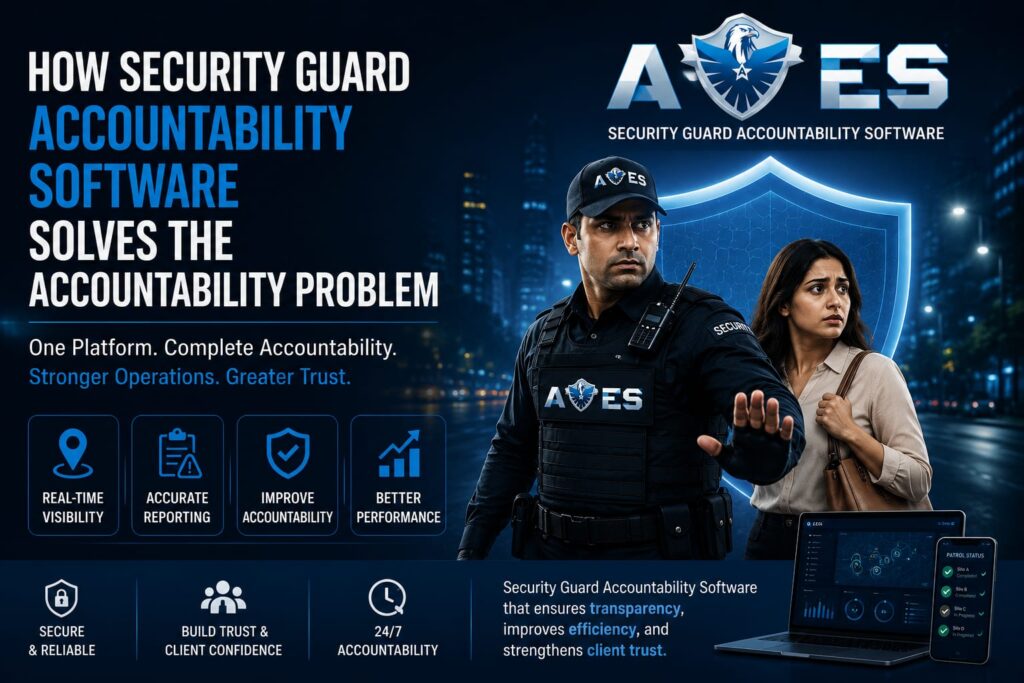
AVES starts from a simple premise. If a security company can’t prove what happened during a shift, pricing, retention and growth all get harder to defend.
Instead of splitting guard tracking, incident reporting, attendance and client reporting into separate tools, AVES keeps all of it in one platform where the pieces connect naturally.
Geo-attendance handles the “were they actually there” question by tying attendance to real-time guard tracking and location data automatically, instead of relying on a guard’s word or a supervisor’s memory. That alone removes a whole category of disputes before they even start.
Incident reporting happens on-site while details are still fresh, functioning as security incident reporting software that timestamps everything automatically. That matters a lot if a report ever needs to hold up for a legal or insurance claim later.
Client reporting stops being a scramble too. The data’s already organized, so instead of losing an afternoon before a client meeting pulling numbers together, it’s mostly filtering and exporting what already exists.
Compliance paperwork builds itself as work happens, since every checklist entry gets timestamped the moment it’s logged. As security compliance software, that means audit trails exist by default instead of getting rebuilt under pressure the week before an audit.
None of this is about piling on more software. It’s about removing the parts of the day that only exist because information is scattered across five different places.
Security guard accountability software brings attendance, patrol tracking, incident reporting and compliance into one connected platform.
What Changes Once It’s Fixed
Client conversations sound different once accountability stops being a question mark. Instead of explaining what probably happened, an owner can show exactly what happened, with timestamps to back it up.
Supervisors get their actual job back, spending less time chasing information and more time supervising people in the field.
New hires ramp up faster since expectations live inside the workflow instead of a training binder nobody reopens after the first week.
And come renewal time, a company isn’t asking clients to trust its word. It’s showing a track record the client can see for themselves, which tends to matter more in a competitive market than any sales pitch.
What This Won’t Fix
No software fixes bad leadership or replaces solid hiring, AVES included. If officers aren’t trained well or post orders are vague, better software just surfaces those problems faster. It doesn’t make them go away.
There’s a real adjustment period as well. Guards coming off paper logs need a few shifts to build the habit of logging through an app, so it’s worth planning for a rough first week rather than expecting perfection.
Migrating old records and past incident files also takes some upfront work. Rushing through that step tends to create more confusion than it saves.
None of that is a reason to keep running on spreadsheets and phone calls. It’s just a realistic picture of what switching actually looks like.
Choosing the right security guard accountability software helps security companies improve accountability, streamline operations and retain more clients.
Even the best security guard accountability software works best when supported by proper training and strong leadership.
Where to Go From Here
The accountability gap doesn’t close because a team suddenly works harder. It closes when the systems behind the work stop depending on memory and good intentions.
Most owners reading this already know which small gaps in their own operation have been quietly adding up. The real question is whether to keep managing around it or actually close it.
AVES was built for security companies tired of apologizing for things they can’t prove one way or the other. A walkthrough of how it fits a specific operation is a reasonable next step if that sounds familiar, not a sales pitch, just a look at whether it actually works the way a given team does.
Even the best security guard accountability software works best when supported by proper training and strong leadership.
Choosing the right security guard accountability software helps security firms improve accountability, strengthen compliance and build long-term client trust.
Isn’t this just GPS tracking with extra steps?
No, and that’s actually the mistake a lot of owners make. GPS tells you a guard was somewhere near a checkpoint. It doesn’t tell you if the checklist got done, or give you anything useful when a client asks what happened on-site. You need the “what,” not just the “where.”
My guards hate change. Won’t this be a mess to roll out?
Probably a little, honestly. Going from radio calls and paper to an app takes a few shifts to feel normal. Anyone who tells you it’s instant is selling you something. Plan for a rough week, not a smooth one.
Can I just use some general employee-management app instead?
You could, but it’ll fight you the whole way. Those tools are built for shift swaps at a retail job, not post orders or incident documentation. You’ll end up bending it into shapes it wasn’t made for.
Does software fix a guard who’s bad at his job?
No. That’s not what this does. If training’s weak or post orders are vague, the software just makes that more obvious, faster. It’s not a leadership replacement.
What do we actually get out of switching?
Mostly this: when a client asks what happened, you can show them instead of guessing. Less time spent rebuilding reports from old texts and emails. Supervisors are doing their actual job instead of playing detective every time someone asks a question.