Category: Security Operations

Insights on digital security operations and management.

  • Security Guard Performance Management Guide

    Security Guard Performance Management Guide

    A security guard performance review is not supposed to feel like a trip to the dentist. But that’s exactly how most security company owners run it. They dig up a dusty generic template, scribble a couple of half-hearted notes, sign the bottom and shove it in a filing cabinet for the next twelve months. That lazy habit is the actual reason your turnover keeps climbing.

    Here’s what that officer actually deals with. Twelve hours alone at a client site. Aggressive visitors at the gate. Access control. A 2 a.m. alarm going off with nobody around to back them up. And then you hand them a review that says “good job.” That’s it. That tells them nobody’s watching, nobody cares. Good guards pick up on that fast and they don’t stick around, they go find a company that treats them like it matters. If you want a security guard performance review process that actually works, forget the corporate HR playbook. Look at what the job really involves.

    Why traditional appraisals fail security teams

    Most evaluation templates were built for someone sitting at a desk under office lights. It’s a bit like scoring a race car driver on typing speed, the metrics just don’t apply. A perimeter fence or a lobby desk doesn’t behave like a cubicle. Judge a mobile patrol officer with corporate benchmarks and the whole security guard performance review feels fake before you’ve even asked the first question.

    Guards know within a minute whether you understand their job. If you don’t, they check out mentally right there and good luck getting honest engagement after that. It kills your credibility as a manager instantly. A strong security guard performance review keeps good people, because it’s built around what the work actually looks like, not what a handbook says it should look like.

    Most managers just inherited whatever system was already in place. Annual check-ins, because that’s tradition. But security isn’t an industry where you can afford to wait a year. One missed patrol turns into a break-in or a client walking away entirely. By the time the annual review comes around, bad habits are already baked in and your best officers have already mentally quit.

    The core framework of a security guard performance review

    A real security guard performance review or security guard evaluation, sticks to objective, observable behavior. You can’t grade someone’s vibe or general attitude. You grade what they actually did. A solid framework captures daily reliability and how someone handles a crisis, in equal measure.

    Start with operational reliability: punctuality at shift handover and how strictly someone follows post relief protocol. A guard who shows up ten minutes late forces the outgoing officer to stay late too and that quietly poisons morale across the whole roster. Let tardiness slide long enough and it becomes the norm and your most reliable people start to resent it.

    Next comes tour execution. Are your guards actually hitting checkpoint scans on schedule or are they pencil-whipping the log from inside the guard shack? Patrol integrity is what your client contract is built on. Skip checkpoints and the client is paying for protection they’re not getting.

    You also need to look at incident documentation, meaning how fast and how accurately reports get filed. A report riddled with spelling errors and missing timestamps can wreck your legal standing the moment a case goes to court. Round out your security guard performance review with professional conduct: uniform, grooming and how officers actually talk to clients and visitors.

    Tracking the guard performance metrics that matter

    A real security guard performance review runs on numbers you can actually track week over week, not vague advice about working harder. One of the most important security guard KPIs to start with is tour completion rate. Anything below ninety-five percent on scheduled checkpoint scans and you’ve got a problem worth investigating.

    Incident response time matters too. How long does it take an officer to acknowledge an alarm or check out something suspicious on the property? When someone unauthorized is already inside, minutes are the whole ballgame.

    Report accuracy is another one worth watching, specifically how often a supervisor sends a report back for corrections. If your supervisor’s spending half their morning rewriting other people’s paperwork, that’s not a discipline issue, that’s a training gap that needs fixing.

    Numbers strip out the bias. Nobody can argue with a system showing they missed twelve checkpoints last Tuesday, that’s just what happened. It turns what used to be a tense, emotional conversation into a coaching session grounded in fact. Officers trust a security guard performance review built on data a lot more than one built on whatever mood their supervisor happened to be in.

    Ditching the paper trail for digital tracking

    Paperwork slows everything down and eventually something gets lost. Try running a security guard performance review across dozens of officers using logbooks and scattered spreadsheets and watch how fast the whole system collapses. A dedicated platform removes that headache entirely. Every hour spent digging through last month’s attendance sheet is an hour that should’ve gone toward training or client calls.

    Paper gets coffee stains. It gets left in a glove compartment. It disappears into a filing cabinet somewhere and never resurfaces. Digital tracking keeps everything tied to the right officer’s profile from day one, no exceptions. Cutting the physical logbook out of the process turns admin work from a scavenger hunt into something manageable.

    Walk through the life cycle of a typical paper incident report. An officer scrawls it on a clipboard mid-shift. Hands it to the supervisor at change of shift. It gets tossed into a folder in the back of a patrol car. Weeks go by. Eventually it lands on someone’s desk back at the office and now an assistant’s squinting at bad handwriting trying to figure out what actually happened. By the time management sees it, the incident’s already two weeks old. A digital system just deletes that whole broken chain.

    How AVES Security Management changes the game

    Bring everything into one place and the whole equation changes. AVES Security Management System builds your security guard performance review process, scheduling and incident reporting into a single platform. Inside the performance module, managers log employee periods and departments in a matter of seconds. Pick the name, set the development period, that’s it. No spreadsheet juggling required.

    Supervisors get a structured space to log development goals and flag concerns instead of hunting through a filing cabinet for last month’s notes. You set an agreed improvement action and a clear success measure directly inside the app. Reviews stop being that once-a-year panic because the notes are already there, logged continuously as the year goes on.

    Once daily activity connects directly to long-term development tracking, the culture around here starts to shift. With a proper security guard performance review system in place, supervisors aren’t guessing what happened three months ago anymore. They open the profile, look at real completion numbers and have an honest conversation backed by actual data instead of fuzzy memory.

    Setting goals that actually change behavior

    A security officer performance plan without a deadline attached to each goal is just a wish. Target start and end dates give remedial training or a promotion track, an actual timeline to work against. The AVES calendar lets you set exact dates for any goal in a couple of taps. Officer struggling with report writing? Give them thirty days and pair it with focused training in the app.

    Measurable success criteria tell you, plainly, whether the error rate actually dropped over that window. Continuous feedback, tracked through the calendar, means notes get logged as things happen rather than everyone scrambling to remember details once a year. Real growth comes from small, steady corrections, not one giant overhaul once every twelve months.

    Tell someone to “be more professional” and you’ve told them nothing useful. Tell them “complete every checkpoint scan within ten minutes for the next thirty days” and now there’s an actual target. That’s the difference between vague advice and something a person can actually act on.

    Overcoming pushback from field supervisors

    Roll out a new security guard performance review system and somebody’s going to push back, usually a supervisor claiming they don’t have time for more paperwork. Fair enough, honestly, paperwork pulls them away from the site. Moving to digital cuts that friction down to almost nothing since entry takes seconds, not an afternoon. Officer skepticism around the review process fades too once it’s tied to metrics instead of whatever mood a supervisor’s in that day.

    Trust in the security guard performance review process comes from transparency.. When officers see their completion rate connecting directly to actual career growth, accountability just becomes part of how things work, not a rule being forced on them. Supervisors stop acting like enforcers and start acting like mentors who actually want their people to do well.

    Getting veteran supervisors on board really comes down to showing them the upside. Once they realize a review takes five minutes on a phone instead of a weekend buried in paper, most of the resistance just disappears on its own.

    Your next move

    A proper security guard performance review process turns your security team from a line-item cost into your biggest asset. Pair clear expectations with digital tracking and the administrative mess across your organization starts to clear up on its own. Stop relying on messy paperwork and habits that were never built for this job in the first place. Streamline your performance tracking and build a stronger team with the AVES Security Management System.

    CONTACT US

    Website : https://www.avessecurity.com

    Linkedin: https://www.linkedin.com/company/aves-security-management-system/

    Instagram: https://www.instagram.com/avessecurity/

  • Unplanned Events, Real Risk: Event Security Coordination

    Unplanned Events, Real Risk: Event Security Coordination

    You get the call on a Tuesday. A VIP is coming next week. Or someone books a private function for Saturday night, out of nowhere. Or a client tacks a gathering onto the calendar nobody planned for.

    There’s a specific stomach drop that comes with that call. Your regular schedule wasn’t built for this. You know it immediately.

    If you’ve felt that particular mix of pressure and “wait, how do we actually handle this,” you already get why event security coordination matters more than most people admit, at least until something goes wrong once.

    The Fear Nobody Says Out Loud

    Here’s the part nobody puts in the client proposal. It’s not really the event you’re afraid of. It’s what happens if you get it wrong while a client is watching closely.

    A scuffle at the door. A VIP standing around with no clear escort because nobody claimed that job. A parking mess that turns the entrance into chaos before the event starts.

    None of that is really about the event itself. It’s about you and your company. That’s the actual weight event security coordination carries, even though on paper it sounds like nothing more than a scheduling task.

    Why Your Normal Setup Falls Apart Here

    Day to day, your operation runs on routine. Fixed patrols. Predictable shifts. Guards who know the site so well they don’t think about it anymore.

    An event blows all of that up. More people you don’t recognize. A schedule that looks nothing like a normal Tuesday. A client whose reputation is tangled up with yours for a few hours whether either of you likes it or not.

    Without event security coordination, teams end up improvising on the fly. Someone scrambles for extra guards at the last minute. Nobody’s totally sure who’s actually responsible for the VIP’s arrival. The parking plan, if you can call it that, lives buried in a group text somewhere.

    What You’re Probably Wondering, If This Is New To You

    If you’ve never had to coordinate security for an event before, here’s the honest question underneath everything else. Can you pull this off without something slipping through?

    Fair question. Most teams learn event security coordination the hard way, usually after one event where a detail nobody thought to plan for showed up unannounced.

    The good news is the details that matter aren’t some mystery. They show up the same way basically every time. Once you know what they are, this stops feeling like guesswork.

    Not Every Event Needs the Same Level of Fuss

    Something most guides skip. Treating a private birthday party the same as a VIP visit wastes effort exactly where you can’t afford to waste it.

    Event security coordination works better when events get sorted by risk first. A VIP event usually needs its own dedicated incharge and tighter coordination, which is really what VIP event security planning comes down to at its core. A private function might just need standard coverage and a confirmed headcount. Private function security planning rarely needs to go further than that. A regular event sits somewhere between the two.

    Sorting things this way is really the whole trick behind good event security coordination. You spend your best planning energy on what actually needs it, instead of applying the same heavy process to every booking.

    The Four Things That Actually Matter

    You don’t need a complicated system for this. You need four things nailed down for every event security coordination effort, no exceptions.

    Who’s in charge. A named security incharge. One person, accountable start to finish. Not a rotating cast of guards with no clear owner. Getting the security incharge assignment right saves you from a dozen small confusions later.

    Roughly how many people. Even a rough headcount changes staffing, parking allocation and entry point coverage.

    Where the cars go. Event parking isn’t the same as daily traffic. Sort it out ahead of time or deal with chaos at the gate.

    What guards need to know first. A briefing built for this specific event, not a generic one, so your team understands what’s different before it starts. Solid event safety briefing management separates a guard who’s ready from one who’s just showing up.

    Skip more than one of these and event security coordination quietly falls apart right when it matters most.

    What Beginners Get Wrong (And Honestly, It’s Not Their Fault)

    The most common mistake is treating event planning like an extension of the regular schedule instead of its own thing. A guard pulled off routine patrol and dropped into an unfamiliar VIP event with no real briefing is set up to miss things.

    That’s not a skill problem. It’s a planning gap. Event security coordination fails quietly when it gets bolted onto the existing roster as an afterthought instead of getting treated like its own step.

    Mistake two, sneaky one this, is letting event details scatter across messages, emails and random phone calls. By the time the event starts, nobody has the full picture.

    There’s a third one that trips up even experienced teams. Short notice events get treated as lower stakes because there’s less time to plan. Backwards, actually. Short notice makes event security coordination more important, not less.

    The Trade-Off Nobody Loves Talking About

    Planning ahead costs time your team doesn’t always have, especially when notice is short. That’s a real cost.

    But weigh it against the alternative. A poorly coordinated event creates problems that take way longer to clean up afterward, both logistically and with the client relationship itself. Event security coordination that happens even a day in advance beats zero planning every single time.

    The teams that get the most out of this aren’t running some elaborate process. They’re the ones who consistently nail the basics, incharge, headcount, parking, briefing, every time, no matter how small the event looks.

    Why This Protects the Relationship, Not Just the Event

    Clients remember how an event felt, not just whether nothing blew up. That distinction matters more than most security teams give it credit for.

    A team with a parking plan ready, briefed staff who know their role and one clear person running the show looks like a company that’s got this handled. A team scrambling through logistics on the day looks like the opposite, even when nothing goes wrong.

    Event security coordination is what turns “we handled it” into “they really had it handled.” Clients notice that difference even when they can’t quite explain why.

    How This Connects To Everything Else You’re Already Doing

    Events don’t happen in a vacuum away from the rest of your security operation. They tie into shift scheduling, patrol coverage and guest access all at once.

    Event security coordination works best as something your team checks alongside the regular schedule, not as a separate silo where an event can quietly overlap with duties nobody remembered to reroute. Keeping it connected is what actually makes event security coordination reliable week over week.

    Making The Call Without Guessing

    You don’t need to overhaul anything this week to get this right. Just one habit. Capture the basics for every event before it starts instead of piecing them together once guests are already walking through the door.

    Ask yourself something simple about your next booked event. If someone asked right now who’s responsible, roughly how many guests to expect and whether guards have actually been briefed, could you answer without hesitating?

    If the honest answer is no, that’s the exact gap event security coordination is meant to close. It’s a small habit, but it pays for itself the first time a client asks a hard question mid-event.

    The Next Step

    You already know what’s riding on this. A client’s trust. A guard’s ability to do their job well. Your company’s reputation next time someone books an event.

    Closing that gap doesn’t mean reinventing how you run your operation. It means building event security coordination around how events actually unfold, not stretching a generic scheduling tool to cover a job it was never built for. That’s all good event security coordination has ever needed to be.

    If your current process still runs on memory and last-minute texts, event security coordination is worth fixing before the next VIP visit forces the question for you.

    No coordination, no proof it was ever handled well.See how event security coordination keeps every detail covered. Book a walkthrough

    CONTACT US

    Website : https://www.avessecurity.com

    Linkedin: https://www.linkedin.com/company/aves-security-management-system/

    Instagram: https://www.instagram.com/avessecurity/

    What’s event security coordination even mean in plain terms?

    Someone owns the event. That’s it, really. Not five people half-responsible. One person, plus the basics sorted before anyone walks in.

    We just throw more guards at events. Isn’t that enough?

    Nope and I get why people think that. More bodies doesn’t help if nobody’s actually running point. I’ve seen four guards standing around an entrance with zero coordination between them.

    Do we really need this? We maybe do two events a year.

    Kind of the opposite logic applies here honestly. Rare events are the ones that catch people off guard, precisely because nobody’s done it enough times to have a rhythm.

    Do VIP events need more attention than a regular one?

    Definitely. VIP stuff usually needs its own dedicated incharge and tighter coordination. A smaller private function can often get by with standard coverage and a decent headcount.

    How does planning ahead actually help the client relationship?

    Clients remember how the event felt more than whether something technically went wrong. A team that clearly has it together, parking sorted, staff briefed, one person running things, just reads as more trustworthy.

  • Visitor Pass Tracking: Closing the Loop on Unreturned Badges

    Visitor Pass Tracking: Closing the Loop on Unreturned Badges

    You’ve probably had this moment. A visitor badge from three weeks ago turns up in someone’s car, still active, still able to open a door it shouldn’t. Nobody remembers issuing it, nobody remembers taking it back.

    That’s not a rare glitch. It’s what happens when temporary access lives on a sign-in sheet instead of a system built to close the loop. If a pass can be issued but never formally returned, it isn’t access control. It’s a gap with a clipboard attached to it.

    This guide walks through what actually breaks down with informal visitor tracking, what real visitor and security pass management should look like instead and how to evaluate a tool without paying for features you’ll never use.

    Why Most Sites Lose Track of Temporary Access

    Most security teams don’t get burned by a bad actor walking in the front door. They get burned by a legitimate pass that was never properly closed out.

    A sign-in book, a spreadsheet, or a stack of laminated badges works fine on a quiet day. It falls apart the moment two supervisors issue passes on the same shift without checking each other’s records. That’s exactly the coordination problem security and visitor pass management is built to solve.

    Real security and visitor pass management isn’t about greeting people at the door. It’s about the full lifecycle of a credential: who issued it, how long it’s valid and confirmation that it came back. Buyers who go shopping for a broad visitor-experience platform with kiosks and host notifications often overpay for features that have nothing to do with the actual liability risk, which is an unreturned credential still sitting active somewhere.

    The Real Risk Isn’t the Visitor, It’s the Unreturned Pass

    Here’s the part most guides skip. The dangerous moment isn’t when a visitor walks in. It’s the moment their access should have expired and didn’t.

    Common failure points we see on sites without structured security and visitor pass management:

    • Passes issued verbally with no record of the validity window
    • No single log showing which credentials are still active right now
    • A returned badge that never gets marked as returned in any system
    • Different supervisors issuing access with no shared visibility

    None of these are visitor problems. They’re record-keeping problems. A tool built for temporary access card management closes this gap by tying every credential to a start time, an end time and a confirmed return, so nothing stays active by accident.

    If you’re worried tightening this process will slow down legitimate visitors or contractors, it usually does the opposite. A guard who can issue and log a pass in under a minute moves faster than one flipping through a paper binder looking for the last entry.

    What Good Visitor and Security Pass Management Actually Covers

    Strip away the sales language and real visitor and security pass management does three things well.

    Any platform claiming to handle visitor and security pass management should be judged against these three steps, not against how polished its sign-in screen looks.

    First, it issues a credential with a defined validity period. Not an open-ended badge that works forever until someone remembers to deactivate it, but a pass scoped to exactly how long that person needs to be on site.

    Second, it tracks the credential while it’s active. A supervisor should be able to see, at a glance, every temporary pass currently valid on the property, not reconstruct that list from memory when a client asks. This is where guest pass tracking software earns its place over a paper log.

    Third, it confirms the return. The credential isn’t closed out because a shift ended. It’s closed out because someone recorded that the badge came back. That confirmation step is what separates visitor and security pass management from a sign-in sheet with extra steps.

    Systems built around unauthorized access prevention software principles treat that third step as non-negotiable, because an unreturned credential is functionally the same risk as a stolen key.

    Hidden Considerations Buyers Discover Too Late

    A few things people usually find out after they’ve already committed to a tool.

    Validity windows matter more than the badge itself. A pass without a hard expiry is a liability that renews itself every day nobody notices it. Ask any vendor directly how visitor pass validity tracking actually works, not just whether the feature exists on a slide.

    Integration with your gate and occurrence records matters. If visitor and security pass management lives in a separate system from your gate logs and occurrence reports, you end up piecing together three records instead of reading one clear picture during a client review.

    Not every “visitor management” tool is scoped the way you need. A lot of platforms in this space are built for corporate lobbies and photo capture, not for a security operation that needs credential issuance, validity and return tracked as one connected record. Ask to see the actual pass lifecycle on a live demo before assuming it fits.

    How to Evaluate a security and visitor Pass Management Tool

    You don’t need the flashiest kiosk on the market. You need a system that closes the loop every single time, which is the actual promise of visitor and security pass management, not just a nicer badge printer.

    A few practical filters worth running any visitor and security pass management platform through:

    • Does every pass get a defined validity window at the moment it’s issued?
    • Can a supervisor see all currently active passes in one place, in real time?
    • Is there a confirmed return step, not just an assumed one?
    • Does it connect to your existing gate and occurrence records, or sit alone?
    • Can the vendor show the actual issuance and return screens live, not in a slide deck?

    If a vendor answers all five clearly, you’re looking at real visitor and security pass management, not a repackaged lobby app wearing a security label.

    Quick Answers Before You Decide

    Do I need visitor and security pass management if my site rarely has visitors? Probably not on day one. But the moment more than one supervisor issues access, informal tracking becomes the risk, not the visitors themselves.

    Is visitor and security pass management the same as a general visitor management system? Not quite. A general visitor management system is often built around lobby check-in and host notifications. Visitor and security pass management is scoped to the credential itself: issuance, validity and confirmed return.

    What’s the single biggest risk this replaces? An active pass nobody remembers issuing. That’s the exact gap unauthorized access prevention software and structured visitor pass validity tracking are designed to close.

    Who Actually Needs This and When

    Not every property needs a full visitor and security pass management platform on day one and that’s worth saying plainly instead of pushing every site toward the same solution. A single-site operation with low visitor traffic can sometimes get by longer on manual tracking than a multi-tenant building or a construction site with rotating contractors.

    The trigger point is usually simple. The moment more than one supervisor can issue a pass, or more than one shift overlaps with active visitors, informal tracking stops working. That’s exactly when visitor and security pass management earns its cost, because the risk isn’t the volume of visitors, it’s the number of people who could issue access without checking a shared record first.

    Sites that delay this decision usually don’t regret the switch. They regret how long they waited, usually after a client audit or an incident forces the question. Building visitor and security pass management into your process before that happens is cheaper than explaining an unreturned credential afterward.

    Where This Leaves You

    None of this requires a complicated rollout. It requires treating every temporary credential as a record with a start, a defined window and a confirmed end, instead of trusting memory to close the loop.

    You already suspect the sign-in sheet isn’t enough. The real question is whether your next system for visitor and security pass management actually tracks the full lifecycle of a pass, or just makes issuing one look more official.

    If you want to see how real visitor and security pass management works end to end, live, on an actual device, that’s a fifteen-minute conversation, not a sales pitch.

    A badge that looks official isn’t the same as access that’s actually controlled.

    See how a real pass gets tracked from issue to return, live. Book a walkthrough.

    CONTACT US

    Website : https://www.avessecurity.com

    Linkedin: https://www.linkedin.com/company/aves-security-management-system/

    Instagram: https://www.instagram.com/avessecurity/

    What is visitor and security pass management?

    It’s the process of issuing, tracking and closing out temporary access credentials for visitors, contractors, or short-term staff. It covers three things: who got access, how long it was valid for and whether the credential was confirmed returned.

    Isn’t this the same thing as a visitor management system?

    Not really, no. Most visitor management systems are built around the check-in moment, taking a photo, printing a badge, pinging the host that someone’s arrived. Pass management cares less about the arrival and more about what happens after, whether that badge ever comes back.

    How does the validity window actually work in practice?

    Every pass gets a start point and an end point when it’s created. Once that window closes, it’s expired, full stop, regardless of whether the physical badge made its way back to a drawer yet.

    How’s this different from a Gate Pass?

    Gate Pass is about vehicles and materials crossing in and out. This is about people. They sound similar, they even sit near each other in the product, but they’re solving two different problems and one doesn’t cover the other automatically.

    What’s the mistake companies make most with this?

    Thinking a good-looking badge means access is under control. A laminated pass with no expiry and no return check is really just a nicer paper sign-in sheet, it just feels more official.

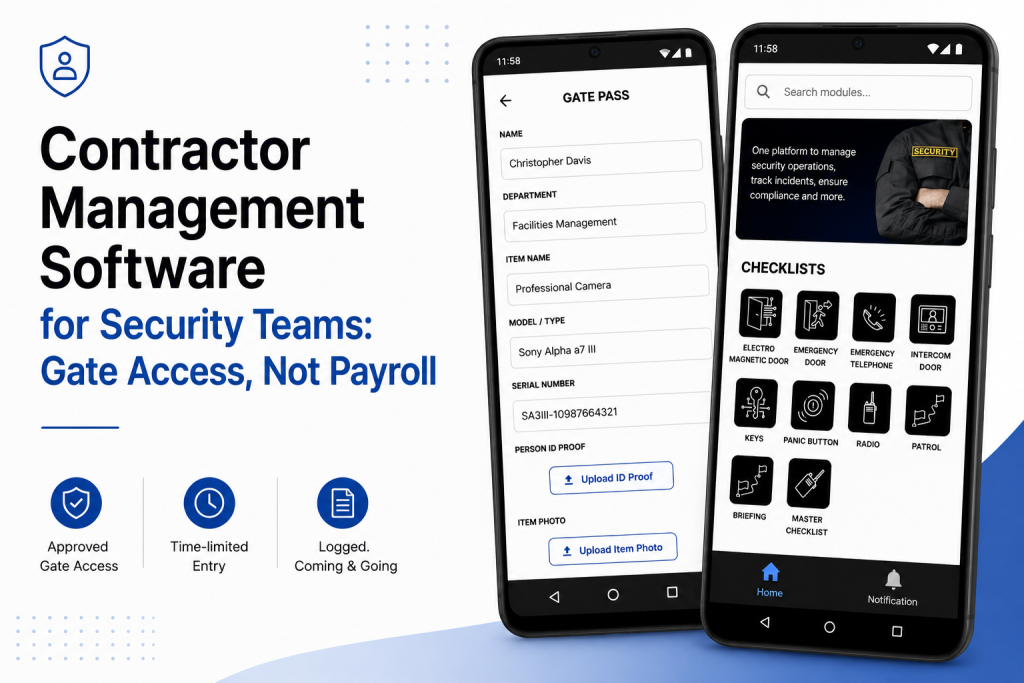
  • Contractor Management Software for Security Teams: Gate Access, Not Payroll

    Contractor Management Software for Security Teams: Gate Access, Not Payroll

    By Nithish, AVES Security

    Why “contractor management software” searches lead you to the wrong tool

    If you’re searching for contractor management software as a security team, you’ve probably already noticed the results don’t match what you need.

    I get this question a lot from site managers: “We searched for contractor management software and none of it does what we need. Is that normal?”

    Yes. Completely normal and worth explaining, because it’ll save a few wasted demo calls.

    Type “contractor management software” into Google and you’ll get Deel, Workday, a handful of HR-compliance platforms and a Capterra listicle comparing all of them.

    Every one of these tools is built for the same job: onboarding a contractor as a worker.

    Collecting their W-9, checking that their insurance is current, paying them in the right currency, tracking whether a certification expires next month.

    According to OSHA’s contractor safety guidance, that side of contractor management is real and regulated. It’s just not what a guard at a gate needs at 7am when a plumber shows up claiming he has a job order for Building C.

    Two different questions, one confusing search term

    “Is this person allowed to be here right now?” and “Is this person set up correctly as a vendor in our system?” are not the same question, even though both are called contractor management software.

    A security team almost never cares about the second one, which is payroll and legal’s job.

    A guard cares about the first and most contractor management software marketed under this term doesn’t answer it at all.

    What actually matters at the gate

    Ask a guard what goes wrong with contractors and the same handful of things come up, over and over.

    The contractor arrives and nobody at the gate knew they were coming, so someone’s calling around trying to find whoever approved it.

    The job finished two days ago, but access was never switched off because turning it off required someone to remember to do it.

    There’s no record of when the contractor actually left, just a guess based on when the truck was gone.

    A contractor wanders into an area they weren’t supposed to be in because nothing stopped them and nobody was watching that door.

    A client asks for a report of every contractor visit last month and someone has to dig through a logbook where three different guards updated it inconsistently.

    None of these are payroll problems. Their access problems are closer to what our gate pass management system already handles for one-off visitors.

    They need a system built around the gate, not the vendor file.

    What good contractor management software for security actually looks like

    Pretty simple, honestly. A contractor’s visit is scheduled and approved in advance, not improvised at the barrier.

    Access has a start and an end and it expires automatically rather than relying on someone to revoke it.

    Entry and exit both get logged the same way our geofence attendance tracking timestamps a guard’s location on a round.

    That means a contractor who checked in but never checked out shows up as exactly that: an open question, not a closed record.

    If a job needs an escort or is restricted to one part of the site, the system knows that and flags it rather than leaving it to memory.

    That’s the whole job. Not glamorous.

    But it’s the difference between a guard answering “who’s on site right now and why” in ten seconds, versus fifteen minutes of phone calls.

    Where this sits next to gate pass

    If you already use a gate pass format, contractor site access is basically the same mechanism.

    It’s applied to people who come back regularly and often need specific rules attached to inductions, restricted zones and a longer access window than a one-off visitor would get.

    Same underlying event, different shape.

    What we’re not claiming

    This doesn’t replace a real HR or compliance platform and it shouldn’t try to.

    It won’t issue a 1099. It won’t chase down an expired insurance certificate covered under something like OSHA’s recordkeeping rules.

    If that’s the gap you’re trying to close, you want Deel, Workday or something in that category.

    The two tools solve different problems and most teams end up needing both eventually.

    The bottom line

    If you went looking for contractor management software because you wanted to know who’s allowed on your site and when, you were in the right neighborhood but the wrong building.

    What you actually need is contractor management software built around the gate approved before arrival, time-limited, logged coming and going, visible to whoever’s asking.

    For More Details: https://avessecurity.com/

    Visit Our visit: https://www.linkedin.com/company/aves-security-management-system

    FAQs

    Isn’t contractor management software just for HR and payroll stuff?
    Most of what shows up under that name, yes, W-9s, insurance certs, payments. That’s a real need, just not a security one. If you’re trying to answer “who’s on my site right now and why,” you need something built around the gate, not the vendor file.

    We already use Deel/Workday for our contractors. Do we still need this?
    Probably, if security is a concern. Deel and Workday tell you that a contractor is set up correctly as a vendor. Neither one tells your guard whether that plumber at the gate is actually supposed to be there today. Different jobs and most sites end up needing both.

    What happens if a contractor forgets to check out?
    It stays open on the record instead of getting quietly closed. No guessing based on when the truck left the lot; if there’s no exit log, the system shows it as unresolved so someone can actually follow up.

    Can we restrict a contractor to certain areas of the site?
    Yes. If a job only needs access to one zone or needs an escort, that gets attached to the visit when it’s approved, not left to whoever’s at the gate that day to remember.

    How is this different from your regular gate pass system?
    Mechanically, it’s close. Contractor access is usually recurring, tied to inductions and open for a longer window than a one-time visitor pass. Same underlying idea, just shaped for people who come back.

    Can we pull a report of every contractor visit for a client or audit?
    Yes and it’s the same log the guards are already using at check-in and check-out, not a logbook that three different shifts filled in differently.

    Does this handle things like expired insurance or certifications?
    No. That’s still HR/compliance territory. OSHA-covered stuff like insurance and certs belongs with a platform like Deel or Workday. This tool answers “are they allowed on site right now,” not “are they legally compliant to be a vendor.”

  • Pocket Book: From Forgotten Notes to Permanent Proof

    Pocket Book: From Forgotten Notes to Permanent Proof

    A guard notices something worth remembering. A gate that sticks. A visitor who seemed off. A reminder for whoever takes over the post next.

    Where does that note actually go? Half the time, nowhere useful. A scrap of paper on a desk, a text to a supervisor that gets buried, a mental note that’s gone by the next shift.

    This is the small, unglamorous problem Pocket Book is built to solve. Not incidents, not formal reports. Just the ordinary notes that keep a site running smoothly when they’re written down and quietly cause confusion when they’re not.

    What Pocket Book Actually Is

    Pocket Book lives inside AVES under Logs & Reference, right next to SOP. Where SOP holds your uploaded documents and procedures. The tool holds the shorter, dated notes guards and managers log day to day.

    It’s not an incident report. It’s not an occurrence log. Think of Pocket Book as a proper electronic guard logbook, the digital version of the notebook a guard used to carry, minus the part where that notebook gets lost, left in a shack, or scribbled in handwriting nobody can read a month later.

    Some companies still call this kind of tool an e-pocketbook for guards, which is a fitting description. It’s personal, it’s quick to use and it’s meant to be checked constantly, not opened once a week.

    How Creating an Entry Actually Works

    Here’s exactly what the Pocket Book create flow looks like, based on the real screens, not a guess.

    From the Home dashboard, scroll to the Logs & Reference section and tap Pocket Books. From there, tap Create.

    The form asks for three things. A Date, picked from a calendar. A Time, picked from a clock selector. And a Message field, where the actual note goes.

    Fill those in and tap Submit. That’s the entire entry process. No categories to choose, no severity level, no extra fields to slow a guard down mid-shift.

    That simplicity is worth noting on purpose. A digital guard logbook that takes thirty seconds to fill out gets used. One that takes five minutes gets skipped, especially at 3am on a slow night when logging a small observation doesn’t feel urgent enough to justify the effort.

    How Reviewing Past Entries Actually Works

    Tap Records from that screen and you land on a screen titled Details of Pocket Book. It opens to a full month calendar, with today’s date already selected by default.

    Two things stand out here. First, the calendar lets you move month to month using the arrows on either side of the month name, so pulling up an entry from six weeks ago is a couple of taps, not a search through a notebook.

    Second, there’s a toggle above the results labeled My Books and Staff Books. My Books shows entries the current user logged. Staff Books shows entries logged by staff. Switching between them is one tap.

    If there’s nothing logged for the date you’ve selected, the screen tells you so, though it’s worth knowing the exact wording differs slightly depending on which toggle you’re on. My Books shows “No Data Available.” Staff Books shows “No Data available for the Selected Date.” Small inconsistency, but worth knowing so you’re not confused wondering if it means something different.

    Why the “My Books vs Staff Books” Split Matters More Than It Looks

    It’s easy to check one Pocket Book toggle, see nothing logged and assume there’s nothing to see. That’s the most common way this feature gets misread.

    My Books and Staff Books are genuinely separate views. A supervisor checking only My Books on a given date could easily miss entries their team logged under Staff Books for that same day. If you’re reviewing a date for any real reason, check both toggles, not just one.

    What’s Confirmed and What Isn’t Yet

    Being straightforward here matters more than sounding polished. The Pocket Book create and records flows above are confirmed directly from real screens. That part isn’t a guess.

    What isn’t shown anywhere in the current screens: whether a Pocket Book entry can be edited or deleted after it’s submitted, what exactly determines whose entries show up under Staff Books and whether the Message field has any length limit.

    If those details matter for how your team plans to use it, the honest answer is to ask for a live walkthrough of those specific flows before assuming how they work.

    Why This Beats a Handwritten Logbook

    If your team is still using paper, the case for Pocket Book as a way to replace handwritten security logbook habits comes down to four things paper can’t do well. A digital record can’t be torn out. It can’t go missing with the notebook. It timestamps automatically instead of relying on a guard’s memory of when something happened. And it’s searchable by date instead of flipped through page by page.

    None of that requires guards to change what they actually write. It changes what happens to the note after it’s written, which is usually where paper systems fail first.

    Getting the Most Out of Pocket Book

    Keep each entry to one note. A message field that turns into a running list of five unrelated observations is harder to scan later than five separate entries would be.

    Log things close to when they happen, not at the end of a shift from memory. The Date and Time fields exist for a reason.

    Check both toggles when reviewing a date for anything that actually matters. It takes one extra tap and avoids the most common way Pocket Book gets misread.

    What This Actually Looks Like Across a Real Shift

    A day shift guard notices the loading dock gate isn’t latching. Not incident-worthy, but worth the next shift knowing. They open Pocket Book, tap Create and log it in under a minute.

    That entry exists whether or not the guard mentions it verbally at handover. The night guard can check Records, filter to today’s date and see it under My Books if they logged it, or Staff Books if a supervisor is reviewing the whole team’s notes.

    This is where the two toggles in Pocket Book earn their place. A guard cares about their own notes. A supervisor cares about the wider picture. Same tool, two different views.

    Picture a slower shift too, nothing worth a formal report. On paper, that shift often produces nothing written down, since nothing felt urgent enough to bother. With Pocket Book, the bar is lower. A visitor who lingered too long. A flickering light. None of it’s an incident, but all of it becomes searchable history instead of a memory that fades.

    That’s really the point. One entry rarely matters. A pattern across two weeks, the same gate mentioned three times, is what a supervisor only catches if the notes exist somewhere searchable. Scattered notebooks can’t show that. A calendar can.

    Guards who know their Pocket Book notes get reviewed tend to write better ones. No complicated rollout needed, just the habit and a supervisor who actually checks.

    Where to Go From Here

    If your team is still relying on scrap paper or memory for the small stuff, that’s exactly the gap Pocket Book is built to close. Simple entry, simple review, one place instead of scattered notes nobody can find later.

    If you want to see the edit, delete and permission details that aren’t shown in these screens yet, ask for a walkthrough of those specific flows before rolling Pocket Book out to your team.

    A logbook nobody can search isn’t a record. It’s just paper that happens to be digital, waiting for the one day someone actually needs it and finds nothing there

    See how Pocket Book actually works. Book a quick walkthrough

    CONTACT US

    Website : https://www.avessecurity.com

    Linkedin: https://www.linkedin.com/company/aves-security-management-system/

    Instagram: https://www.instagram.com/avessecurity/

    What is Pocket Book in AVES?

    Pocket Book is a feature under Logs & Reference where guards and managers log short, dated notes. It functions as an electronic guard logbook, not an incident report or occurrence log, for the everyday observations that don’t need formal escalation.

    How do you create a Pocket Book entry?

    From the Home dashboard, go to Logs & Reference, tap Pocket Books, then Create. Fill in a Date, a Time and a Message, then tap Submit.

    What’s the difference between My Books and Staff Books in Pocket Book?

    My Books shows entries the current user logged. Staff Books shows entries logged by staff. They’re separate views, so checking only one can mean missing entries logged under the other.

    Can a Pocket Book entry be edited after it’s submitted?

    That isn’t confirmed in the current screens. Ask for a live demo of that specific flow before assuming how it works.

    Is Pocket Book meant to replace a handwritten security logbook entirely?

    That’s the intent. A digital guard logbook removes the risks paper carries, lost pages, illegible handwriting, no backup, while asking guards to log roughly the same information they already would on paper.

    What happens if you select a date with no entries?

    The screen tells you plainly rather than leaving it blank. Under My Books it shows “No Data Available.” Under Staff Books it shows a slightly longer message, “No Data available for the Selected Date.” Both mean the same thing, no entries exist for that day, but the wording isn’t identical between the two views, so don’t read it as a different kind of result.

  • Medical Incident Reporting Software: What Actually Matters

    Medical Incident Reporting Software: What Actually Matters

    You’re probably here because a paper form failed you. A worker got hurt, maybe, and the incident report took three days to land on the right desk. Or a hospitalization case got logged with half the details missing.

    Medical incident reporting software exists to close exactly that gap. But before you spend money on a platform, you need to know what actually separates a real system from a glorified digital form.

    Call it a medical incident report, an injury report, or medical incident reporting software, the underlying problem doesn’t change. That gap has a name. Medical incident reporting software, and most sites still don’t have it. That’s what this guide covers, no sales pitch attached.

    Why Paper Still Fails Even When Everyone Tries Hard

    Nobody sets out to lose an incident report. It happens because paper depends on someone remembering to fill it out completely, then physically carrying it to the right desk.

    A guard writes down that someone got injured. Forgets the injured body part. Forgets whether the person was hospitalized. Three weeks later, someone asks for the medical clearance date, and nobody can find it.

    Not a training problem. A structural one. Paper has no required fields, no timestamps, no way to flag a case as still open. That’s the exact gap medical incident reporting is supposed to close, and it’s the failure point medical incident reporting software was built to eliminate.

    What Real Medical Incident Reporting Software Actually Tracks

    Here’s where most buyers get surprised. Proper incident reporting software doesn’t just capture “what happened.” It captures the entire medical and legal trail around an injury.

    Personal details. Who was involved, their role, their department. Sounds basic. It’s also the first thing that goes missing on a rushed paper form. Healthcare incident reporting software should never let this field go blank.

    Incident details. What happened, when, where. Specific enough that someone reading it six months later understands the full picture without guessing. This is where medical incident reporting software actually earns its keep.

    Observance data. Condition of the scene, whether the person appeared intoxicated, what they were wearing, their movement at the time, any witnesses present. Most software skips this section entirely, and it’s often the first thing lawyers ask about. Most cheap medical incident reporting software skips it too.

    Personal injury classification. A checklist covering exact injury types, bruises and lacerations through concussions and chemical burns, mapped to a front and back body diagram showing exactly where the injury occurred. A body diagram like that is the clearest sign you’re looking at real medical incident reporting software.

    Hospitalization and case tracking. Whether the person was hospitalized, how many medical certificate days got issued, which hospital or clinic treated them, the date they returned to work, the ambulance or transport number used. Non-negotiable, in any serious medical incident reporting software.

    Accountability fields. Who was in charge at the time, whether that person got notified, whether the case is still open, whether a police report was filed. Medical incident reporting software without accountability tracking is only half a system.

    Skip any one of these six and you’re not looking at real healthcare incident reporting software. You’re looking at a form builder wearing a healthcare label.

    The Fear You Are Not Saying Out Loud

    You’re probably worried this is going to be complicated to roll out. Your team already resists paperwork, and you’re picturing another system nobody actually uses.

    That fear is reasonable. Most failed rollouts happen because the tool asks guards or staff to enter data in a format that doesn’t match how the incident actually unfolded in real life.

    The fix isn’t more training. It’s choosing software structured the way an actual incident happens. Scene first. Injury second. Medical outcome third. Not one giant form with fifty fields dumped onto a single screen. Good medical incident reporting software is built to prevent exactly that rollout failure.

    What Beginners Get Wrong When Choosing a Platform

    The most common mistake: picking software based on how clean the incident form looks in a demo, without checking whether it captures hospitalization and return-to-work data at all. Honestly, this is the single biggest mistake buyers make when shopping for medical incident reporting software.

    A close second: assuming any generic incident reporting software will work for medical cases. Generic tools usually skip the personal injury body diagram, the intoxication field, the police report status, because those are healthcare and workplace-safety specific, not general security fields. Generic tools rebranded as medical incident reporting software rarely hold up under real use.

    Third mistake, and a sneaky one: not checking whether photos attach directly to the injury record. If your incident reporting software makes you email photos separately, you’ve already lost your single source of truth. Photo attachment is a baseline requirement in medical incident reporting software, not a bonus feature.

    Fourth mistake, and people usually only discover this one after something’s already gone wrong: not checking whether the software tracks case status over time. An injury doesn’t end the moment the form gets submitted. Someone needs to know if the case is still open, if the person’s returned to work, if a police report is still pending weeks later. A tool that only captures the initial report and nothing after is solving half the problem. Ongoing case tracking is what separates real medical incident reporting software from a one-time form.

    What This Looks Like in AVES

    AVES is a working example of healthcare incident reporting software built around how real incidents actually unfold, through its Medical Report module.

    An officer opens the Medical Report screen and works through five sections in order: Report, Personal Details, Incident Details, Observance, Personal Injury. Each section expands only when needed, so the form never feels overwhelming.

    The Personal Injury section uses a front and back body diagram. Tap the injured area, select the injury type from a checklist covering everything from abrasions to electrocution, add a written reason if needed.

    Hospitalization gets its own dedicated fields. Hospital or clinic name, number of medical certificate days, date of return to work, ambulance or transport number. Nothing buried inside a generic notes field.

    Accountability’s built in too. In-charge name, whether that person got notified, current case status, whether a police report exists, all sitting as clear yes-or-no fields instead of something someone has to remember to mention out loud.

    Photos attach directly through an upload button, so evidence stays tied to the exact case it belongs to instead of floating in a separate folder somewhere.

    What Good Actually Looks Like Once This Is Running

    This is the actual payoff of switching to real medical incident reporting software. A site running it properly doesn’t feel more complicated day to day. It feels calmer, because nobody’s chasing paperwork after the fact.

    Supervisors stop reconstructing incidents from memory weeks later. HR stops asking guards to recall details from a shift that happened a month ago. Legal teams get a clean, timestamped record instead of a stack of inconsistent notes.

    That’s the real return on switching to medical incident reporting software. Not fewer incidents. Zero incidents quietly disappearing from the record because nobody logged them properly the first time.

    Frequently Asked Questions

    What is medical incident reporting software?


    A digital system, sometimes called medical incident reporting software, that captures the full details of a workplace injury or medical incident, personal details, incident details, injury classification, hospitalization status, and accountability information, all in one searchable record.

    How is it different from general incident reporting software?


    General incident reporting software usually covers security events like theft or trespassing. Medical incident reporting software adds medical-specific fields, injured body part diagrams, hospitalization tracking, medical certificate days, police report status.

    What information should a medical incident report always include?


    At minimum, personal details of the injured person, incident details, scene observance, injury classification, hospitalization and treatment information, plus accountability fields like in-charge notification and case status.

    Can photos be attached to a medical incident report?


    Yes. A proper system lets you upload photos directly into the report record, so visual evidence stays attached to the exact case it documents.

    Is this only useful for large organizations?


    No. Even a small team benefits, because the alternative, relying on memory and scattered paper notes, fails regardless of company size the moment a case gets questioned later.

    Where This Leaves You

    You don’t need to overhaul your entire operation to fix this. You need one piece of medical incident reporting software that captures an incident the way it actually happens: scene, injury, treatment, accountability, in that order.

    Get that in place and you stop losing details to memory. You stop scrambling when a case gets questioned months later. And you finally have a record you can actually stand behind. That’s what proper medical incident reporting software gives you. Nothing more, nothing less.

    If you want to see how AVES handles medical incident reporting, injury tracking, and case accountability in one dashboard visit AVES security and request a demo https://master.avessecurity.com/book-demo.

    CONTACT US

    Website : https://www.avessecurity.com

    Linkedin: https://www.linkedin.com/company/aves-security-management-system/

    Instagram: https://www.instagram.com/avessecurity/

  • Daily Briefing: The Missing Piece Every Security Team Overlooks (2026)

    Daily Briefing: The Missing Piece Every Security Team Overlooks (2026)

    You know the feeling already. A guard walks onto post and within the first hour something goes wrong. Something a two-minute conversation could’ve prevented.

    Maybe a contractor was on site and nobody said a word. Maybe an incident from yesterday was still open and nobody followed up on it. Not bad luck. A missing daily briefing, plain and simple.

    If you manage a security team, you’re probably reading this because something already slipped through the cracks. Fair enough. You want to know how a daily briefing should actually work, what it prevents and how to stop losing information between shifts without dumping more paperwork on your guards.

    What a Daily Briefing Actually Is

    A daily briefing is the structured update a supervisor gives guards before their shift starts. Site conditions. Open follow ups. Anything that changed since the last shift.

    Don’t mix it up with a shift handover. A handover happens between two guards, right at the moment one leaves and the other arrives. A briefing comes earlier, usually run by a supervisor and it covers the bigger picture across the whole site, not just one handoff between two people.

    Think of it like a flight crew briefing before takeoff. The plane flew fine yesterday. Doesn’t mean today looks the same. Weather shifts. Traffic shifts. Crews change. Pilots brief before every single flight because assuming yesterday still applies is exactly how mistakes happen.

    Security sites work no differently. Guards need today’s actual picture when they start, not yesterday’s leftover assumptions carried forward out of habit.

    Why Most Sites Get This Wrong

    Here’s the part nobody says out loud. Most sites don’t skip briefing on purpose. They just never build it into an actual process.

    It turns into a quick chat in the parking lot. Someone mentions the important stuff or thinks they do and everyone heads to post. Nothing written down anywhere.

    Works fine, until it doesn’t. The day a client asks what got communicated last Tuesday or a follow up item quietly vanishes for three weeks, that’s when you realize the verbal version was never a real system to begin with.

    The fix isn’t more meetings. It’s turning the briefing into something you can actually go back and check.

    What Should Be Inside Every Daily Briefing

    A daily briefing that actually holds up covers five specific things. Skip even one and you’ve left a gap waiting to open up.

    Date and shift. Every briefing needs a specific date and a specific shift attached, morning, evening or night. Skip this and you can’t search back later to confirm what got covered on any given day.

    Who was actually present. Every guard in the briefing should be logged by name, role and department, with confirmation they showed up. A briefing nobody can confirm happened isn’t much different from one that never happened.

    Current site conditions. The property specific update. What changed since yesterday. What needs attention today that didn’t before.

    The actual topic covered. What got communicated. Sounds obvious, sure, but this is exactly the part most verbal briefings lose within a day, because it only ever existed as spoken words in the air.

    Open follow up items. Anything raised in a previous briefing that’s still unresolved carries forward with a clear status attached. Not just a passing mention that fades out by the next shift.

    Miss any one of these and the briefing turns into a formality. Not a working system.

    The Fear Behind This and Why It Is Reasonable

    Worried that fixing this means piling on more admin work? That fear makes sense. Nobody wants another form standing between guards and the job they’re actually there to do.

    Here’s the honest tradeoff. A logged daily briefing takes a little longer than a hallway conversation. Two extra minutes, maybe.

    What you get back is proof. A searchable record instead of a guess about what got said three weeks ago. For most supervisors, two minutes a day beats standing in front of a client with nothing to show.

    Common Mistakes That Quietly Undermine a Daily Briefing

    A handful of habits show up again and again on sites where briefing exists on paper but doesn’t really function.

    The briefing happens while guards are already walking to post, so half of it gets lost because nobody’s fully listening.

    Follow up items get mentioned once and never checked again. Weeks go by and nobody notices, because there was never a status attached forcing someone to close it out.

    Site conditions get skipped because “nothing changed.” Which is exactly the assumption that causes problems the one day something actually did.

    Briefings never get tied to specific dates, so when someone asks what got communicated on a particular day, there’s nothing to pull up. Just a memory of what probably happened.

    None of this is complicated to fix. It just needs treating as a logged step, not a habit you hope holds up on its own.

    How AVES Turns Daily Briefing Into a Real Record

    Here’s where most manual systems fall apart. A notebook or a group chat message disappears into the noise within days. Nobody can search it. Nobody can prove it happened.

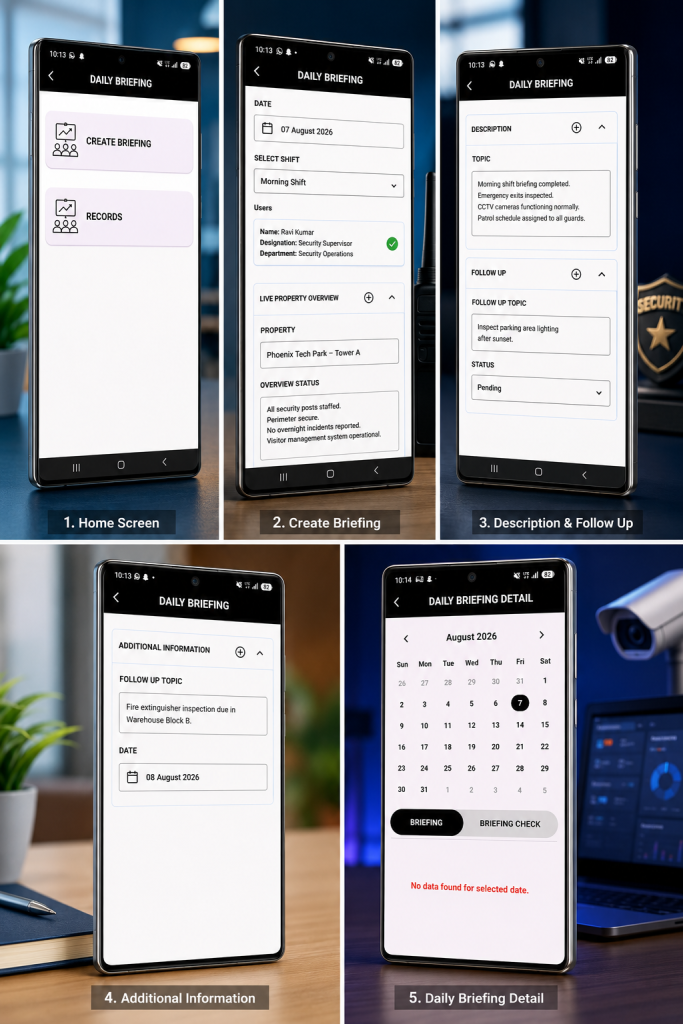
    AVES handles this through its Daily Briefing module. A supervisor creates a briefing, picks the date and shift and pulls in the guards being briefed, role and department shown clearly right there.

    The Live Property Overview section captures site conditions at the exact moment of briefing. The Topic and Description fields capture exactly what got communicated, not a rough memory of it weeks later.

    Follow Up items carry their own status field, so something raised Monday can’t quietly disappear by Friday without anyone catching it. Every briefing logs against a calendar too, so a supervisor can pull up any date and see exactly what got covered,or spot right away when a briefing got missed.

    That last part matters more than people expect. A missed daily briefing is often the first sign of a bigger accountability gap on a site. Catching it early costs a lot less than finding out after something’s already gone wrong.

    What This Looks Like in Practice

    Walk through an actual briefing and the process becomes obvious fast.

    A supervisor opens the Daily Briefing screen and taps Create Briefing. They select today’s date and pick the shift, morning, evening, or night. The relevant guards get pulled in, each one shown with their name, designation, and department, so there is no confusion about who is actually being briefed.

    Next comes the Live Property Overview. The supervisor types in the property, then logs the overview status in plain language, security posts staffed, perimeter secure, nothing unusual overnight. This is the part that replaces a rushed verbal summary with something searchable.

    The Description and Topic fields capture exactly what was communicated that day. If anything needs following up, it goes into Follow Up with its own status, pending, in progress, or resolved, so it does not disappear the moment the shift starts.

    Every entry lands on a calendar. A supervisor can jump back to any date and see exactly what was briefed, or immediately notice a date with no entry at all.

    What Good Actually Looks Like

    A site running a proper daily briefing doesn’t feel more complicated. Honestly, it feels calmer.

    Supervisors stop repeating themselves because everything’s logged and searchable. Guards stop starting shifts blind because today’s conditions are already documented before they even arrive.

    Clients stop asking questions you can’t answer, because you can pull up exactly what got briefed on any given day. That confidence is the real payoff here. Not the process for its own sake.

    Frequently Asked Questions

    What is a daily briefing in security operations?


    A daily briefing is a structured update given to guards before a shift starts, covering site conditions, communication topics and any unresolved follow up items from previous shifts.

    How is a daily briefing different from a shift handover?


    A handover happens between two guards at the point one shift ends and another begins. A briefing happens earlier, usually led by a supervisor and covers the wider site picture rather than a single handoff.

    Why does a daily briefing need to be logged instead of spoken?


    Because a spoken briefing leaves nothing behind. If a follow up item gets missed or a client asks what got communicated on a specific date, there’s nothing to check against without a logged entry.

    What happens to follow up items raised in a daily briefing?


    They carry a status forward until resolved. Not just get mentioned once and forgotten. This is usually where verbal briefings fail the hardest.

    Who is responsible for running the daily briefing?


    Typically a supervisor or shift lead, though the real responsibility is confirming every guard present actually got briefed, not just assuming attendance because they were on site.

    Where This Leaves You

    A daily briefing isn’t another form standing between your guards and their job. It’s the reason guards start each shift knowing today’s actual conditions, instead of carrying yesterday’s assumptions forward out of habit.

    Get it logged properly, tied to date, shift and follow up status and it stops being a hallway conversation nobody can verify. It becomes a record you can actually stand behind when it matters most.

    If you want to see how AVES handles daily briefing, follow up tracking and shift records in one dashboard, visit avessecurity.com and request a demo.

    CONTACT US

    Website : https://www.avessecurity.com

    Linkedin: https://www.linkedin.com/company/aves-security-management-system/

    Instagram: https://www.instagram.com/avessecurity/

  • Security Guard Audit Checklist: What Site Inspectors Actually Check

    Security Guard Audit Checklist: What Site Inspectors Actually Check

    By Nithish, AVES Security

    A security audit checklist is what separates a clean inspection from an awkward one. I’ve sat across the table during audits that went fine and audits that went badly and the difference was almost never the guards. It was the paperwork. An inspector asks for last month’s patrol records and someone digs out a stack of registers a few gaps here, a guessed time there, one page where the ink’s gone faint enough you can’t read it. Nobody’s accusing anyone of skipping rounds. The client just wanted proof and there wasn’t any sitting ready.

    That’s really what a security audit checklist is for. Not “did the guard do the job,” that part’s usually fine, but “can you show someone who wasn’t there that it happened.”

    What is a security audit checklist actually for

    A security audit checklist like this ends up in front of three kinds of people and they’re not all looking for the same thing.

    A client’s compliance officer is checking the contract got delivered right number of patrols, right intervals, incidents logged and closed. A regulator wants to see statutory requirements actually followed, not just claimed on paper. And your own supervisor doing a spot-check is trying to catch a site that’s slipping before the client notices it first.

    Different people, same underlying test though: does this record match something that actually happened and when.

    What a security audit checklist actually covers

    Every site has its own quirks, but pull those aside and most audits client, regulatory, internal, doesn’t matter end up checking the same seven things.

    Attendance and shift coverage. Was someone actually on site every hour they were supposed to be, no unexplained gaps between shifts.

    Patrol completion. Were the rounds walked, in the right order, not just marked done at the end of the night.

    Incident handling. Logged when it happened, escalated if it needed escalating, closed with an actual outcome not left open.

    Key and access control. Who had which key, when they took it, when it came back.

    Visitor and contractor movement. Who came in, when and who approved it?

    Equipment and defect reporting. Faults and damage flagged when they’re found ideally before the client spots them first.

    Training records. Can you actually show who was trained on what and when?

    An inspector isn’t expecting a perfect site. They’re expecting a record for each of those seven, produced without anyone scrambling to reconstruct it from memory the night before.

    Where a security audit checklist usually finds gaps

    It’s rarely the first item that trips a site up. It’s usually somewhere in the middle a patrol that got logged but has no timestamp to prove it was on schedule or a visitor with an entry time and no exit time. Any one of those looks minor on its own. Line up a month of them and that’s the gap between a clean audit and a follow-up visit.

    The worst version of this is when two records that should match don’t. A key register showing a guard holding keys during a shift, the attendance log says they weren’t even on site that’s not a gap, that’s a records problem and it’s a lot harder to explain away than a missing entry.

    How a security audit checklist changes on audit day

    None of this means guards do more work. It means the same seven categories get captured once, when they happen, tied to a timestamp and a name instead of written up later from memory. When a client or regulator wants the last quarter, that’s a filtered report instead of someone flipping through binders looking for the right week.

    It’s the same shift that’s already happened with patrol verification, key custody and occurrence logging on individual sites. A security audit checklist stops being a scramble before an inspection and just becomes a byproduct of the daily paperwork being accurate to begin with.

    Regulatory bodies like ASIS International publish general standards for physical security audits and most client contracts in this space borrow the same core structure coverage, incident handling and access control, at minimum.

    Preparing your security audit checklist before an inspection

    Don’t try to backfill history inspectors can usually tell a record written at the time from one written last week to cover a gap. Better to pull those seven categories from your duty roster and gate pass records for the last thirty days and see where the actual holes are that’s usually where a security audit checklist review starts anyway. Most of the time it’s one or two, not all seven. Fix the process from here, be straight about it if asked and treat the audit as the thing that told you where the weak spot actually was.

    The bottom line on your security audit checklist

    A security audit checklist isn’t a form you fill in before someone visits. It’s a check on whether the records you’re already keeping can stand on their own, without you in the room explaining what really happened. The sites that get through audits without drama aren’t the ones with the thickest file they’re the ones where the paperwork was right the first time it was written.


    Frequently asked questions

    What is a security audit checklist? A security audit checklist is a list of the records and controls an inspector checks to confirm a site’s security operations are actually happening as reported attendance, patrols, incidents, keys, visitor movement, equipment condition and training records.

    Who typically requests a security audit checklist? Three groups usually ask for it: a client’s compliance officer verifying contract terms are met, a regulator or licensing body confirming statutory requirements and a company’s own supervisor running an internal spot-check.

    How often should a security audit checklist be reviewed? Most sites review it monthly at minimum, with a fuller pass before any scheduled client or regulatory audit. Waiting until an audit is announced to check your records usually means finding the gaps too late to fix them.

    What’s the difference between a security audit checklist and a daily guard checklist? A daily guard checklist covers what happens during a single shift gear checks, rounds, handover. A security audit checklist looks backward across a period of time to confirm those daily records are complete, consistent and provable.

    Can a security audit checklist be done digitally instead of on paper? Yes. A digital checklist ties each entry to a timestamp and the person who logged it, which is what most inspectors are actually looking for a record they don’t have to take on trust.

    What happens if gaps show up during a security audit? A gap on its own usually isn’t fatal to an audit. What matters more is whether the company can explain it and show the process has since been fixed, rather than trying to backfill records after the fact.

    For more details visit our website: https://avessecurity.com/

  • Security Post Orders: Fixing the Gap Guards Fall Through

    Security Post Orders: Fixing the Gap Guards Fall Through

    You put real effort into your security post orders. You covered the doors, the contacts, the access rules.

    Then something goes wrong at 2am and the guard on duty had no idea what to do.

    If that sounds familiar, you are not doing anything wrong as a manager. You are running into a problem almost every security company hits. The document exists. It just isn’t working.

    This guide walks through why that happens, what a security post order actually needs to contain and how to fix the gap between “we have post orders” and “guards actually follow them.” No fluff, no generic templates copied from a dozen other sites. Just what actually works on real posts.

    What a Security Post Order Actually Is

    A security post order is not a job description. It is not a duty roster either.

    It is the site-specific instructions for one physical post, at one site, written for the guard standing there right now. Some companies call these security guard post orders instead, but the idea is the same.

    A duty roster tells someone when to show up. A general “security guard duties” page tells them what the role covers everywhere. A security post order tells them what to do at this exact gate, this exact lobby, this exact loading dock.

    That distinction matters more than it sounds like it should. A guard who only knows the generic version of the job fills in every site-specific gap on their own. That is exactly where liability shows up, where clients get frustrated and where incidents happen that could have been avoided with one clear sentence written down in advance.

    Why Most Post Orders Fail Once They’re Written

    Here is the part most guides skip. Writing the security post order is the easy part. Keeping it useful is where almost every site falls apart.

    They go stale fast. A security post order gets written once at site handover. Six months later the client changed the after-hours contact, a door schedule shifted and nobody updated the document. The guard is now working from instructions that describe a site that no longer exists.

    They try to cover everything. A fifteen-page post order feels thorough on paper. In practice, nobody reads fifteen pages in the middle of a shift. Length feels like diligence. It actually kills usability.

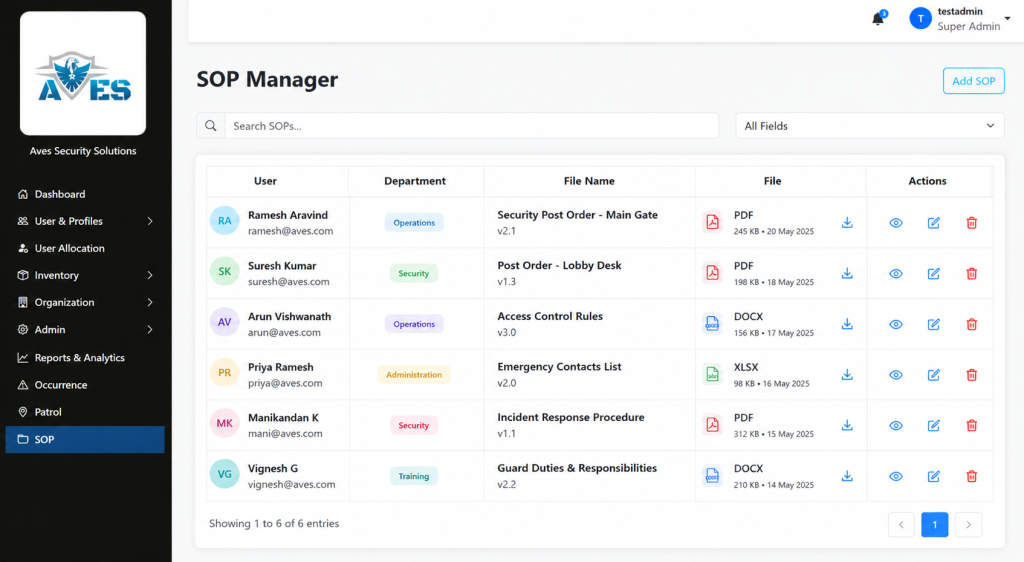
    Nobody owns the update. Ask most operations managers who is responsible for keeping security post orders current and you will get a pause before an answer. Without a named owner, updates happen never.

    There’s no proof anyone read it. A binder in a guard shack does not confirm the current guard has actually seen the current version. That gap is where most “the guard didn’t know” incidents actually start.

    None of this means security post orders are the wrong tool. It means most companies are running a good idea badly.

    The Real Cost of Getting This Wrong

    This is the part that’s easy to underestimate until it costs you a client.

    An outdated post order does not just create confusion. It creates security liability. If a guard follows instructions that no longer match the site and something goes wrong, the paper trail shows your company gave them wrong information. This is also where guard accountability breaks down, because a guard can’t be held to instructions that were never accurate in the first place.

    Turnover makes this worse. New guards rotate through posts constantly in this industry. Every rotation is a moment where an unclear or outdated security post order turns into a real mistake, not a hypothetical one.

    And clients notice. A client who catches a guard not knowing basic site procedure starts wondering what else your company is getting wrong. That is how contracts get lost, not through one dramatic failure but through a slow loss of confidence.

    The Five Things Every Post Order Needs

    Strip away the extras and a security post order that actually works comes down to five parts.

    Post boundaries. What area this post covers and exactly where responsibility hands off to the next post. No gray zones.

    Standing instructions. The default state of the post. Which doors lock on schedule, what routine checks happen without being told.

    Access rules. Who walks through without escort, who signs in, who gets turned away. Spelled out by role, not left to judgment in the moment.

    Emergency contacts. Real names and real numbers for this site. Not a head office line that rings through to voicemail at 3am.

    Exceptions and escalation. What falls outside normal instructions and exactly who to call when something doesn’t match what’s written.

    If a security post order covers those five things clearly, it works. If it tries to cover every hypothetical situation on top of that, it stops getting read.

    How to Write Post Orders Guards Will Actually Follow

    Start from real incidents, not imagined ones. The best security post orders come from actual questions guards have asked at that post, not a template built from a desk somewhere else.

    One instruction, one sentence. If an instruction needs a paragraph to explain, it belongs in training material, not the post order itself.

    Name a person, not a department. “Contact facilities” solves nothing at 2am. A name and a direct number gets a problem handled instead of routed into a voicemail loop.

    Update the moment something changes. Do not wait for an annual review. The day a client changes a rule is the day the security post order should change too.

    Confirm the guard actually read it. This is the step almost everyone skips. A printed page on a wall does not prove anything. Some form of sign-off, even a simple log, closes that gap.

    Paper vs Digital: An Honest Look

    You might be wondering if this even needs software, or if a well-organized shared folder solves the problem.

    Here’s the honest answer. A shared folder fixes the “which version is current” problem. It does not fix the “did the guard actually read it” problem on its own.

    That second gap is where most companies get burned and it’s worth being upfront about the limitation. No system, digital or paper, replaces a supervisor who actually walks the post and checks. Software reduces the risk. It does not eliminate the need for management attention.

    What digital tools genuinely solve well is version control and searchability. One current file per post, tagged by department, findable by name instead of buried in a binder nobody has opened since onboarding.

    That’s the gap most guard instructions software claims to close and most of it doesn’t.

    Where AVES Fits Into This

    AVES has a real, confirmed feature for exactly the version control problem above. It’s called SOP Management and it works as a document repository built for this kind of site procedure. Think of it less as guard instructions software with built-in workflows and more as the single source of truth those instructions need to live in.

    You upload a file, tag it to a user and a department and give it a clear file name. It shows up in a searchable list where anyone can find it by department, username, or file name. Deleting an outdated version takes two confirmation steps, not one accidental click, so an old copy doesn’t disappear by mistake while the current one is still needed.

    To be fully transparent, SOP Management is a document upload and search tool. It is not an interactive checklist builder where guards check off individual steps inside the app. If that’s what you’re picturing, it’s worth knowing that upfront rather than finding out later.

    AVES also has a confirmed Shift Briefing capability, built around guards acknowledging instructions before going on duty, which is the natural next step after centralizing security post orders. The detailed screen-by-screen workflow for that feature isn’t something we can walk you through yet and we’d rather tell you that plainly than describe steps that don’t exist.

    Where to Go From Here

    If your current security post orders are living in a binder or scattered across old email attachments, the fix isn’t complicated. It’s organizational first and tools second.

    Start by naming one owner per site. Then get every current post order into one searchable place instead of several. That single change solves most of the version confusion described above.

    If you want to see how AVES’s SOP Management handles that part, a short walkthrough will show you exactly what it does and, just as importantly, what it doesn’t do yet, so you can decide if it fits how your team actually works.

    A binder guards stop reading is not backup protection. It is a liability sitting quietly on a shelf, waiting for the one shift where it mattered and nobody opened it.

    See how AVES keeps every post order current. Book a quick walkthrough.

    CONTACT US

    Website : https://www.avessecurity.com

    Linkedin: https://www.linkedin.com/company/aves-security-management-system/

    Instagram: https://www.instagram.com/avessecurity/

    What are security post orders, exactly?

    Think of security post orders as the cheat sheet for one specific post, not the whole job. They spell out what a guard does at that particular gate or lobby, down to which doors get checked and who to call if something’s off. A generic job description won’t tell you any of that. Post orders will, or at least they should.

    Aren’t security post orders basically the same as SOPs?

    Not quite. Standard operating procedures cover the big stuff that applies everywhere, like what to do if someone collapses on site. Security post orders are narrower and messier in a good way. They’re written for one post, one set of doors, one set of quirks that only that location has. You need both. One without the other leaves a gap.

    Do I really need to go digital, or can paper work fine?

    Paper can work. It’s just harder to keep straight once you’ve got three shifts and a stack of photocopies floating around. The real problem isn’t paper versus digital. It’s that nobody can tell which copy is the right one. Fix that part and the format matters a lot less.

    Can I just use a post order template for every site?

    A template’s fine for the skeleton, five sections, same structure every time. But the actual content has to be specific to that post. Copy-paste a template with the site name swapped and you’ve basically written nothing useful. Guards can tell the difference immediately.

    Is there software that actually helps manage this across sites?

    Some. though I wouldn’t call it guard instructions software exactly. AVES has an SOP Management feature that at least solves the “which file is current” mess, one document per post, searchable by department or file name instead of buried in someone’s inbox. It won’t replace a supervisor actually walking the post and checking. Nothing does that. But it kills the version-control headache that causes most of these problems in the first place.

  • Deadly Gaps, Proven Fix: Digital Inspection Checklist

    Deadly Gaps, Proven Fix: Digital Inspection Checklist

    You already know the feeling. It’s 6 AM, the shift just changed and somewhere in the back of your mind is a question you don’t want to ask out loud: was the panic button actually tested last night, or did someone just sign the sheet?

    That doubt is exactly why a digital inspection checklist exists and if you’re reading this, you’ve probably already lived through the moment where a paper checklist let you down.

    Maybe it wasn’t a disaster. Maybe it was just a client walkthrough where the emergency phone didn’t ring and the log said it was “checked” three hours earlier. Either way, you felt it. That small, sinking realization that your paperwork and your reality had quietly stopped matching.

    That’s the exact question a digital inspection checklist exists to answer, before a client or an insurer ever has to ask it.

    The Fear Nobody Says Out Loud

    Security operators don’t lie awake worrying about the equipment itself. They lie awake worrying about the gap between what the paperwork says and what actually happened on site.

    A paper form can be filled out from memory at the end of a shift. It can be backdated. It can say “all clear” on a piece of equipment nobody actually walked over to touch. That’s not a guard problem. That’s a systems problem and it’s exactly the gap a digital inspection checklist is built to close.

    If you’ve ever had to explain to a client why a piece of safety equipment failed during the one moment it mattered, you already understand why this matters more than almost anything else on a guard’s shift list.

    What a Digital Inspection Checklist Actually Solves

    Here’s the part most people get wrong when they first look into this. They think a digital inspection checklist is just a fancier form. It isn’t.

    The real value of a digital inspection checklist is the timestamp. A record that gets created the moment a guard is standing in front of a panic button, testing it, not the moment they get back to the desk and remember to write it down.

    That single shift, from memory-based logging to real-time logging, is what makes a digital inspection checklist worth adopting in the first place. It’s not about looking more modern. It’s about closing the exact gap that keeps security managers up at night.

    Six Things That Actually Need Checking, Every Single Shift

    A good digital inspection checklist doesn’t try to cover everything under the sun. It focuses on the equipment that matters most in an actual emergency:

    • Emergency telephones, confirmed operational and connected
    • Emergency doors, checked for unobstructed operation
    • Panic buttons, tested and confirmed active
    • Intercom doors, verified and logged
    • Electromagnetic doors, verified and logged
    • Radios, verified and logged

    Notice what’s on that list. None of it is decorative. Every item is something that, if it fails silently, turns a manageable situation into a genuinely dangerous one.

    This is the part that separates a serious digital inspection checklist from a generic to-do app repackaged for security teams. It isn’t trying to track everything. It’s trying to make absolutely sure the handful of things that matter most never get skipped.

    The Doubt You’re Probably Carrying Right Now

    If you’re evaluating whether to move to a digital inspection checklist, you’re probably carrying a few quiet doubts. Let’s name them honestly instead of pretending they don’t exist.

    “What if my guards just fake the digital version too?”

    Fair concern. The difference is that a digital inspection checklist creates a record that can’t be backdated or edited after the fact the way a paper form can. A guard can still choose not to test a panic button, but they can’t quietly write “9 PM” on a form at 11:45 PM and make it look accurate. The system captures when the entry was actually made.

    “Is this going to be complicated to roll out?”

    This is where a lot of people overthink it. A digital inspection checklist doesn’t require retraining your entire operation. Guards are already doing the physical check. The tool just changes what happens after they touch the equipment, not the check itself.

    “What if the software becomes another thing I have to babysit?”

    This is the most reasonable fear on the list about any digital inspection checklist and it deserves an honest answer, not a sales pitch. Any digital inspection checklist is only as good as whether your team actually opens it every shift. The ones worth choosing are the ones simple enough that a tired guard at 3 AM can use it without friction. That’s the real test, not the feature list.

    What Good Actually Looks Like

    Picture the version of your operation where this works the way it’s supposed to.

    A guard starts their shift. They walk the fixed equipment list, physically testing each item. Each check gets logged the moment it happens, not reconstructed later from memory. By the time your morning report lands, you already know whether every panic button, door and radio on site was actually verified, not just claimed to be verified.

    That’s the entire promise of a digital inspection checklist. Not more paperwork. Less uncertainty.

    When a client asks you to prove equipment was checked before an incident, you’re not scrambling through a filing cabinet. You’re pulling up a timestamped record that speaks for itself.

    Why This Matters More Than It Looks Like It Does

    Most security operators don’t think about equipment checks as a competitive advantage. They think of them as a chore, something guards grumble through because someone above them said it’s required.

    That mindset is exactly what a digital inspection checklist is designed to change. Every completed, timestamped check is proof of due diligence. It’s the difference between a security company that can defend its record in a liability conversation and one that’s hoping nobody ever asks hard questions.

    If you’ve ever felt that quiet unease about whether your equipment checks would actually hold up under scrutiny, that feeling is worth listening to. It’s usually a sign the process, not the guards, needs fixing.

    The Honest Trade-Offs

    No tool solves everything and it would be dishonest to pretend a digital inspection checklist is a silver bullet.

    It doesn’t replace the physical act of checking equipment. A guard still has to walk over and test the panic button. What it changes is whether that action leaves behind proof and whether that proof can be trusted months later when it actually matters.

    It also won’t fix a culture problem on its own. If a team doesn’t take the underlying duty seriously, no piece of software forces genuine diligence. What a digital inspection checklist does is make it much harder to fake diligence that isn’t there, which tends to change behavior on its own over time.

    Where This Leaves You

    If you’ve made it this far, you already know the real question isn’t whether equipment checks matter. You know they do. The real question is whether you can currently prove they’re happening the way your paperwork says they are.

    That’s the exact gap a digital inspection checklist is built to close. Not a bigger to-do list. A record you can actually stand behind.

    You don’t need to overhaul your entire operation to adopt a digital inspection checklist. You need a system that captures the moment a check actually happens, instead of the moment someone remembers to write it down.

    That’s the whole shift. And once you see it working on your own site, it’s hard to imagine going back to a clipboard.

    See how a digital inspection checklist works on a real site → Book a free walkthrough

    CONTACT US

    Website : https://www.avessecurity.com

    Linkedin: https://www.linkedin.com/company/aves-security-management-system/

    Instagram: https://www.instagram.com/avessecurity/

    What equipment actually needs checking every shift?

    That six things and they’re not random.That’s the list. Not because other equipment doesn’t matter, but because these six are the ones you reach for when something’s already going wrong. If they don’t work in that moment, nothing else about your setup matters much.

    Can someone go back and edit an entry after it’s submitted?

    That’s the whole reason to move off paper in the first place.
    A form filled out from memory can say whatever the person writing it wants it to say. A record created the second someone actually tests the panic button can’t be rewritten later to look tidier than reality. That gap between “what happened” and “what got written down” is exactly what this kind of system is built to close.

    How disruptive is it to actually switch over?

    Less than people expect, usually.
    The underlying job doesn’t move an inch. Guards are already walking the site and testing equipment. All that’s really shifting is how that gets recorded. Most teams find their footing within a shift or two, not weeks.

    What if my guards just fake the digital version too?

    Fair concern. The difference is that a digital inspection checklist creates a record that can’t be backdated or edited after the fact the way a paper form can. A guard can still choose not to test a panic button, but they can’t quietly write “9 PM” on a form at 11:45 PM and make it look accurate. The system captures when the entry was actually made.