
Most security companies have something they call a security guard SOP. A folder somewhere. A printed document from three years ago. A WhatsApp message that became the unofficial policy for handling late deliveries.
None of that is a real security guard SOP. And the difference shows up at the worst possible time, usually at 2am when something goes wrong and nobody knows whose call it is to make.
Writing a proper security guard SOP is one of the most practical things a security operation can do. Not because auditors ask for it, but because it’s the only thing that creates consistent behaviour across guards, sites and shifts.
SOP, Post Orders, Duty Roster: They Are Not the Same Thing
This confusion causes real problems, so it’s worth getting it straight before anything else.
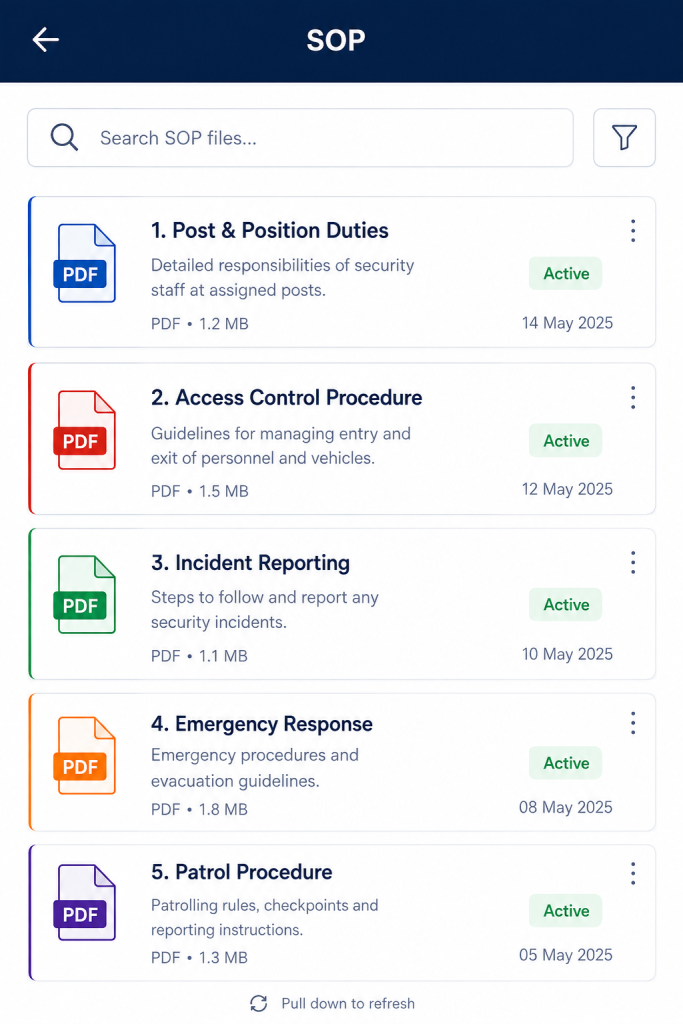
A security guard SOP is the company-wide rulebook. It covers how your operation handles visitor access, vehicle movement, material entry and exit, emergency response and escalation. It applies to every guard, at every site, regardless of who the client is.
According to the ASIS International Security Management Standards, a well-documented SOP is a foundational requirement for any professional security operation seeking to demonstrate compliance and operational consistency.
Post orders are site-specific. They tell a guard what to do at this particular location, which entrance to use, who to call when the client’s alarm triggers and where to park the response vehicle. Post orders sit underneath the SOP, not beside it. We cover this distinction in detail in our guide on security post orders.
A duty roster is just scheduling who is on post, when and where.
If your guards are making judgment calls about visitor handling differently at each site, that’s a missing security guard SOP, not a post orders problem. The SOP is what creates consistency across sites. Post orders handle the exceptions and specifics.
Why Most Security Guard SOPs Don’t Get Used
Walk into most security operations and ask a guard where the SOP is. Watch what happens.
The honest answer is usually “I don’t know” or “I think it’s in the office.” That’s not a staffing problem. It’s a document problem.
Security guard SOPs fail in practice for a few predictable reasons.
They’re written for auditors, not guards. Long paragraphs, legal language, clause references. A guard dealing with a confrontational visitor at 11pm is not reading a policy document.
They cover everything except what actually happens. Three pages on emergency evacuation procedures. Nothing on what to do when a contractor shows up without a pass and gets argumentative about it.
Nobody trained anyone on them. The document exists. The sign-off sheet exists. The actual understanding of what’s in it mostly does not.
A security guard SOP that nobody reads is just a liability document. It proves you wrote something. It doesn’t prove your operation runs by it.
Industry guidance from bodies like the International Foundation for Protection Officers (IFPO) consistently stresses that written procedures only work when guards can actually understand and apply them. In practice, shorter and clearer documents get followed. Long, technical ones get filed and forgotten.
What a Working Security Guard SOP Actually Covers
A functional security guard SOP is shorter than most people write and more specific than most people expect. Here’s what it needs to cover.
Visitor and personnel access. Who gets in, under what conditions, what ID is required, who can authorise entry for someone not on the approved list and what happens when someone refuses to follow the process? Cross-reference this with your visitor pass tracking process to close the loop on unreturned badges.
Vehicle and material movement. How vehicles enter and exit, what documentation is required for materials leaving the site, who approves it and what a guard does when the paperwork is missing or doesn’t match.
Incident response and escalation. What counts as an incident, how it gets reported, who gets called first and at what point the client or emergency services enter the chain. This is the section that matters most during anything serious and it’s the one most often left vague. Your security audit checklist will confirm whether this section holds up under inspection.
Emergency procedures. Fire, medical, security breach, power failure. Separate from incident response, these are the situations where guards need to act before they can think, which means the procedure needs to be memorised, not referenced.
Communication standards. What gets logged, in what format, how quickly. Whether guards use the platform, a radio, a phone call or all three depends on your operation, but the security guard SOP decides it, not individual guards.
How to Write a Security Guard SOP Guards Will Actually Read
Short sentences. Direct language. No paragraph where a numbered list will do.
Write it from the guard’s position, not the manager’s. “When a visitor arrives without a pre-approved pass, do the following” works. “In situations wherein a visitor presents at the access control point without prior authorisation having been obtained” does not.
Test every section against one question: if a guard read only this page and nothing else, would they know what to do? If the answer is no, the section isn’t finished.
Keep the main security guard SOP to the essentials. If you’re writing more than 10-12 pages, you’re probably including things that belong in site-specific post orders instead. A guard should be able to read the SOP in one sitting and come away knowing how the operation works.
Put a version date on it and review it at least once a year. An SOP that nobody has touched since the company started is not a living document. It’s a record of how things worked back then.
Regular reviews matter most in operations with high staff turnover, which is common across the security industry. A procedure written for last year’s team is not the procedure this year’s guards need.
Where AVES Fits Into Your Security Guard SOP
A security guard SOP defines the rules. AVES is how you prove the rules are being followed.
When AVES is configured to match your security guard SOP visitor pass workflows, reflecting your access policy; incident reports capturing the escalation chain your SOP defines; patrol checkpoint sequences matching your coverage requirements the platform stops being just a tool and starts being evidence that the operation runs the way it’s supposed to.
Clients asking for proof of compliance get audit-ready reports pulled from real, timestamped activity. Guards working across multiple sites follow the same procedures because the platform enforces them, not because someone hopes they remembered the training session. You can also tie SOP compliance directly into your daily briefing process so guards are reminded of key procedures at the start of every shift.
The SOP tells your team what good looks like. AVES shows your clients that it happened.
One Thing to Do Before Writing Anything
Before you start drafting, walk one shift at one of your sites and write down every decision a guard makes that isn’t covered by a written rule.
How did they handle the contractor who arrived after hours? What did they do with the delivery that had the wrong paperwork? Who did they call when the client’s contact number went to voicemail?
Those gaps are your security guard SOP. Start there, not with a template you found online.
The best security guard SOP isn’t the most comprehensive one. It’s the one your guards actually know.
FAQ 1
Q: What is a security guard SOP?
A: A security guard SOP (Standard Operating Procedure) is a company-wide rulebook that defines how guards handle visitor access, vehicle movement, incident response and emergency situations. It applies to every guard at every site, regardless of the client.
FAQ 2
Q: What is the difference between a security guard SOP and post orders?
A: A security guard SOP covers company-wide procedures that apply across all sites. Post orders are site-specific instructions for one particular location. The SOP is the rulebook. Post orders are the site-level exceptions underneath them.
FAQ 3
Q: How long should a security guard SOP be?
A: A working security guard SOP should be no longer than 10 to 12 pages. Anything longer usually includes content that belongs in site-specific post orders. Guards need to read and remember it in one sitting not file it away unread.
FAQ 4
Q: What should a security guard SOP include?
A: A security guard SOP should cover visitor and personnel access, vehicle and material movement, incident response and escalation, emergency procedures and communication standards. These five areas cover the decisions guards make every single shift.
FAQ 5
Q: Why do most security guard SOPs fail?
A: Most security guard SOPs fail because they are written for auditors, not guards. They use legal language, cover unlikely scenarios and skip the situations guards actually face. If a guard cannot read it once and know what to do, the SOP needs rewriting.
FAQ 6
Q: How often should a security guard SOP be reviewed?
A: A security guard SOP should be reviewed at least once a year. It should also be updated whenever there is significant staff turnover, a new client site is added or an incident reveals a gap in existing procedures.
FAQ 7
Q: Is a security guard SOP the same as a duty roster?
A: No. A security guard SOP defines how guards carry out their duties. A duty roster is simply a schedule showing who is on post, when and where. The two serve completely different purposes.
FAQ 8
Q: How does software help enforce a security guard’s SOP?
A: Security management software like AVES enforces SOP compliance by timestamping patrol rounds, logging visitor pass activity, capturing incident reports in real time and generating audit-ready PDFs. Instead of hoping guards remember the SOP, the platform builds it into every shift.
FOR MORE DETAILS, VISIT OUR WEBSITE: https://avessecurity.com/https://avessecurity.com/
VISIT OUR LINKEDIN PAGE FOR FUTURE UPDATES:https://www.linkedin.com/company/aves-security-management-system