Category: Incident Management

Incident reporting and response best practices.

  • Fire Watch Log: The Complete Guide to Compliance

    Fire Watch Log: The Complete Guide to Compliance

    I’ve seen fire watch logs handled two completely different ways. One kind gets pulled out during an inspection and the inspector barely glances at it before moving on. The other kind gets picked apart line by line and the facility manager standing there realizes halfway through that they’re in trouble. The difference almost never comes down to bad luck. It comes down to whether the person filling out the fire watch log understood why each line existed in the first place.

    This guide walks through everything you need to know about keeping a compliant fire watch log, not just the checklist version.

    Start with what a fire watch log is actually standing in for

    Every building with a fire suppression system is relying on automation. A sprinkler head senses heat and activates. A detector senses smoke and triggers an alarm. None of that requires a person to notice anything.

    The moment that system goes offline, even temporarily, the building loses that automatic response. A fire watch exists to replace it with a human one. A trained person walks the space, uses their senses instead of a sensor and is ready to pull an alarm or grab an extinguisher if something starts.

    A fire watch log is the only thing that proves that human backup was actually functioning during the gap. Nobody can retroactively prove they were paying attention during a window that’s already passed. The log is the substitute for that proof, which is why an accurate fire watch log matters as much as the watch itself.

    Real scenarios where a fire watch log is required

    It helps to think through actual situations rather than abstract rules.

    A restaurant’s kitchen suppression system needs annual servicing. The technician is on site for four hours doing the inspection and recharge. Depending on local code, that might fall under a window where a fire watch log isn’t required at all, or it might require one if the servicing runs long or if hot cooking equipment stays in use during the work.

    A mid-rise apartment building under construction has framing done on floors one through six, but the standpipe system for the fire department connection isn’t hooked up yet. Workers are doing electrical rough-in with power tools that create sparks near stored lumber. This is a textbook case where a fire watch log isn’t optional, according to guidance published by the National Fire Protection Association on construction and demolition fire safety.

    A hospital wing has its sprinkler system impairment shut down overnight for a valve replacement. Patients are still in adjacent rooms. This is one of the highest scrutiny situations you can be in, because occupant safety concerns stack on top of property concerns and fire marshals tend to inspect a healthcare facility’s fire watch log with a finer comb than almost any other occupancy type.

    A warehouse is hosting a private event with string lighting, a stage and folding chairs set up in a way that partially blocks two of the sprinkler zones. Even though the system is technically operational, the physical obstruction can trigger a fire watch requirement in some jurisdictions because the sprinklers can’t do their job through a blocked zone.

    Each of these looks different on the surface, but the underlying question is the same. Is there a period when the automatic protection can’t do its job and is a fire watch log being kept to document the person filling that gap?

    Getting the trigger conditions right

    This is the part people guess on most often and guessing wrong is expensive in either direction. Assume you need a fire watch log when you don’t and you’re paying for staffing that wasn’t required. Assume you don’t need one when you do and you’re sitting on a violation waiting to be discovered.

    The baseline framework in the US comes from NFPA 1, the Fire Code and NFPA 241, which covers construction and demolition specifically. Both give general guidance on impairment durations and hot work precautions that determine when a fire watch log becomes mandatory. But the actual enforcement sits with your local Authority Having Jurisdiction and that office can be stricter than the NFPA baseline. Some cities require a fire watch log the moment a system goes down, regardless of expected duration. Others give a grace window, commonly four hours, before one becomes mandatory. The U.S. Fire Administration also publishes general fire prevention guidance worth reviewing if you’re setting up a policy for the first time.

    Calling your local fire marshal’s office before starting any impairment work isn’t excessive caution. It’s the only way to know which version of the rule actually applies to your address and which fire watch log requirements apply to your specific occupancy type.

    What the entries in a fire watch log need to contain

    Break this down entry by entry rather than treating it as one lump requirement.

    Timestamp for every single round. If your required interval is 30 minutes, sixteen rounds happen across an eight-hour shift. Sixteen separate timestamps should exist in the fire watch log, not four broad time blocks.

    Signature per entry, not one signature covering the whole log. Individual accountability for each specific round matters if anything is ever questioned later.

    Named locations, specific enough that someone reading the fire watch log later could retrace the exact path. “Checked mechanical room, loading dock and east stairwell” holds up. “Checked building” does not.

    Genuine observations. This is the one people skip the most. If a round was uneventful, write down what was specifically checked and confirmed clear, not just the word “clear.” If something was slightly off, a space heater running unattended, an exit door propped open with a trash can, note it and note what was done about it.

    Equipment status per round or at reasonable intervals depending on your local requirements. Extinguishers present and accessible. Exits unobstructed. Alarm pulls undamaged and reachable.

    Communication method confirmed working. Whoever’s on watch needs an actual way to call for help immediately and that should be verified rather than assumed.

    Irregularities were logged even when nothing came of them. A pattern across several watches, the same door getting propped open every week, a storage area slowly accumulating boxes near a heat source, is often more valuable information in a fire watch log than any single clean round.

    Total watch period start and end times are tracked separately from the individual round timestamps.

    The reason for the watch is documented specifically. A permit number for hot work. A work order number for the impaired system. Vague reasons like “system down” without a reference number make the fire watch log harder to tie back to an actual authorized event.

    Supervisor sign-off at whatever interval your jurisdiction requires, commonly at the end of the shift or the end of the full watch period.

    (Related reading: see our guide on hot work permit requirements and our fire alarm system impairment checklist for related compliance steps.)

    The failure that catches people off guard

    Missing one round doesn’t just cost you that round. It tends to undermine the credibility of the entire fire watch log.

    Picture an eight-hour watch with a required 30-minute interval. If there’s a 90-minute stretch where nothing was logged, an inspector reviewing that fire watch log after an incident isn’t going to read it as “97 percent compliant.” They’re going to read it as evidence that the watch broke down at some point and that undermines the reliability of everything else on the page, even the rounds that were done correctly.

    There’s a second failure that’s less obvious but just as damaging. A fire watch log where every single entry says “all clear” in identical wording, shift after shift, starts to look manufactured rather than lived. Real buildings have small variations. Different foot traffic at different hours. A door that sticks sometimes and not others. Weather affects how a space feels. When a log shows zero variation across dozens of entries, it reads like it was filled out from memory or copied from a previous shift rather than walked in real time and that’s the exact impression that invites deeper scrutiny.

    Paper logs versus digital fire watch log tools, honestly compared

    Paper is nearly free and requires no training. The trade-off is that a paper fire watch log depends entirely on discipline. It is genuinely easy, on a slow overnight shift with nothing happening, to fill in the last three rounds from memory at 2am instead of walking them as they occur. Handwriting inconsistencies, a smudged timestamp, a page that got left in a truck instead of being filed properly, all of these are common paper-specific failures that show up during real audits.

    Digital fire watch log tools timestamp the moment an entry is submitted, which removes the ability to backfill rounds after the fact. Some tools use location verification to confirm the watch person was actually in the area they logged. The Occupational Safety and Health Administration also recommends documented monitoring procedures as part of a broader workplace fire safety program, which digital tools tend to make easier to maintain consistently.

    Neither format automatically wins in an inspector’s eyes. A meticulously kept paper fire watch log beats a careless digital one every time. But digital tools remove a lot of the human shortcuts that create problems, which is why larger facilities and construction sites increasingly default to them.

    What actually happens when a fire watch log falls short

    Fines are the most visible consequence and the range varies enormously by jurisdiction and severity, sometimes a few hundred dollars, sometimes into the thousands for repeat or serious violations.

    Construction sites face something often worse than a fine: a stop-work order. Every day of delay on an active job site can cost far more than any fine attached to the original violation.

    The insurance side tends to be the largest financial risk in the long term. If a fire happens during an impairment period and the fire watch log is missing, incomplete or clearly falsified, the insurer has a real basis to deny the claim outright, which can mean the facility absorbs the full cost of the damage with no coverage at all.

    Whoever supervised the watch can also face personal liability questions, particularly in a case involving injury, where negligence gets examined in detail by investigators and potentially in court.

    And there’s a compounding effect on future inspections. Fire marshals keep records of past violations at a given address and a facility with a documented fire watch log failure tends to get inspected more closely and more often going forward.

    Building a fire watch log system that holds up over time

    None of this requires a complicated system, just a consistent one.

    Pick one format, paper or digital and use it every time without exception. Inconsistency between shifts or between different staff members is where gaps in a fire watch log tend to open up.

    Train the actual watch person on hazard recognition, not just paperwork. Someone who doesn’t know what a fire risk looks like can produce a perfectly formatted fire watch log that misses everything that matters.

    Treat the interval requirement as fixed. If it’s 30 minutes, that stands regardless of how uneventful the shift feels.

    Retain completed fire watch logs for whatever period your local authority requires, commonly one to three years, sometimes longer for higher-risk occupancy types like healthcare or high-rise residential.

    Go back through old fire watch logs periodically instead of only filing them. Recurring small issues across multiple watches are often the earliest warning signs of a bigger hazard forming.

    (For a deeper dive into staff training requirements, see our fire safety training for facility staff guide.)

    A basic fire watch log template

    DateTimeArea CheckedObservationsEquipment StatusWatch Person Signature

    An eight-hour watch with a 30-minute interval should produce sixteen individual rows in the fire watch log, not one summary line at the end of the shift.

    Common questions people ask about fire watch logs

    Does a fire watch need to be a dedicated person or can existing staff rotate through it? This depends on your local code and the specific situation. Some jurisdictions allow existing staff to take on the role as long as they’re properly trained and it doesn’t pull them away from other safety duties. Others require a dedicated person with no other responsibilities during the watch. Check with your AHJ before assuming either way.

    How long does a fire watch log need to be kept after the watch ends? Most jurisdictions require one to three years, but certain occupancy types, especially healthcare and high-rise residential, sometimes require longer. Confirm with your local authority rather than assuming a standard timeframe applies everywhere.

    Can a fire watch log be handwritten and still hold up during an audit? Yes, as long as it’s filled out accurately and in real time. Handwritten fire watch logs are only a problem when they show signs of being filled out after the fact, inconsistent handwriting, timestamps that don’t match a plausible sequence of events or gaps that suggest rounds were skipped.

    What’s the difference between a fire watch log for an impaired system and one for hot work? An impairment fire watch log covers a period when an automatic system, sprinklers or alarms are offline. A hot work fire watch log covers the period during and often after welding, cutting or similar work, since sparks and heat from that work can ignite something nearby well after the actual work has stopped. The reason for the watch should always be documented clearly since the two situations sometimes carry different durations and monitoring requirements.

    Where this leaves you

    The rules themselves aren’t complicated once you’ve walked through them. What actually separates a fire watch log that holds up from one that falls apart under review comes down to the same handful of details every time. A real timestamp on every round. Observations that describe what was actually checked instead of a repeated phrase. Discipline to keep the intervals consistent even on the quietest shift of the month.

    Get those right and your fire watch log does its job the one time it’s actually needed. Skip them and you end up with a stack of paper that looks like compliance from a distance but won’t hold up the moment someone actually reads it closely.

    For information, visit our website https://avessecurity.com/

    FAQ

    How long does a fire watch log need to be kept after the watch ends? Most jurisdictions require one to three years, but certain occupancy types, especially healthcare and high-rise residential, sometimes require longer. Confirm with your local authority rather than assuming a standard timeframe applies everywhere.

    Can a fire watch log be handwritten and still hold up during an audit? Yes, as long as it’s filled out accurately and in real time. Handwritten fire watch logs are only a problem when they show signs of being filled out after the fact, inconsistent handwriting, timestamps that don’t match a plausible sequence of events, or gaps that suggest rounds were skipped.

    What’s the difference between a fire watch log for an impaired system versus one for hot work? An impairment fire watch log covers a period where an automatic system, sprinklers or alarms, is offline. A hot work fire watch log covers the period during and often after welding, cutting, or similar work, since sparks and heat from that work can ignite something nearby well after the actual work has stopped. The reason for the watch should always be documented clearly since the two situations sometimes carry different duration and monitoring requirements.

    How often does a fire watch log need to be filled out? Most codes require a new entry every 30 minutes, though some higher-risk occupancies or more severe impairments call for more frequent rounds, sometimes every 15 minutes. The exact interval depends on your local fire code and the nature of the hazard, so confirm with your AHJ rather than assuming 30 minutes applies universally.

    Who is legally responsible if a fire watch log is incomplete or inaccurate? Responsibility typically falls on whoever was assigned to conduct the watch, along with the supervisor or facility manager who signed off on it. In serious incidents, both parties can face liability questions, which is part of why signature and sign-off requirements exist at multiple levels of the log.

    Does a fire watch log need to be notarized or certified in any way? Generally no. A fire watch log doesn’t need notarization, but it does need to be signed by the person conducting each round and typically countersigned by a supervisor. Some jurisdictions may require the log to be available for review by the fire marshal on request, but formal certification isn’t standard practice.

    Can one person cover a fire watch for multiple buildings or zones at once? This depends entirely on local code and the size and layout of the area involved. Some jurisdictions allow one person to cover multiple adjacent zones if they can complete the required rounds within the mandated interval. Others require a dedicated watch per building or per zone, especially in higher-risk occupancies. Never assume one person can cover more ground than the interval realistically allows.

    What’s the difference between a fire watch log and a fire watch permit? A fire watch permit is often issued alongside a hot work permit and authorizes the watch to take place, sometimes required before work can even begin. A fire watch log is the ongoing record of what happened during that authorized watch period. Some jurisdictions require both, so check whether your permit process and your logging requirements are handled by the same office or separately.

    Do fire watch log requirements apply to residential buildings, or just commercial ones? Fire watch requirements can apply to residential buildings too, particularly high-rise apartments or buildings undergoing construction or major system impairment. Occupied residential buildings often face stricter scrutiny because life safety concerns are higher, so don’t assume residential properties are exempt just because they aren’t commercial or industrial.

    What should happen if a hazard is discovered during a fire watch round? The immediate priority is addressing the hazard directly, whether that means removing a combustible item, correcting a propped-open door, or in a serious case, evacuating and calling emergency services. The fire watch log should document what was found, what action was taken, and the time it happened. A hazard that gets fixed but never logged leaves no record that the watch was actually doing its job.
  • Emergency Response Plan: What It Is, the Template, and How to Prove It Worked

    Emergency Response Plan: What It Is, the Template, and How to Prove It Worked

    An emergency response plan is a written procedure that tells everyone on a site exactly what to do the moment an emergency is declared — who takes command, which teams are called, which emergency services are contacted, and how each step is recorded. It turns a panic moment into a rehearsed, accountable sequence instead of a scramble.

    When an emergency is called on a guarded site — a fire, a medical collapse, an intruder, a bomb threat — the difference between a controlled response and chaos is almost never courage. It is whether an emergency response plan existed, whether the people on shift knew it, and whether anyone recorded what actually happened. This guide covers what an emergency response plan is, what belongs in the template, the codes that trigger it, and where the traditional paper process quietly fails.

    Why sites need an emergency response plan

    Emergencies are rare and high-stakes, which is the worst possible combination for improvised decisions. The guard on duty at 2am may never have handled a real fire evacuation. Under pressure, people forget steps, call the wrong number, or wait for someone else to take charge.

    An emergency response plan removes that guesswork. It pre-decides, in calm conditions, who does what: who declares the emergency, who takes command, which internal teams mobilise, which outside services are called, and who logs the timeline. On the night, nobody has to invent a process — they follow one.

    What is an emergency response plan?

    An emergency response plan is a formal, site-specific procedure for handling defined emergency scenarios. It is not a generic safety poster. A proper plan ties five things together:

    1. The triggers — the emergency codes or scenarios the plan covers.
    2. The command structure — who runs the response (the command centre) and who reports to whom.
    3. The teams — the emergency response team (ERT) and crisis management team (CMT), and who is on each.
    4. The external contacts — ambulance, police, and fire, and who calls them.
    5. The record — how each activation is logged, minute by minute, for the after-action review.

    Drop any one of those and the plan stops being operational and becomes a document nobody can act on.

    Emergency codes: the triggers that start the plan

    Many sites use colour or word codes so that an emergency can be declared quickly and consistently, without broadcasting alarming detail to the public. Codes vary by organisation and country, so the plan must define them for that site. Common examples include a code for fire, one for a medical emergency, one for an active threat or intruder, one for evacuation, and one for a bomb threat.

    The point of a code is speed and clarity: a single announced code should map to one specific, rehearsed response in the plan. If your team cannot say what each code means and what it triggers, the codes are decoration, not a system.

    The emergency response plan template

    A workable emergency response plan template covers, at minimum:

    • Scope and codes — which scenarios and codes the plan covers for this specific site.
    • Command centre — where response is coordinated from, and who leads it.
    • Response teams — the ERT and CMT rosters: names, roles, and contact details.
    • Notification sequence — who is informed internally, and in what order.
    • Emergency services — which services are called, by whom, and the arrival details recorded on the day.
    • Evacuation and assembly — routes, muster points, and roll-call responsibility.
    • The activation log — a running, timed narration of what happened, who did what, and when.
    • Stand-down and review — how the emergency is closed and what the after-action review must capture.

    Where the paper process breaks down

    The plan concept is sound. The paper version is where it fails when it matters most:

    • The plan is in a binder no one opens. A response plan filed on a shelf is not a plan the 2am guard has rehearsed.
    • No live activation record. During the event, nobody is writing down times; the timeline is reconstructed afterwards from memory, which auditors and insurers distrust.
    • Rosters go stale. The ERT list names people who left months ago, with old phone numbers.
    • No accountability trail. “When did we call the ambulance?” and “who took command?” too often end in a shrug.

    An emergency handled without a recorded activation is, when an investigator or insurer asks what happened, very hard to defend.

    Managing code activation digitally

    Related reading: keep the plan rehearsed with fire drill and safety drill management.

    This is where a digital workflow closes the gaps a binder leaves open. In AVES, a Code Activation report runs as a structured, tracked record rather than notes on a clipboard:

    • The activation is coordinated from a defined command centre, captured on the report.
    • The ERT and CMT rosters are recorded against the activation, so it is clear who was mobilised and in what role.
    • Emergency service arrivals — ambulance, police, and fire — are logged with their arrival details as the event unfolds.
    • A running narration captures the sequence of what happened and when, so the timeline is written during the response, not reconstructed from memory afterwards.

    The point isn’t software for its own sake. It’s that the accountability a serious incident demands — who took command, when each service arrived, what was done in what order — becomes a record you can actually produce, on demand, months later when someone asks.

    Common mistakes to avoid

    1. Writing the plan and never drilling it. A plan the team has never rehearsed will not survive first contact with a real emergency. Pair it with scheduled drills.
    2. Undefined or inconsistent codes. If different shifts read the same code differently, the code is a liability, not a shortcut.
    3. Stale rosters. An ERT list that names people who have left is worse than no list, because it wastes time on the night.
    4. No live log. Reconstructing the timeline after the fact is exactly what auditors and insurers distrust. Capture it as it happens.
    5. No after-action review. An activation with no review teaches the team nothing and repeats the same gaps next time.

    Frequently asked questions

    What is an emergency response plan?

    A written, site-specific procedure that defines what to do when an emergency is declared — who takes command, which teams mobilise, which emergency services are called, and how each step is recorded — so the response is rehearsed rather than improvised.

    What should an emergency response plan include?

    At minimum: the scenarios and codes it covers, the command structure, the ERT and CMT rosters, the emergency-service notification sequence, evacuation and assembly arrangements, and a timed activation log with an after-action review.

    What are emergency codes?

    Short colour or word codes used to declare a specific type of emergency quickly and consistently. Codes vary by organisation and country, so each site’s plan must define what every code means and the response it triggers.

    How often should an emergency response plan be reviewed?

    Whenever the site, team, or risks change, and after every drill or real activation. Rosters and contact details in particular should be checked regularly so they are current on the night.

    Do I need software for an emergency response plan?

    No — the requirement is the plan and the drills behind it, which can be done on paper. A digital record mainly helps during and after an activation, where capturing a timed log of command, teams, and emergency-service arrivals is hard to do reliably on a clipboard.

    Running guarded sites where an emergency could be called on any shift, and you cannot prove afterwards exactly what happened? See how AVES turns code activation into a tracked, auditable record — command centre, response-team rosters, and timed emergency-service arrivals. Book a 30-minute demo and we’ll walk you through the actual Code Activation screen — or start a free trial.

  • CCTV Investigation Management: Stop Guessing, Start Proving

    CCTV Investigation Management: Stop Guessing, Start Proving

    The footage exists. The proof doesn’t

    Someone pulls the camera footage. Watches it. Confirms what happened.

    Then, three months later, a client calls asking for the investigation report. And nobody wrote one. There’s a guard who half remembers what the clip showed and that’s about it.

    That gap, between “we checked” and “we can prove we checked,” is where a lot of security companies get burned. It rarely has anything to do with camera quality.

    Footage was never the whole story

    Cameras record what happened. They don’t record what your team did about it once they saw it.

    Most operators don’t feel that distinction until they’re sitting across from a lawyer or an upset client, being asked for documentation nobody ever created.

    CCTV investigation management exists for exactly this gap. It doesn’t make the camera see more. It documents what happens after someone reviews the footage.

    What skipping the paperwork actually costs you

    An undocumented investigation is, legally speaking, close to no investigation at all.

    Say your team watched the footage, reached a conclusion and acted on it. If none of that got written down, you have nothing to show when someone challenges your version of events six months later.

    That’s the gap CCTV incident review software closes. Not extra admin for its own sake. The difference between “we handled it” and being able to prove you handled it.

    What this module actually does (and doesn’t)

    Worth being blunt about the terminology here, because it gets murky fast.

    This isn’t camera hardware. It isn’t a live monitoring dashboard. It isn’t a place to store footage files. Those live in a completely different system. If someone tries to sell you “CCTV investigation management” that turns out to be a video player with a new label slapped on it, that’s not the same thing and it’s worth walking away from.

    Real video investigation management gives you a record built around three things: who reviewed the footage and when, what they actually found in their own words and what got done about it afterward.

    Drop any one of those three and you’re right back to relying on someone’s memory. Which is the exact problem this exists to solve.

    A memory and a group chat isn’t a system

    Here’s roughly how it goes without a formal process. Supervisor asks in a group chat if anyone checked the footage. Someone replies “yeah, looked fine.” That reply is the entire record, forever, unless someone screenshots it.

    Surveillance investigation tracking swaps that out for something a client or a legal team can actually sit down and review. Every check gets logged, found something or not, because a blank spot and a checked-and-cleared entry look identical from the outside. Only one of those actually protects you.

    The mistake almost everyone makes

    Teams tend to only log a review when the footage turns up something. Feels efficient at the time.

    It’s a trap. If a dispute comes up later about an incident where the footage was checked and nothing was there and there’s no record anyone looked, you’re standing in the exact same spot as if you’d never reviewed it at all. Good CCTV evidence trail practice means logging the review itself, not just whatever it happened to find.

    Where this fits next to your broader investigation record

    Worth being clear about one thing before going further. If you’re centralizing patrols, incident reports and retrieval speed across an entire investigation, that’s a different piece of ground, already covered in our security investigation timeline guide.

    What’s covered here is narrower and doesn’t overlap with that. This is specifically about the footage review itself: who watched it, what they found and whether that got written down anywhere at all. A site can have a perfectly centralized investigation system and still have zero record of who checked a specific camera on a specific night. That gap is what this piece is about.

    Who actually asks to see this record

    Easy to assume this stuff only matters if there’s ever a lawsuit. That’s only half of it.

    Clients ask for this more than you’d think, usually right after a disputed incident, a theft claim, or a complaint about how something got handled on their site. Handing over a clean, timestamped investigation record on the spot is a very different conversation than “let me check with the team and get back to you.”

    Insurance reviews and compliance audits want the same thing. A documented CCTV evidence trail isn’t just insurance against the worst-case scenario. It’s part of what makes a client renew your contract, because it shows exactly how seriously incidents on their site get treated.

    Making this a habit instead of an afterthought

    The teams that stick with this aren’t running the fanciest software. They’ve just made logging a review as automatic as writing up an occurrence log entry.

    A few things that help:

    • Log the review the same day. Details blur fast once a week’s gone by.
    • Write findings in plain language, not shorthand only the reviewer understands. Someone else may need to read it months later.
    • Attach a name and a timestamp to every review, no exceptions.
    • Spot-check the log occasionally, the way you’d spot-check patrol records, before a client or a lawyer does it for you.

    None of that needs new hardware or a change to how footage actually gets watched. It just means treating the review as worth writing down, every time, not only on the days something goes wrong.

    How to pick a system that holds up under pressure

    You don’t need the platform with the longest feature list. You need one that produces a clean, defensible record without slowing down a busy shift.

    Before committing to anything, check for:

    1. A logged review event, kept separate from the finding, so “we checked” and “we found something” are two distinct, timestamped facts.
    2. Free-text findings instead of a dropdown, because real investigations rarely fit a preset menu of options.
    3. A link back to the related incident, so the CCTV review connects to the bigger record instead of sitting off on its own.
    4. Search that actually works, so a legal request six months from now doesn’t turn into a scavenger hunt through old files.

    If a platform can’t manage those four cleanly, nothing else on its feature list matters yet.

    What actually changes once this is in place

    How your team watches footage doesn’t change. They still pull the clip, still review it, still form a conclusion.

    What changes is that the review stops living only in someone’s memory. It becomes a record, with a name and a time and a finding attached, the same way a solid incident report or occurrence log already works.

    That’s really the whole value of proper video investigation management. It doesn’t make your cameras any smarter. It makes your team’s diligence something you can actually point to.

    What this looks like on an actual shift

    Picture a fairly ordinary Tuesday. A tenant reports something missing from a storage area and a guard pulls two hours of footage from the corridor camera to check.

    Nothing turns up. No one enters the room during the window in question. The guard closes the laptop and moves on, because as far as they’re concerned, the question’s been answered.

    Six weeks later, the tenant escalates the claim to their insurer and the insurer wants to know exactly what your team did to investigate. Without a logged entry, the honest answer is “someone looked and don’t remember what they saw.” With CCTV investigation management in place, the answer is a dated record showing who reviewed the footage, the exact window covered and the finding of no activity.

    That single logged entry, taking under two minutes to write at the time, is the difference between a claim your team can close and one that drags on because nobody can prove the review happened. This is really what surveillance investigation tracking is for. Not the dramatic cases where footage clearly shows something. The quiet ones, where nothing happened and proving that took actual work.

    It’s also worth remembering CCTV investigation management sits next to, not inside, your incident reporting record. A footage review might support an incident, or it might stand entirely on its own, the way this storage room example does. Either way, it deserves its own entry.

    The bottom line

    Your cameras were never the weak point. The missing record of what your team did with what they saw always was.

    CCTV investigation management, real CCTV incident review software and a documented CCTV evidence trail turn “we checked the footage” from a claim into something you can actually back up. It’s not a bigger promise than your team can keep. It’s proof that the work you were already doing finally has a paper trail behind it.

    Want to see what a documented investigation record actually looks like in practice? Book a walkthrough and we’ll show you.

    CONTACT US

    Website : https://www.avessecurity.com

    Linkedin: https://www.linkedin.com/company/aves-security-management-system/

    Instagram: https://www.instagram.com/avessecurity/

    Does CCTV investigation management include live camera monitoring?

    No. It’s a record-keeping layer for documenting footage reviews and findings. Live camera feeds and monitoring dashboards live in a separate system entirely.

    How is this different from incident reporting?

    Incident reporting is the central record of the incident itself. CCTV investigation management documents the footage review tied to that incident specifically, including who checked it and what they found.

    Should we still log it if the footage never shows anything unusual?

    Yes, if anything that matters more. A “reviewed, no findings” entry is exactly what proves due diligence later, when someone questions whether the footage was ever checked at all.

    How much time does surveillance investigation tracking really add to a shift?

    A couple of minutes to log a review. Compare that to the hours it takes to reconstruct an undocumented investigation after the fact and it’s not close.

  • Security Supervisor Daily Report: 5 Proven Ways to Roll Up Every Site Without Missing a Thing

    Security Supervisor Daily Report: 5 Proven Ways to Roll Up Every Site Without Missing a Thing

    By Nithish, AVES Security Management.

    Here is something nobody tells you when you move from guard to supervisor.

    The job does not get harder because of the sites. It gets harder because of the paperwork that is supposed to make sense of them.

    A guard has one shift to account for. You have five sites, twelve guards, three client contacts who want updates by 8am and a pile of daily reports that all look slightly different because nobody agreed on a format when the company started.

    The security supervisor daily report is supposed to solve that. Most of the time, it just adds to the pile. Getting the security supervisor daily report right is not about working harder; it is about knowing what the report is actually for and building it the right way from day one.


    Nobody Taught You This Part

    When you were a guard, your daily activity report covered your shift. Your post, your patrols, your incidents. Simple enough.

    The moment you became a supervisor, the expectation changed. Now you are supposed to produce a security supervisor daily report that covers everything across every site, makes sense to a client who was not there and still lands in the inbox before the next shift starts.

    What most supervisors actually do is stitch together bits from each guard’s report, add a few lines at the top and call it done. That is not a supervisor’s report. That is a compilation. And there is a real difference between the two.

    A compilation tells you what happened. A proper security supervisor daily report tells you what mattered, who is handling it and what tomorrow looks like because of it.

    According to ASIS International, documented supervisor oversight is one of the core requirements for security operations seeking compliance certification. A daily roll-up that covers exceptions, actions and outcomes is the practical version of that requirement.


    What the Security Supervisor Daily Report Is Actually For

    Before fixing the format, get clear on who reads this and what they need from it.

    Your operations manager needs to know if anything blew up overnight and whether it is handled. They do not want to read six pages to find out.

    Your client needs to know their site was covered, that anything unusual was caught and that someone is on top of it. They are not interested in what happened at your other accounts.

    You need a record that protects you if something from last Tuesday becomes a legal question next month.

    One security supervisor daily report has to serve all three purposes. That is why the format matters more than most supervisors think. You can read more about how shift-level records connect to the supervisor roll-up in our guide on the security daily activity report.


    1. Lead With What Went Wrong, Not What Went Right

    Most security supervisor daily reports are written like everything is fine until you get to the part where it was not.

    Flip that. Open with anything that broke pattern today. A guard who did not show. A checkpoint that was skipped. An incident is still open. A piece of equipment that was flagged and not yet fixed.

    If there is nothing in that list, say so in one line and move on. If there is something, it goes first. Not because you want to lead with bad news, but because that is what everyone reading the report actually needs to know.

    Burying a problem in paragraph four of the Site 3 section is how things get missed. A client who skims the security supervisor daily report, which most of them do, should not have to hunt for the part that affects them.

    The International Foundation for Protection Officers notes that supervisor reporting failures are most commonly traced back to poor prioritisation critical information buried behind routine updates rather than leading the document.


    2. Write by Site, Not by Guard

    This one sounds obvious, but almost nobody does it right.

    A well-structured security supervisor daily report is organised by site, not by individual guard. If you manage fifteen guards across five sites, you do not write fifteen summaries. You write five. One per site, covering the same four things each time: who showed up, whether patrols were completed, what incidents occurred and what is still open from a previous day.

    That structure means anyone reading the security supervisor daily report can go straight to the site they care about. It also means you stop spending time on guard-level detail that belongs in the individual DAR, not in your roll-up. For a clear picture of what belongs in a guard-level DAR versus a supervisor report, see our breakdown of shift handover checklists.

    A client managing a logistics warehouse does not need to know that the guard on the night shift at your retail account went home early. They need to know what happened at their site. Keep it that way.


    3. Every Problem Needs an Owner

    A security supervisor daily report that lists problems without saying who is fixing them is just a complaint log.

    For every open item, put one line underneath it. Who is handling it and when will it be resolved?

    That is it. No long explanation. No defensive justification. Just accountability in writing.

    When you do this consistently, two things happen. Clients stop asking follow-up questions because the answer is already there. And your own team gets used to the idea that if something is flagged in the security supervisor daily report, someone’s name goes next to it.

    That is how you stop the same problem from appearing in the report three days in a row with no movement.


    4. The Client Version Is Not the Same as Your Internal Version

    Everything goes in the internal security supervisor daily report. Guard performance issues, roster gaps, operational problems across accounts, anything you need for your own records.

    The client gets a filtered version. Their site, their coverage, their incidents and the resolution timeline for anything that affected them. Nothing about your other accounts. Nothing about internal staffing conversations.

    This is not about hiding things. It is about relevance. A client reading a security supervisor daily report, full of information about accounts they have nothing to do with, stops trusting that you know what is important.

    With AVES, this is not a manual process. The supervisor sees everything across all sites in the dashboard. The client report pulls only what is relevant to them and exports as a PDF. You are not rewriting the report. You are just choosing who sees which part of it. The same approach applies when you structure your daily briefings: internal detail stays internal, client communication stays clean.


    5. The Report Is Only as Good as the Data Going Into It

    This is the part most people do not want to hear.

    If your guards are filling in their daily reports at the end of a twelve-hour shift from memory, your security supervisor daily report is built on guesswork. Times get rounded. Small things that happened at 3am do not make it in because nobody wrote them down when they happened.

    When entries are logged in real time, patrol rounds are confirmed by checkpoint scanning, incidents are recorded on the spot with a photo and visitor passes are entered at the gate rather than remembered later, the roll-up you build from that is accurate. Not approximately accurate. Actually accurate.

    A client who asks what happened at 2am on a specific night gets a timestamped answer from a live record, not a best reconstruction from a tired guard’s memory. That difference is the entire reason digital reporting exists.

    The Security Industry Association consistently highlights real-time data capture as the single biggest driver of reporting quality in modern security operations. Use it.


    One Last Thing

    The security supervisor daily report does not have to take an hour every day. With the right structure and real-time data feeding it, ten minutes is realistic.

    What a good security supervisor daily report has to do is give the people reading it exactly what they need, without making them dig for it. That is not a complicated ask. It just requires being deliberate about what goes in, what gets left out and who the security supervisor daily report is actually written for.

    Get that right and the report stops being the part of the job you resent. It becomes the thing that proves you are on top of it.

    Q: What is a security supervisor daily report?
    A: It is the end-of-day document a supervisor puts together covering every site they are responsible for. Not a copy of the guard reports. A review of what happened, what needs attention and who is handling what. Think of it as the view from one level up.


    Q: How is it different from a guard’s daily activity report?
    A: A guard writes about one shift at one site. A supervisor writes about all shifts across all sites. Same day, completely different scope. If you are just forwarding guard reports to a client, that is not a supervisor report. That is just email forwarding.


    Q: How long should it be?
    A: Long enough to cover what matters, short enough that someone actually reads it. Most well-run operations land between one and two pages. If yours is running five or six pages every day, you are including things that do not belong in a supervisor-level document.


    Q: How often should a security supervisor daily report be submitted?
    A: Every day. Not when something happens. Not when a client asks. Every day, whether the shift was quiet or chaotic. A report that only appears when something went wrong is not a reporting system. It is damage control.


    Q: Do clients get the same report as internal management?
    A: They should not. Internal reports carry everything: staffing issues, performance notes and problems across other accounts. Clients only need to know about their site. Their coverage, their incidents, anything open that affects them. Mixing the two in one document is how you create confusion and erode trust.


    Q: What is the biggest reason supervisor reports fail?
    A: The data going into them. A report built from guard entries that were filled in from memory at the end of a twelve-hour shift is not accurate. It is the best guess written when everyone is tired. Real-time logging fixes this. Not partially, completely.


    Q: Can software actually help with this or is it just another tool to manage?
    A: Depends on the software. If it just stores reports digitally, it saves paper and not much else. If it timestamps entries as they happen, confirms patrol rounds through checkpoint scanning, and lets you generate a client-facing PDF without rewriting everything manually, it saves real time and produces a report you can actually stand behind when a client asks a hard question.

    FOR MORE INFORMATION, VISIT OUR WEBSITE: https://avessecurity.com/

    NEED FASTER UPDATES FOLLOW US ON LINKEDIN: https://www.linkedin.com/company/aves-security-management-system

  • Security Guard SOP: Stop Writing Useless Procedures That Every Guard Ignores

    Security Guard SOP: Stop Writing Useless Procedures That Every Guard Ignores

    Most security companies have something they call a security guard SOP. A folder somewhere. A printed document from three years ago. A WhatsApp message that became the unofficial policy for handling late deliveries.

    None of that is a real security guard SOP. And the difference shows up at the worst possible time, usually at 2am when something goes wrong and nobody knows whose call it is to make.

    Writing a proper security guard SOP is one of the most practical things a security operation can do. Not because auditors ask for it, but because it’s the only thing that creates consistent behaviour across guards, sites and shifts.

    SOP, Post Orders, Duty Roster: They Are Not the Same Thing

    This confusion causes real problems, so it’s worth getting it straight before anything else.

    A security guard SOP is the company-wide rulebook. It covers how your operation handles visitor access, vehicle movement, material entry and exit, emergency response and escalation. It applies to every guard, at every site, regardless of who the client is.

    According to the ASIS International Security Management Standards, a well-documented SOP is a foundational requirement for any professional security operation seeking to demonstrate compliance and operational consistency.

    Post orders are site-specific. They tell a guard what to do at this particular location, which entrance to use, who to call when the client’s alarm triggers and where to park the response vehicle. Post orders sit underneath the SOP, not beside it. We cover this distinction in detail in our guide on security post orders.

    A duty roster is just scheduling who is on post, when and where.

    If your guards are making judgment calls about visitor handling differently at each site, that’s a missing security guard SOP, not a post orders problem. The SOP is what creates consistency across sites. Post orders handle the exceptions and specifics.

    Why Most Security Guard SOPs Don’t Get Used

    Walk into most security operations and ask a guard where the SOP is. Watch what happens.

    The honest answer is usually “I don’t know” or “I think it’s in the office.” That’s not a staffing problem. It’s a document problem.

    Security guard SOPs fail in practice for a few predictable reasons.

    They’re written for auditors, not guards. Long paragraphs, legal language, clause references. A guard dealing with a confrontational visitor at 11pm is not reading a policy document.

    They cover everything except what actually happens. Three pages on emergency evacuation procedures. Nothing on what to do when a contractor shows up without a pass and gets argumentative about it.

    Nobody trained anyone on them. The document exists. The sign-off sheet exists. The actual understanding of what’s in it mostly does not.

    A security guard SOP that nobody reads is just a liability document. It proves you wrote something. It doesn’t prove your operation runs by it.

    Industry guidance from bodies like the International Foundation for Protection Officers (IFPO) consistently stresses that written procedures only work when guards can actually understand and apply them. In practice, shorter and clearer documents get followed. Long, technical ones get filed and forgotten.

    What a Working Security Guard SOP Actually Covers

    A functional security guard SOP is shorter than most people write and more specific than most people expect. Here’s what it needs to cover.

    Visitor and personnel access. Who gets in, under what conditions, what ID is required, who can authorise entry for someone not on the approved list and what happens when someone refuses to follow the process? Cross-reference this with your visitor pass tracking process to close the loop on unreturned badges.

    Vehicle and material movement. How vehicles enter and exit, what documentation is required for materials leaving the site, who approves it and what a guard does when the paperwork is missing or doesn’t match.

    Incident response and escalation. What counts as an incident, how it gets reported, who gets called first and at what point the client or emergency services enter the chain. This is the section that matters most during anything serious and it’s the one most often left vague. Your security audit checklist will confirm whether this section holds up under inspection.

    Emergency procedures. Fire, medical, security breach, power failure. Separate from incident response, these are the situations where guards need to act before they can think, which means the procedure needs to be memorised, not referenced.

    Communication standards. What gets logged, in what format, how quickly. Whether guards use the platform, a radio, a phone call or all three depends on your operation, but the security guard SOP decides it, not individual guards.

    How to Write a Security Guard SOP Guards Will Actually Read

    Short sentences. Direct language. No paragraph where a numbered list will do.

    Write it from the guard’s position, not the manager’s. “When a visitor arrives without a pre-approved pass, do the following” works. “In situations wherein a visitor presents at the access control point without prior authorisation having been obtained” does not.

    Test every section against one question: if a guard read only this page and nothing else, would they know what to do? If the answer is no, the section isn’t finished.

    Keep the main security guard SOP to the essentials. If you’re writing more than 10-12 pages, you’re probably including things that belong in site-specific post orders instead. A guard should be able to read the SOP in one sitting and come away knowing how the operation works.

    Put a version date on it and review it at least once a year. An SOP that nobody has touched since the company started is not a living document. It’s a record of how things worked back then.

    Regular reviews matter most in operations with high staff turnover, which is common across the security industry. A procedure written for last year’s team is not the procedure this year’s guards need.

    Where AVES Fits Into Your Security Guard SOP

    A security guard SOP defines the rules. AVES is how you prove the rules are being followed.

    When AVES is configured to match your security guard SOP visitor pass workflows, reflecting your access policy; incident reports capturing the escalation chain your SOP defines; patrol checkpoint sequences matching your coverage requirements the platform stops being just a tool and starts being evidence that the operation runs the way it’s supposed to.

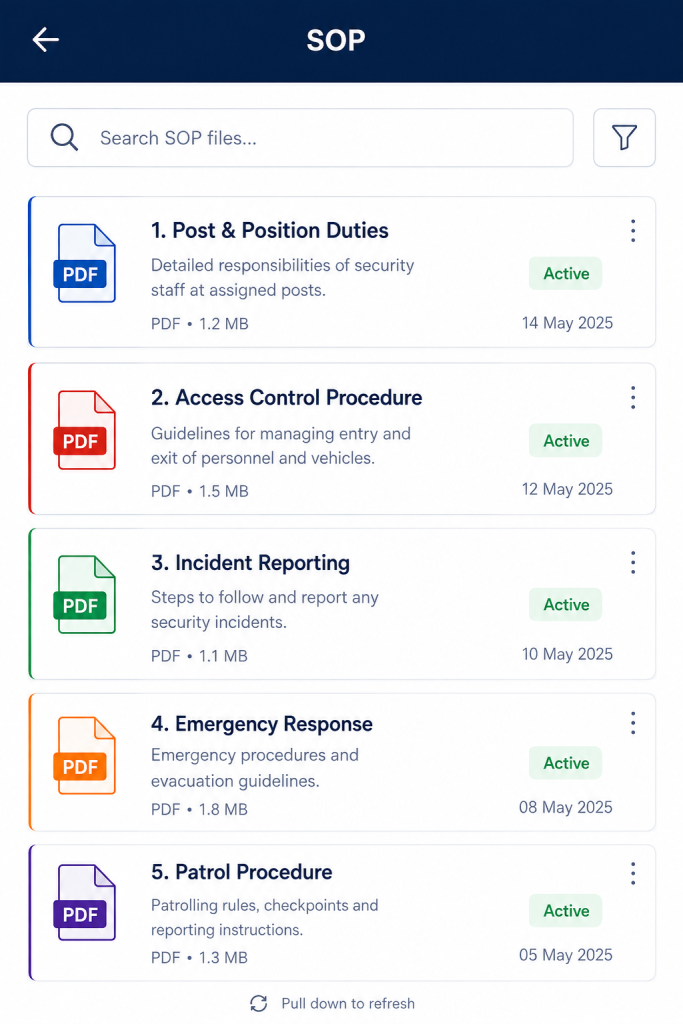
    Clients asking for proof of compliance get audit-ready reports pulled from real, timestamped activity. Guards working across multiple sites follow the same procedures because the platform enforces them, not because someone hopes they remembered the training session. You can also tie SOP compliance directly into your daily briefing process so guards are reminded of key procedures at the start of every shift.

    The SOP tells your team what good looks like. AVES shows your clients that it happened.

    One Thing to Do Before Writing Anything

    Before you start drafting, walk one shift at one of your sites and write down every decision a guard makes that isn’t covered by a written rule.

    How did they handle the contractor who arrived after hours? What did they do with the delivery that had the wrong paperwork? Who did they call when the client’s contact number went to voicemail?

    Those gaps are your security guard SOP. Start there, not with a template you found online.

    The best security guard SOP isn’t the most comprehensive one. It’s the one your guards actually know.

    FAQ 1
    Q: What is a security guard SOP?
    A: A security guard SOP (Standard Operating Procedure) is a company-wide rulebook that defines how guards handle visitor access, vehicle movement, incident response and emergency situations. It applies to every guard at every site, regardless of the client.


    FAQ 2
    Q: What is the difference between a security guard SOP and post orders?
    A: A security guard SOP covers company-wide procedures that apply across all sites. Post orders are site-specific instructions for one particular location. The SOP is the rulebook. Post orders are the site-level exceptions underneath them.


    FAQ 3
    Q: How long should a security guard SOP be?
    A: A working security guard SOP should be no longer than 10 to 12 pages. Anything longer usually includes content that belongs in site-specific post orders. Guards need to read and remember it in one sitting not file it away unread.


    FAQ 4
    Q: What should a security guard SOP include?
    A: A security guard SOP should cover visitor and personnel access, vehicle and material movement, incident response and escalation, emergency procedures and communication standards. These five areas cover the decisions guards make every single shift.


    FAQ 5
    Q: Why do most security guard SOPs fail?
    A: Most security guard SOPs fail because they are written for auditors, not guards. They use legal language, cover unlikely scenarios and skip the situations guards actually face. If a guard cannot read it once and know what to do, the SOP needs rewriting.


    FAQ 6
    Q: How often should a security guard SOP be reviewed?
    A: A security guard SOP should be reviewed at least once a year. It should also be updated whenever there is significant staff turnover, a new client site is added or an incident reveals a gap in existing procedures.


    FAQ 7
    Q: Is a security guard SOP the same as a duty roster?
    A: No. A security guard SOP defines how guards carry out their duties. A duty roster is simply a schedule showing who is on post, when and where. The two serve completely different purposes.


    FAQ 8
    Q: How does software help enforce a security guard’s SOP?
    A: Security management software like AVES enforces SOP compliance by timestamping patrol rounds, logging visitor pass activity, capturing incident reports in real time and generating audit-ready PDFs. Instead of hoping guards remember the SOP, the platform builds it into every shift.

    FOR MORE DETAILS, VISIT OUR WEBSITE: https://avessecurity.com/https://avessecurity.com/

    VISIT OUR LINKEDIN PAGE FOR FUTURE UPDATES:https://www.linkedin.com/company/aves-security-management-system

  • Contractor Management Software for Security Teams: Gate Access, Not Payroll

    Contractor Management Software for Security Teams: Gate Access, Not Payroll

    By Nithish, AVES Security

    Why “contractor management software” searches lead you to the wrong tool

    If you’re searching for contractor management software as a security team, you’ve probably already noticed the results don’t match what you need.

    I get this question a lot from site managers: “We searched for contractor management software and none of it does what we need. Is that normal?”

    Yes. Completely normal and worth explaining, because it’ll save a few wasted demo calls.

    Type “contractor management software” into Google and you’ll get Deel, Workday, a handful of HR-compliance platforms and a Capterra listicle comparing all of them.

    Every one of these tools is built for the same job: onboarding a contractor as a worker.

    Collecting their W-9, checking that their insurance is current, paying them in the right currency, tracking whether a certification expires next month.

    According to OSHA’s contractor safety guidance, that side of contractor management is real and regulated. It’s just not what a guard at a gate needs at 7am when a plumber shows up claiming he has a job order for Building C.

    Two different questions, one confusing search term

    “Is this person allowed to be here right now?” and “Is this person set up correctly as a vendor in our system?” are not the same question, even though both are called contractor management software.

    A security team almost never cares about the second one, which is payroll and legal’s job.

    A guard cares about the first and most contractor management software marketed under this term doesn’t answer it at all.

    What actually matters at the gate

    Ask a guard what goes wrong with contractors and the same handful of things come up, over and over.

    The contractor arrives and nobody at the gate knew they were coming, so someone’s calling around trying to find whoever approved it.

    The job finished two days ago, but access was never switched off because turning it off required someone to remember to do it.

    There’s no record of when the contractor actually left, just a guess based on when the truck was gone.

    A contractor wanders into an area they weren’t supposed to be in because nothing stopped them and nobody was watching that door.

    A client asks for a report of every contractor visit last month and someone has to dig through a logbook where three different guards updated it inconsistently.

    None of these are payroll problems. Their access problems are closer to what our gate pass management system already handles for one-off visitors.

    They need a system built around the gate, not the vendor file.

    What good contractor management software for security actually looks like

    Pretty simple, honestly. A contractor’s visit is scheduled and approved in advance, not improvised at the barrier.

    Access has a start and an end and it expires automatically rather than relying on someone to revoke it.

    Entry and exit both get logged the same way our geofence attendance tracking timestamps a guard’s location on a round.

    That means a contractor who checked in but never checked out shows up as exactly that: an open question, not a closed record.

    If a job needs an escort or is restricted to one part of the site, the system knows that and flags it rather than leaving it to memory.

    That’s the whole job. Not glamorous.

    But it’s the difference between a guard answering “who’s on site right now and why” in ten seconds, versus fifteen minutes of phone calls.

    Where this sits next to gate pass

    If you already use a gate pass format, contractor site access is basically the same mechanism.

    It’s applied to people who come back regularly and often need specific rules attached to inductions, restricted zones and a longer access window than a one-off visitor would get.

    Same underlying event, different shape.

    What we’re not claiming

    This doesn’t replace a real HR or compliance platform and it shouldn’t try to.

    It won’t issue a 1099. It won’t chase down an expired insurance certificate covered under something like OSHA’s recordkeeping rules.

    If that’s the gap you’re trying to close, you want Deel, Workday or something in that category.

    The two tools solve different problems and most teams end up needing both eventually.

    The bottom line

    If you went looking for contractor management software because you wanted to know who’s allowed on your site and when, you were in the right neighborhood but the wrong building.

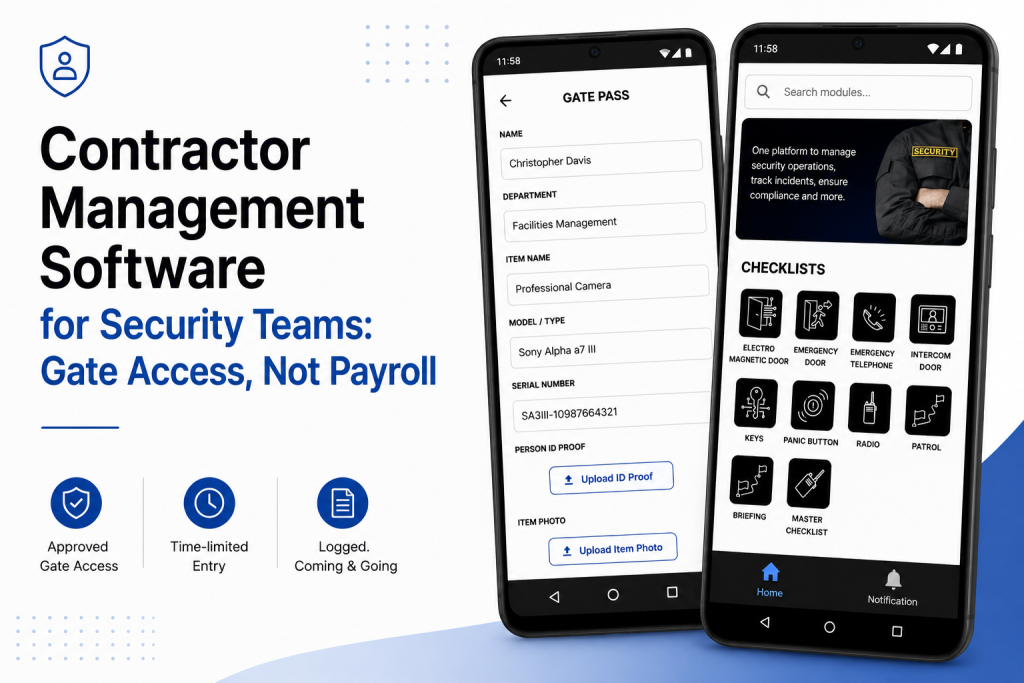
    What you actually need is contractor management software built around the gate approved before arrival, time-limited, logged coming and going, visible to whoever’s asking.

    For More Details: https://avessecurity.com/

    Visit Our visit: https://www.linkedin.com/company/aves-security-management-system

    FAQs

    Isn’t contractor management software just for HR and payroll stuff?
    Most of what shows up under that name, yes, W-9s, insurance certs, payments. That’s a real need, just not a security one. If you’re trying to answer “who’s on my site right now and why,” you need something built around the gate, not the vendor file.

    We already use Deel/Workday for our contractors. Do we still need this?
    Probably, if security is a concern. Deel and Workday tell you that a contractor is set up correctly as a vendor. Neither one tells your guard whether that plumber at the gate is actually supposed to be there today. Different jobs and most sites end up needing both.

    What happens if a contractor forgets to check out?
    It stays open on the record instead of getting quietly closed. No guessing based on when the truck left the lot; if there’s no exit log, the system shows it as unresolved so someone can actually follow up.

    Can we restrict a contractor to certain areas of the site?
    Yes. If a job only needs access to one zone or needs an escort, that gets attached to the visit when it’s approved, not left to whoever’s at the gate that day to remember.

    How is this different from your regular gate pass system?
    Mechanically, it’s close. Contractor access is usually recurring, tied to inductions and open for a longer window than a one-time visitor pass. Same underlying idea, just shaped for people who come back.

    Can we pull a report of every contractor visit for a client or audit?
    Yes and it’s the same log the guards are already using at check-in and check-out, not a logbook that three different shifts filled in differently.

    Does this handle things like expired insurance or certifications?
    No. That’s still HR/compliance territory. OSHA-covered stuff like insurance and certs belongs with a platform like Deel or Workday. This tool answers “are they allowed on site right now,” not “are they legally compliant to be a vendor.”

  • Security Guard Audit Checklist: What Site Inspectors Actually Check

    Security Guard Audit Checklist: What Site Inspectors Actually Check

    By Nithish, AVES Security

    A security audit checklist is what separates a clean inspection from an awkward one. I’ve sat across the table during audits that went fine and audits that went badly and the difference was almost never the guards. It was the paperwork. An inspector asks for last month’s patrol records and someone digs out a stack of registers a few gaps here, a guessed time there, one page where the ink’s gone faint enough you can’t read it. Nobody’s accusing anyone of skipping rounds. The client just wanted proof and there wasn’t any sitting ready.

    That’s really what a security audit checklist is for. Not “did the guard do the job,” that part’s usually fine, but “can you show someone who wasn’t there that it happened.”

    What is a security audit checklist actually for

    A security audit checklist like this ends up in front of three kinds of people and they’re not all looking for the same thing.

    A client’s compliance officer is checking the contract got delivered right number of patrols, right intervals, incidents logged and closed. A regulator wants to see statutory requirements actually followed, not just claimed on paper. And your own supervisor doing a spot-check is trying to catch a site that’s slipping before the client notices it first.

    Different people, same underlying test though: does this record match something that actually happened and when.

    What a security audit checklist actually covers

    Every site has its own quirks, but pull those aside and most audits client, regulatory, internal, doesn’t matter end up checking the same seven things.

    Attendance and shift coverage. Was someone actually on site every hour they were supposed to be, no unexplained gaps between shifts.

    Patrol completion. Were the rounds walked, in the right order, not just marked done at the end of the night.

    Incident handling. Logged when it happened, escalated if it needed escalating, closed with an actual outcome not left open.

    Key and access control. Who had which key, when they took it, when it came back.

    Visitor and contractor movement. Who came in, when and who approved it?

    Equipment and defect reporting. Faults and damage flagged when they’re found ideally before the client spots them first.

    Training records. Can you actually show who was trained on what and when?

    An inspector isn’t expecting a perfect site. They’re expecting a record for each of those seven, produced without anyone scrambling to reconstruct it from memory the night before.

    Where a security audit checklist usually finds gaps

    It’s rarely the first item that trips a site up. It’s usually somewhere in the middle a patrol that got logged but has no timestamp to prove it was on schedule or a visitor with an entry time and no exit time. Any one of those looks minor on its own. Line up a month of them and that’s the gap between a clean audit and a follow-up visit.

    The worst version of this is when two records that should match don’t. A key register showing a guard holding keys during a shift, the attendance log says they weren’t even on site that’s not a gap, that’s a records problem and it’s a lot harder to explain away than a missing entry.

    How a security audit checklist changes on audit day

    None of this means guards do more work. It means the same seven categories get captured once, when they happen, tied to a timestamp and a name instead of written up later from memory. When a client or regulator wants the last quarter, that’s a filtered report instead of someone flipping through binders looking for the right week.

    It’s the same shift that’s already happened with patrol verification, key custody and occurrence logging on individual sites. A security audit checklist stops being a scramble before an inspection and just becomes a byproduct of the daily paperwork being accurate to begin with.

    Regulatory bodies like ASIS International publish general standards for physical security audits and most client contracts in this space borrow the same core structure coverage, incident handling and access control, at minimum.

    Preparing your security audit checklist before an inspection

    Don’t try to backfill history inspectors can usually tell a record written at the time from one written last week to cover a gap. Better to pull those seven categories from your duty roster and gate pass records for the last thirty days and see where the actual holes are that’s usually where a security audit checklist review starts anyway. Most of the time it’s one or two, not all seven. Fix the process from here, be straight about it if asked and treat the audit as the thing that told you where the weak spot actually was.

    The bottom line on your security audit checklist

    A security audit checklist isn’t a form you fill in before someone visits. It’s a check on whether the records you’re already keeping can stand on their own, without you in the room explaining what really happened. The sites that get through audits without drama aren’t the ones with the thickest file they’re the ones where the paperwork was right the first time it was written.


    Frequently asked questions

    What is a security audit checklist? A security audit checklist is a list of the records and controls an inspector checks to confirm a site’s security operations are actually happening as reported attendance, patrols, incidents, keys, visitor movement, equipment condition and training records.

    Who typically requests a security audit checklist? Three groups usually ask for it: a client’s compliance officer verifying contract terms are met, a regulator or licensing body confirming statutory requirements and a company’s own supervisor running an internal spot-check.

    How often should a security audit checklist be reviewed? Most sites review it monthly at minimum, with a fuller pass before any scheduled client or regulatory audit. Waiting until an audit is announced to check your records usually means finding the gaps too late to fix them.

    What’s the difference between a security audit checklist and a daily guard checklist? A daily guard checklist covers what happens during a single shift gear checks, rounds, handover. A security audit checklist looks backward across a period of time to confirm those daily records are complete, consistent and provable.

    Can a security audit checklist be done digitally instead of on paper? Yes. A digital checklist ties each entry to a timestamp and the person who logged it, which is what most inspectors are actually looking for a record they don’t have to take on trust.

    What happens if gaps show up during a security audit? A gap on its own usually isn’t fatal to an audit. What matters more is whether the company can explain it and show the process has since been fixed, rather than trying to backfill records after the fact.

    For more details visit our website: https://avessecurity.com/

  • Security Post Orders: Fixing the Gap Guards Fall Through

    Security Post Orders: Fixing the Gap Guards Fall Through

    You put real effort into your security post orders. You covered the doors, the contacts, the access rules.

    Then something goes wrong at 2am and the guard on duty had no idea what to do.

    If that sounds familiar, you are not doing anything wrong as a manager. You are running into a problem almost every security company hits. The document exists. It just isn’t working.

    This guide walks through why that happens, what a security post order actually needs to contain and how to fix the gap between “we have post orders” and “guards actually follow them.” No fluff, no generic templates copied from a dozen other sites. Just what actually works on real posts.

    What a Security Post Order Actually Is

    A security post order is not a job description. It is not a duty roster either.

    It is the site-specific instructions for one physical post, at one site, written for the guard standing there right now. Some companies call these security guard post orders instead, but the idea is the same.

    A duty roster tells someone when to show up. A general “security guard duties” page tells them what the role covers everywhere. A security post order tells them what to do at this exact gate, this exact lobby, this exact loading dock.

    That distinction matters more than it sounds like it should. A guard who only knows the generic version of the job fills in every site-specific gap on their own. That is exactly where liability shows up, where clients get frustrated and where incidents happen that could have been avoided with one clear sentence written down in advance.

    Why Most Post Orders Fail Once They’re Written

    Here is the part most guides skip. Writing the security post order is the easy part. Keeping it useful is where almost every site falls apart.

    They go stale fast. A security post order gets written once at site handover. Six months later the client changed the after-hours contact, a door schedule shifted and nobody updated the document. The guard is now working from instructions that describe a site that no longer exists.

    They try to cover everything. A fifteen-page post order feels thorough on paper. In practice, nobody reads fifteen pages in the middle of a shift. Length feels like diligence. It actually kills usability.

    Nobody owns the update. Ask most operations managers who is responsible for keeping security post orders current and you will get a pause before an answer. Without a named owner, updates happen never.

    There’s no proof anyone read it. A binder in a guard shack does not confirm the current guard has actually seen the current version. That gap is where most “the guard didn’t know” incidents actually start.

    None of this means security post orders are the wrong tool. It means most companies are running a good idea badly.

    The Real Cost of Getting This Wrong

    This is the part that’s easy to underestimate until it costs you a client.

    An outdated post order does not just create confusion. It creates security liability. If a guard follows instructions that no longer match the site and something goes wrong, the paper trail shows your company gave them wrong information. This is also where guard accountability breaks down, because a guard can’t be held to instructions that were never accurate in the first place.

    Turnover makes this worse. New guards rotate through posts constantly in this industry. Every rotation is a moment where an unclear or outdated security post order turns into a real mistake, not a hypothetical one.

    And clients notice. A client who catches a guard not knowing basic site procedure starts wondering what else your company is getting wrong. That is how contracts get lost, not through one dramatic failure but through a slow loss of confidence.

    The Five Things Every Post Order Needs

    Strip away the extras and a security post order that actually works comes down to five parts.

    Post boundaries. What area this post covers and exactly where responsibility hands off to the next post. No gray zones.

    Standing instructions. The default state of the post. Which doors lock on schedule, what routine checks happen without being told.

    Access rules. Who walks through without escort, who signs in, who gets turned away. Spelled out by role, not left to judgment in the moment.

    Emergency contacts. Real names and real numbers for this site. Not a head office line that rings through to voicemail at 3am.

    Exceptions and escalation. What falls outside normal instructions and exactly who to call when something doesn’t match what’s written.

    If a security post order covers those five things clearly, it works. If it tries to cover every hypothetical situation on top of that, it stops getting read.

    How to Write Post Orders Guards Will Actually Follow

    Start from real incidents, not imagined ones. The best security post orders come from actual questions guards have asked at that post, not a template built from a desk somewhere else.

    One instruction, one sentence. If an instruction needs a paragraph to explain, it belongs in training material, not the post order itself.

    Name a person, not a department. “Contact facilities” solves nothing at 2am. A name and a direct number gets a problem handled instead of routed into a voicemail loop.

    Update the moment something changes. Do not wait for an annual review. The day a client changes a rule is the day the security post order should change too.

    Confirm the guard actually read it. This is the step almost everyone skips. A printed page on a wall does not prove anything. Some form of sign-off, even a simple log, closes that gap.

    Paper vs Digital: An Honest Look

    You might be wondering if this even needs software, or if a well-organized shared folder solves the problem.

    Here’s the honest answer. A shared folder fixes the “which version is current” problem. It does not fix the “did the guard actually read it” problem on its own.

    That second gap is where most companies get burned and it’s worth being upfront about the limitation. No system, digital or paper, replaces a supervisor who actually walks the post and checks. Software reduces the risk. It does not eliminate the need for management attention.

    What digital tools genuinely solve well is version control and searchability. One current file per post, tagged by department, findable by name instead of buried in a binder nobody has opened since onboarding.

    That’s the gap most guard instructions software claims to close and most of it doesn’t.

    Where AVES Fits Into This

    AVES has a real, confirmed feature for exactly the version control problem above. It’s called SOP Management and it works as a document repository built for this kind of site procedure. Think of it less as guard instructions software with built-in workflows and more as the single source of truth those instructions need to live in.

    You upload a file, tag it to a user and a department and give it a clear file name. It shows up in a searchable list where anyone can find it by department, username, or file name. Deleting an outdated version takes two confirmation steps, not one accidental click, so an old copy doesn’t disappear by mistake while the current one is still needed.

    To be fully transparent, SOP Management is a document upload and search tool. It is not an interactive checklist builder where guards check off individual steps inside the app. If that’s what you’re picturing, it’s worth knowing that upfront rather than finding out later.

    AVES also has a confirmed Shift Briefing capability, built around guards acknowledging instructions before going on duty, which is the natural next step after centralizing security post orders. The detailed screen-by-screen workflow for that feature isn’t something we can walk you through yet and we’d rather tell you that plainly than describe steps that don’t exist.

    Where to Go From Here

    If your current security post orders are living in a binder or scattered across old email attachments, the fix isn’t complicated. It’s organizational first and tools second.

    Start by naming one owner per site. Then get every current post order into one searchable place instead of several. That single change solves most of the version confusion described above.

    If you want to see how AVES’s SOP Management handles that part, a short walkthrough will show you exactly what it does and, just as importantly, what it doesn’t do yet, so you can decide if it fits how your team actually works.

    A binder guards stop reading is not backup protection. It is a liability sitting quietly on a shelf, waiting for the one shift where it mattered and nobody opened it.

    See how AVES keeps every post order current. Book a quick walkthrough.

    CONTACT US

    Website : https://www.avessecurity.com

    Linkedin: https://www.linkedin.com/company/aves-security-management-system/

    Instagram: https://www.instagram.com/avessecurity/

    What are security post orders, exactly?

    Think of security post orders as the cheat sheet for one specific post, not the whole job. They spell out what a guard does at that particular gate or lobby, down to which doors get checked and who to call if something’s off. A generic job description won’t tell you any of that. Post orders will, or at least they should.

    Aren’t security post orders basically the same as SOPs?

    Not quite. Standard operating procedures cover the big stuff that applies everywhere, like what to do if someone collapses on site. Security post orders are narrower and messier in a good way. They’re written for one post, one set of doors, one set of quirks that only that location has. You need both. One without the other leaves a gap.

    Do I really need to go digital, or can paper work fine?

    Paper can work. It’s just harder to keep straight once you’ve got three shifts and a stack of photocopies floating around. The real problem isn’t paper versus digital. It’s that nobody can tell which copy is the right one. Fix that part and the format matters a lot less.

    Can I just use a post order template for every site?

    A template’s fine for the skeleton, five sections, same structure every time. But the actual content has to be specific to that post. Copy-paste a template with the site name swapped and you’ve basically written nothing useful. Guards can tell the difference immediately.

    Is there software that actually helps manage this across sites?

    Some. though I wouldn’t call it guard instructions software exactly. AVES has an SOP Management feature that at least solves the “which file is current” mess, one document per post, searchable by department or file name instead of buried in someone’s inbox. It won’t replace a supervisor actually walking the post and checking. Nothing does that. But it kills the version-control headache that causes most of these problems in the first place.

  • Deadly Gaps, Proven Fix: Digital Inspection Checklist

    Deadly Gaps, Proven Fix: Digital Inspection Checklist

    You already know the feeling. It’s 6 AM, the shift just changed and somewhere in the back of your mind is a question you don’t want to ask out loud: was the panic button actually tested last night, or did someone just sign the sheet?

    That doubt is exactly why a digital inspection checklist exists and if you’re reading this, you’ve probably already lived through the moment where a paper checklist let you down.

    Maybe it wasn’t a disaster. Maybe it was just a client walkthrough where the emergency phone didn’t ring and the log said it was “checked” three hours earlier. Either way, you felt it. That small, sinking realization that your paperwork and your reality had quietly stopped matching.

    That’s the exact question a digital inspection checklist exists to answer, before a client or an insurer ever has to ask it.

    The Fear Nobody Says Out Loud

    Security operators don’t lie awake worrying about the equipment itself. They lie awake worrying about the gap between what the paperwork says and what actually happened on site.

    A paper form can be filled out from memory at the end of a shift. It can be backdated. It can say “all clear” on a piece of equipment nobody actually walked over to touch. That’s not a guard problem. That’s a systems problem and it’s exactly the gap a digital inspection checklist is built to close.

    If you’ve ever had to explain to a client why a piece of safety equipment failed during the one moment it mattered, you already understand why this matters more than almost anything else on a guard’s shift list.

    What a Digital Inspection Checklist Actually Solves

    Here’s the part most people get wrong when they first look into this. They think a digital inspection checklist is just a fancier form. It isn’t.

    The real value of a digital inspection checklist is the timestamp. A record that gets created the moment a guard is standing in front of a panic button, testing it, not the moment they get back to the desk and remember to write it down.

    That single shift, from memory-based logging to real-time logging, is what makes a digital inspection checklist worth adopting in the first place. It’s not about looking more modern. It’s about closing the exact gap that keeps security managers up at night.

    Six Things That Actually Need Checking, Every Single Shift

    A good digital inspection checklist doesn’t try to cover everything under the sun. It focuses on the equipment that matters most in an actual emergency:

    • Emergency telephones, confirmed operational and connected
    • Emergency doors, checked for unobstructed operation
    • Panic buttons, tested and confirmed active
    • Intercom doors, verified and logged
    • Electromagnetic doors, verified and logged
    • Radios, verified and logged

    Notice what’s on that list. None of it is decorative. Every item is something that, if it fails silently, turns a manageable situation into a genuinely dangerous one.

    This is the part that separates a serious digital inspection checklist from a generic to-do app repackaged for security teams. It isn’t trying to track everything. It’s trying to make absolutely sure the handful of things that matter most never get skipped.

    The Doubt You’re Probably Carrying Right Now

    If you’re evaluating whether to move to a digital inspection checklist, you’re probably carrying a few quiet doubts. Let’s name them honestly instead of pretending they don’t exist.

    “What if my guards just fake the digital version too?”

    Fair concern. The difference is that a digital inspection checklist creates a record that can’t be backdated or edited after the fact the way a paper form can. A guard can still choose not to test a panic button, but they can’t quietly write “9 PM” on a form at 11:45 PM and make it look accurate. The system captures when the entry was actually made.

    “Is this going to be complicated to roll out?”

    This is where a lot of people overthink it. A digital inspection checklist doesn’t require retraining your entire operation. Guards are already doing the physical check. The tool just changes what happens after they touch the equipment, not the check itself.

    “What if the software becomes another thing I have to babysit?”

    This is the most reasonable fear on the list about any digital inspection checklist and it deserves an honest answer, not a sales pitch. Any digital inspection checklist is only as good as whether your team actually opens it every shift. The ones worth choosing are the ones simple enough that a tired guard at 3 AM can use it without friction. That’s the real test, not the feature list.

    What Good Actually Looks Like

    Picture the version of your operation where this works the way it’s supposed to.

    A guard starts their shift. They walk the fixed equipment list, physically testing each item. Each check gets logged the moment it happens, not reconstructed later from memory. By the time your morning report lands, you already know whether every panic button, door and radio on site was actually verified, not just claimed to be verified.

    That’s the entire promise of a digital inspection checklist. Not more paperwork. Less uncertainty.

    When a client asks you to prove equipment was checked before an incident, you’re not scrambling through a filing cabinet. You’re pulling up a timestamped record that speaks for itself.

    Why This Matters More Than It Looks Like It Does

    Most security operators don’t think about equipment checks as a competitive advantage. They think of them as a chore, something guards grumble through because someone above them said it’s required.

    That mindset is exactly what a digital inspection checklist is designed to change. Every completed, timestamped check is proof of due diligence. It’s the difference between a security company that can defend its record in a liability conversation and one that’s hoping nobody ever asks hard questions.

    If you’ve ever felt that quiet unease about whether your equipment checks would actually hold up under scrutiny, that feeling is worth listening to. It’s usually a sign the process, not the guards, needs fixing.

    The Honest Trade-Offs

    No tool solves everything and it would be dishonest to pretend a digital inspection checklist is a silver bullet.

    It doesn’t replace the physical act of checking equipment. A guard still has to walk over and test the panic button. What it changes is whether that action leaves behind proof and whether that proof can be trusted months later when it actually matters.

    It also won’t fix a culture problem on its own. If a team doesn’t take the underlying duty seriously, no piece of software forces genuine diligence. What a digital inspection checklist does is make it much harder to fake diligence that isn’t there, which tends to change behavior on its own over time.

    Where This Leaves You

    If you’ve made it this far, you already know the real question isn’t whether equipment checks matter. You know they do. The real question is whether you can currently prove they’re happening the way your paperwork says they are.

    That’s the exact gap a digital inspection checklist is built to close. Not a bigger to-do list. A record you can actually stand behind.

    You don’t need to overhaul your entire operation to adopt a digital inspection checklist. You need a system that captures the moment a check actually happens, instead of the moment someone remembers to write it down.

    That’s the whole shift. And once you see it working on your own site, it’s hard to imagine going back to a clipboard.

    See how a digital inspection checklist works on a real site → Book a free walkthrough

    CONTACT US

    Website : https://www.avessecurity.com

    Linkedin: https://www.linkedin.com/company/aves-security-management-system/

    Instagram: https://www.instagram.com/avessecurity/

    What equipment actually needs checking every shift?

    That six things and they’re not random.That’s the list. Not because other equipment doesn’t matter, but because these six are the ones you reach for when something’s already going wrong. If they don’t work in that moment, nothing else about your setup matters much.

    Can someone go back and edit an entry after it’s submitted?

    That’s the whole reason to move off paper in the first place.
    A form filled out from memory can say whatever the person writing it wants it to say. A record created the second someone actually tests the panic button can’t be rewritten later to look tidier than reality. That gap between “what happened” and “what got written down” is exactly what this kind of system is built to close.

    How disruptive is it to actually switch over?

    Less than people expect, usually.
    The underlying job doesn’t move an inch. Guards are already walking the site and testing equipment. All that’s really shifting is how that gets recorded. Most teams find their footing within a shift or two, not weeks.

    What if my guards just fake the digital version too?

    Fair concern. The difference is that a digital inspection checklist creates a record that can’t be backdated or edited after the fact the way a paper form can. A guard can still choose not to test a panic button, but they can’t quietly write “9 PM” on a form at 11:45 PM and make it look accurate. The system captures when the entry was actually made.

  • “Security Guard Checklist: The Foolproof Shift Template”

    “Security Guard Checklist: The Foolproof Shift Template”

    Ask five site supervisors for their “security guard checklist,” and you’ll get five different PDFs, and none of them will match what actually happens on a shift. Some are a single page with ten boxes on it that could apply to literally any job site. Others run four pages long and read like they were drafted by someone in a compliance office who’s never walked a perimeter at 2 a.m. with a flashlight that’s about to die.

    Neither version gets used properly, and honestly, guards can’t be blamed for that. A checklist has to fit into the time a shift actually gives you. Eleven minutes between rounds isn’t eleven minutes to fill out a form.

    So here’s a security guard checklist built the other way around starting from what a shift actually looks like, hour by hour, and working out what needs to be written down at each stage.

    Why Most Security Guard Checklists Don’t Get Filled In Properly

    Talk to enough guards and supervisors and the same complaints keep coming up.

    Length is the obvious one. Nobody’s filling out fifty line items in the fifteen minutes before a shift starts. What happens instead is that the form gets completed after the fact, from memory, sitting in the guard shack, which more or less defeats the point of having it.

    There’s also the problem of everything being lumped together. Gate checks, radio tests, end-of-shift notes, all sitting in one long undifferentiated list. A guard glancing at that mid-shift can’t quickly tell what’s due right now versus what’s for later.

    Then there’s the stuff a plain checklist just can’t capture. Say a door’s been propped open with a brick and you’ve told the site manager about it. Where does that go on a form made entirely of tick boxes? Usually nowhere. It ends up scrawled in the margin, or in a separate notebook that nobody ever cross-references again.

    And the last one is more of a trust issue. If a checklist doesn’t line up with what a supervisor or a client actually looks at during a review, guards catch on fast, and the whole thing starts feeling like busywork.

    None of that gets solved by tacking on more boxes. It gets solved by matching the security guard checklist to how a shift actually unfolds, and by making sure whatever gets written down has somewhere real to go afterward.

    Security Guard Checklist, Broken Down by Stage of the Shift

    Before You’re Even Posted

    The first five or ten minutes on site, ideally before you relieve whoever’s coming off shift.

    • Uniform and ID badge on and correct for the site
    • Radio switched on, charged, tested on the right channel
    • Flashlight charged and actually working (not “worked yesterday”)
    • Duty phone or panic button charged, if the site issues one
    • Keys, cards, or fobs collected and checked against the key log
    • Previous shift’s incident log or occurrence book read through
    • Any handover notes from the outgoing guard read and understood, not just glanced at
    • Standing orders checked in case anything’s changed since last shift
    • PPE checked, if the site calls for it

    If something’s off here dead radio, keys missing from the log that’s the moment to say something. Not two hours in, once you’ve already started rounds without it. This is the part of the security guard checklist that gets rushed most often, and it’s the cheapest one to get right.

    On Rounds

    This is the part guards carry with them, clipboard in hand or phone in pocket. It has to be quick, or it slows the whole patrol down and people start skipping it.

    At each point on the round:

    • Door or gate is in the state it’s supposed to be in
    • Locks and hinges look fine, nothing pried or forced
    • Lighting’s working in the area
    • Fire exits and extinguishers aren’t blocked
    • Anything unusual a car that shouldn’t be there, someone loitering gets a note
    • Checkpoint scanned or logged, whatever method the site uses
    • Time noted

    At access points specifically:

    • Visitor log current, nobody unregistered wandering around
    • ID actually checked for anyone coming in, not waved through
    • Deliveries logged

    The time matters more than people think. A checkmark tells you the check happened; a timestamp tells you when. That gap is exactly what digital patrol tools are built to close automatically. We go into that in guard duty verification if you want the fuller picture. It’s also a piece of a security guard’s checklist that a paper form struggles to prove after the fact.

    In the Control Room

    For anyone posted there or rotating through:

    • Camera feeds all up and recording
    • No dead cameras that haven’t been flagged
    • Playback tested, works when you need it to
    • Alarm panel showing the correct armed/disarmed status
    • Access control system logging properly
    • Storage isn’t about to run out
    • Any system alerts actually looked at, not dismissed

    Even sites without a real control room usually have someone holding this responsibility. That person should still run through it once at the start of the shift and once more before handing off.

    Logging What Actually Happened

    This is the step that gets skipped most, and it’s usually the one that matters most when something goes wrong later.

    • Every incident logged with a time, a location, and a description that isn’t three words
    • Photos where it’s safe and relevant to take one
    • Anything serious escalated to a supervisor or client contact, not sat on
    • Log reviewed before the shift ends, not left half-finished
    • Lost property logged and put somewhere secure
    • Maintenance stuff: a broken light, a lock that sticks noted separately so facilities actually see it

    An occurrence log is only worth something the day a client rings up asking what happened at 2 a.m. on the 14th and someone can actually answer. It’s arguably the most overlooked line on the whole security guard checklist. We’ve written more about what a decent log should include in the daily occurrence log walkthrough.

    Handing Off

    This is where a good shift either counts for something or doesn’t. A guard can do everything right for eight hours and still leave the next person in the dark if the handover is just a wave and “nothing happened.”

    • Everything above is actually completed, not half-done
    • Keys, radios, equipment physically handed over
    • Anything unresolved flagged clearly, not left for the incoming guard to discover
    • Incident log gone through together, not just left on the desk
    • Any follow-ups noted with where things stand
    • Handover signed or timestamped by the person coming on

    If the site runs a set roster, this is also a decent moment to double-check that the next shift is actually staffed the way it’s meant to be, worth checking against the security guard duty roster. Handover is the last checkpoint on the security guard checklist, and it’s the one that decides whether everything before it actually meant something.

    Paper Security Guard Checklist or an App: Does It Matter?

    Paper’s fine. Guards have been using clipboards for as long as there’s been a job to do, and there’s nothing wrong with printing this list and sticking it in a guard shack.

    Where it falls apart is proof. A ticked box tells you the box got ticked; it doesn’t tell you the guard was actually standing at the checkpoint when they ticked it. On a slow night, it’s not hard to fill in ten boxes at once from memory near the end of a shift. That’s fine right up until a client wants proof of coverage, or an incident needs to be matched against the exact minute a patrol went past a specific door.

    That’s the gap digital tools are built for: a guard scans a checkpoint or logs something in the moment, the time and location attach on their own, and a supervisor can actually see the shift happening rather than reconstructing it off a clipboard the next morning. If attendance by location is also something your team tracks, geofence attendance covers how that fits alongside patrol checks.

    Format matters less than structure, though. A checklist built around how a shift actually runs pre-shift, patrol, control room, incidents, handover gets used whether it’s on paper or on a phone. A forty-item list with no shape to it usually doesn’t, no matter what it’s printed on.

    Adjusting This Security Guard Checklist for Your Own Site

    Treat this as a starting point, not something to follow word for word. A retail site is going to care a lot more about the visitor log than about a fence line. A warehouse is roughly the reverse. The five stages hold up across both; what changes is which specific items sit inside each one.

    One rule holds regardless of how you tweak it: if a check doesn’t have a clear instruction to be written down, it won’t get written down consistently. Build around where the information needs to end up, not just what someone’s supposed to look at.

    Last Word on This

    A security guard checklist earns its place by matching how a shift actually goes, not by looking thorough on paper. Five stages: pre-shift, patrol, control room, incidents, handover cover what needs checking without turning the job into paperwork.

    Print it out and laminate it, or build it into a patrol app. Either way, the point’s the same: every check needs somewhere real to go once it’s done.

    Curious how AVES turns this same checklist into a digital patrol and occurrence log that guards actually use on shift? Book a walkthrough and see it on a real screen →

    CONTACT US

    Website: https://www.avessecurity.com

    LinkedIn: https://www.linkedin.com/company/aves-security-management-system/

    Instagram: https://www.instagram.com/avessecurity/

    FAQ

    Do I need a separate checklist for every site?

    Not a separate one exactly, more of an adjusted one. The five stages carry over no matter the site, since this security guard checklist is meant to be a base, not a rigid form. What changes underneath them is which specific items matter, since a warehouse and a retail store aren’t watching for the same things.

    Paper or phone, which one should guards actually use?

    Both get the job done day to day. Paper’s simple, and guards already know how to use it without training. The catch is what happens afterward: the paper shows the boxes got filled in, not that anyone was actually there when it happened. A phone-based version timestamps and locates the entry without anyone having to think about it.

    What’s the step guards skip the most?

    Getting the handover actually acknowledged by the incoming guard, rather than just talked through on the way out the door. Easy to skip, but it’s usually the one thing that decides whether the next shift can trust what’s on the page.

    Isn’t this the same thing as a duty roster?

    No roster tells you who’s working and when. This is what that person is meant to actually do once they’re on post. They sit next to each other, but one’s about staffing and the other’s about what happens during the shift itself.

    Does filling in a checklist actually prove the rounds happened?

    Not by itself. It shows boxes were ticked, not necessarily when or where. If you need something closer to actual proof, timestamped checkpoint scans tied to a location, that’s what guard duty verification covers.