Category: Security Operations

Insights on digital security operations and management.

  • Shift Handover Checklist: What Every Outgoing Guard Must Log

    Shift Handover Checklist: What Every Outgoing Guard Must Log

    Most accountability failures on a security site don’t happen during a shift. They happen in the ninety seconds between shifts.

    Staff a sharp guard on days, an equally sharp one on nights you can still end up with a gap nobody can explain. A missing key. A pending incident nobody flagged to the next person. A visitor who signed in and nobody remembers signing out. Neither guard was careless here. That’s exactly the gap a shift handover checklist is built to close. The handover itself just has no structure, so whatever gets said in that ninety-second exchange is whatever the outgoing guard happens to remember right then.

    A shift handover checklist fixes exactly this. Not the shift. The changeover.

    Why the Handover Moment Is the Real Risk Point

    Think of a relay race. Two fast runners can still lose if the baton drops during the exchange, doesn’t matter how clean each leg was run individually. Races get won or lost in the handoff, every single time.

    Guard duty’s no different. Morning shift runs clean, night shift runs clean and the site still ends up exposed because the exchange between them was verbal, rushed or just skipped when the incoming guard rolled in two minutes late.

    A shift handover checklist that isn’t written down isn’t really a handover. It’s a conversation one person may or may not remember correctly six hours later, when a client wants to know exactly what happened.

    What Actually Belongs on a Shift Handover Checklist

    A good handover checklist isn’t long, it’s specific. Four things need to move from outgoing guard to incoming guard, every single time and none of them should ride on memory. Skip any one of these on your shift handover checklist and you’ve built a hole straight into it.

    Keys and access items. Every key, fob or access card checked out at shift start gets checked back in or physically handed over, with both people confirming the count matches. Sounds obvious, until you’ve chased a missing master key three weeks later and nobody can say which shift lost it. Some teams run this as its own key control checklist inside the larger handover works fine, as long as it still gets logged and timestamped. This is item one on every shift handover checklist, for good reason.

    Pending incidents. Something happened during the shift and it hasn’t been closed out, resolved or escalated? It doesn’t just vanish when the shift ends. Write it down. Hand it over as an open item, with enough detail that the next guard actually knows what to watch for. No shift handover checklist is complete without this logged.

    Visitor logs. Anyone who entered during the shift and hasn’t formally exited needs flagging. Matters even more at sites running contractors or maintenance crews outside normal visitor hours they’re the ones who slip through a verbal handover every time.

    Equipment condition. Radios, torches, patrol devices, whatever hardware the post depends on. Something’s low on battery, damaged or missing? The incoming guard needs to know before the round starts, not halfway through when the radio dies on them mid-patrol. Equipment checks close out the shift handover checklist and it’s usually the first thing forgotten.

    Those four form the core of any real security handover register. Weather notes, general site observations that’s optional context. These four aren’t.

    How AVES Turns This Into a Register, Not a Guessing Game
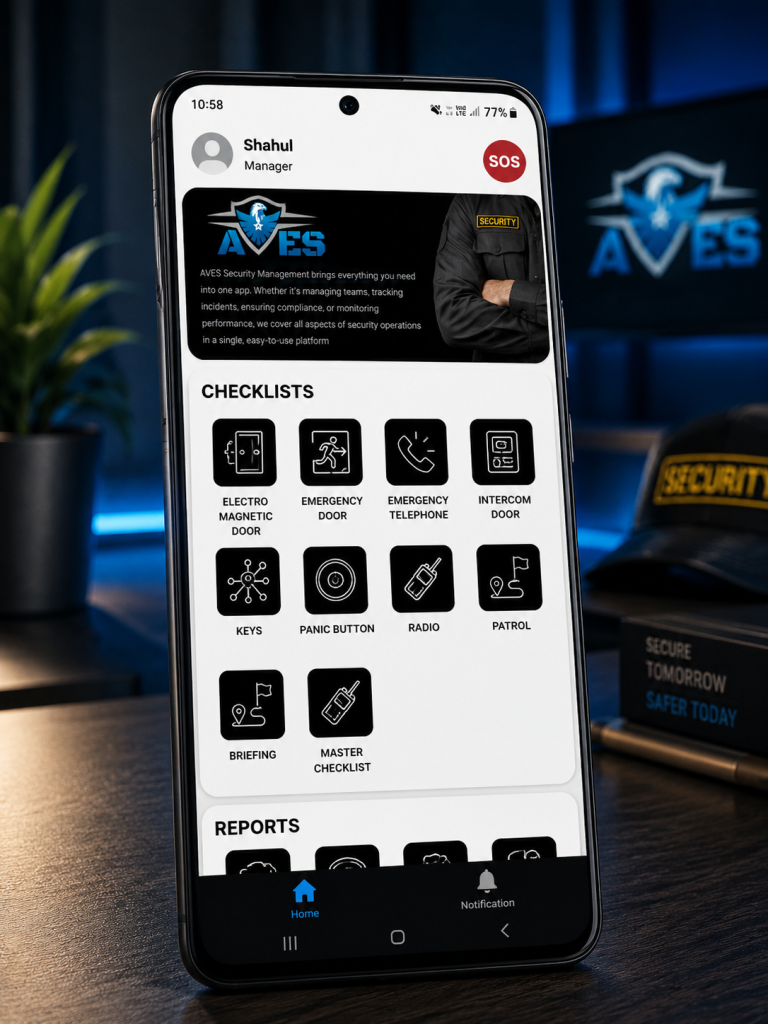
    Here’s what most people get wrong: writing your shift handover checklist on a paper register doesn’t solve the problem, it just delays it. Pages go missing. Logs get lost. And there’s no way to prove after the fact that a handover even happened, let alone what got said during it.

    AVES is built to make your shift handover checklist enforceable, not just documented. That happens through its digital Books and Checklist modules. Officers log handover entries right through the app and every entry gets timestamped automatically the second it’s created. That timestamp is what actually makes the register useful during an audit or a client dispute nobody’s relying on anyone’s word for when something got logged.

    The Reports module ties in for pending incidents specifically. An incident that hasn’t closed out by end of shift stays visible in the system instead of living only in someone’s memory and it can carry photo or video evidence attached from when it was first logged. The Pass & Permit module handles visitor tracking the same way a searchable record of who entered and whether they’ve formally exited, instead of a paper sign-in sheet that only tells you half the story.

    None of this is about extra paperwork. It’s about making the handover something you can actually check, not something you just have to trust blindly.

    Mistakes That Quietly Break a Handover

    A few habits quietly break even a well-designed shift handover checklist.

    The handover happens verbally, nothing written down anywhere, so the only record of what was said is whatever both guards happen to remember. That record disappears the second either one forgets.

    The incoming guard skips physically verifying keys and equipment, just takes the outgoing guard’s word for it. This right here is how a missing item goes unnoticed for days.

    Pending incidents get mentioned in passing instead of logged as open items, so they fall straight off the radar the moment the outgoing guard walks out the door.

    And the classic one: the handover gets rushed because the incoming guard is running late, so both of them cut corners on the exact checklist built to stop corners from being cut.

    None of this is complicated to fix. It just means treating the handover as its own step, with its own checklist, not an afterthought wedged between two shifts.

    Frequently Asked Questions

    What is a shift handover checklist?
    A shift handover checklist is a fixed set of items an outgoing guard confirms and logs before leaving post keys, pending incidents, visitor status, equipment condition so the incoming guard starts with the full picture instead of a verbal summary.

    Why does the handover matter more than the shift itself?
    Because it’s the one point where information can actually get lost and once it’s lost, the incoming guard has no idea what they’re missing. A clean shift followed by a sloppy handover still leaves the site exposed.

    What’s the difference between a handover checklist and a handover register?
    The checklist is what gets confirmed at handover. The register is the ongoing record of every handover that’s happened timestamped, searchable, the thing that actually gets pulled up during an audit.

    Can a handover checklist be done on paper?
    Sure, but paper registers get lost easily and can’t be timestamped reliably. A digital log through something like AVES gives you the same checklist backed by a record you can actually verify later.

    Who is responsible for confirming the handover happened correctly?
    Both guards. Outgoing guard logs everything accurately. Incoming guard verifies it physically instead of just nodding along to a verbal summary.

    Where This Leaves You

    A shift handover checklist isn’t about piling on process for its own sake. It’s about closing the one gap in your operation that has nothing to do with how good your guards are individually and everything to do with what happens in the handoff between them.

    Get that ninety-second exchange right, backed by a real security handover register and most of the accountability gaps plaguing 24/7 sites just stop happening on their own. This connects directly to how your rotation gets structured in the first place and it runs alongside live key control at the post too worth looking at both together rather than separately. Build your shift handover checklist once, enforce it every shift and the gaps stop showing up.

    Want to see how AVES handles handover logging, incident tracking and visitor management in one dashboard? Visit AVES Security Guard Management and request a demo.

    CONTACT US

    Website : https://www.avessecurity.com

    Linkedin: https://www.linkedin.com/company/aves-security-management-system/

    Instagram: https://www.instagram.com/avessecurity/
  • “Security Guard Checklist: The Foolproof Shift Template”

    “Security Guard Checklist: The Foolproof Shift Template”

    Ask five site supervisors for their “security guard checklist,” and you’ll get five different PDFs, and none of them will match what actually happens on a shift. Some are a single page with ten boxes on it that could apply to literally any job site. Others run four pages long and read like they were drafted by someone in a compliance office who’s never walked a perimeter at 2 a.m. with a flashlight that’s about to die.

    Neither version gets used properly, and honestly, guards can’t be blamed for that. A checklist has to fit into the time a shift actually gives you. Eleven minutes between rounds isn’t eleven minutes to fill out a form.

    So here’s a security guard checklist built the other way around starting from what a shift actually looks like, hour by hour, and working out what needs to be written down at each stage.

    Why Most Security Guard Checklists Don’t Get Filled In Properly

    Talk to enough guards and supervisors and the same complaints keep coming up.

    Length is the obvious one. Nobody’s filling out fifty line items in the fifteen minutes before a shift starts. What happens instead is that the form gets completed after the fact, from memory, sitting in the guard shack, which more or less defeats the point of having it.

    There’s also the problem of everything being lumped together. Gate checks, radio tests, end-of-shift notes, all sitting in one long undifferentiated list. A guard glancing at that mid-shift can’t quickly tell what’s due right now versus what’s for later.

    Then there’s the stuff a plain checklist just can’t capture. Say a door’s been propped open with a brick and you’ve told the site manager about it. Where does that go on a form made entirely of tick boxes? Usually nowhere. It ends up scrawled in the margin, or in a separate notebook that nobody ever cross-references again.

    And the last one is more of a trust issue. If a checklist doesn’t line up with what a supervisor or a client actually looks at during a review, guards catch on fast, and the whole thing starts feeling like busywork.

    None of that gets solved by tacking on more boxes. It gets solved by matching the security guard checklist to how a shift actually unfolds, and by making sure whatever gets written down has somewhere real to go afterward.

    Security Guard Checklist, Broken Down by Stage of the Shift

    Before You’re Even Posted

    The first five or ten minutes on site, ideally before you relieve whoever’s coming off shift.

    • Uniform and ID badge on and correct for the site
    • Radio switched on, charged, tested on the right channel
    • Flashlight charged and actually working (not “worked yesterday”)
    • Duty phone or panic button charged, if the site issues one
    • Keys, cards, or fobs collected and checked against the key log
    • Previous shift’s incident log or occurrence book read through
    • Any handover notes from the outgoing guard read and understood, not just glanced at
    • Standing orders checked in case anything’s changed since last shift
    • PPE checked, if the site calls for it

    If something’s off here dead radio, keys missing from the log that’s the moment to say something. Not two hours in, once you’ve already started rounds without it. This is the part of the security guard checklist that gets rushed most often, and it’s the cheapest one to get right.

    On Rounds

    This is the part guards carry with them, clipboard in hand or phone in pocket. It has to be quick, or it slows the whole patrol down and people start skipping it.

    At each point on the round:

    • Door or gate is in the state it’s supposed to be in
    • Locks and hinges look fine, nothing pried or forced
    • Lighting’s working in the area
    • Fire exits and extinguishers aren’t blocked
    • Anything unusual a car that shouldn’t be there, someone loitering gets a note
    • Checkpoint scanned or logged, whatever method the site uses
    • Time noted

    At access points specifically:

    • Visitor log current, nobody unregistered wandering around
    • ID actually checked for anyone coming in, not waved through
    • Deliveries logged

    The time matters more than people think. A checkmark tells you the check happened; a timestamp tells you when. That gap is exactly what digital patrol tools are built to close automatically. We go into that in guard duty verification if you want the fuller picture. It’s also a piece of a security guard’s checklist that a paper form struggles to prove after the fact.

    In the Control Room

    For anyone posted there or rotating through:

    • Camera feeds all up and recording
    • No dead cameras that haven’t been flagged
    • Playback tested, works when you need it to
    • Alarm panel showing the correct armed/disarmed status
    • Access control system logging properly
    • Storage isn’t about to run out
    • Any system alerts actually looked at, not dismissed

    Even sites without a real control room usually have someone holding this responsibility. That person should still run through it once at the start of the shift and once more before handing off.

    Logging What Actually Happened

    This is the step that gets skipped most, and it’s usually the one that matters most when something goes wrong later.

    • Every incident logged with a time, a location, and a description that isn’t three words
    • Photos where it’s safe and relevant to take one
    • Anything serious escalated to a supervisor or client contact, not sat on
    • Log reviewed before the shift ends, not left half-finished
    • Lost property logged and put somewhere secure
    • Maintenance stuff: a broken light, a lock that sticks noted separately so facilities actually see it

    An occurrence log is only worth something the day a client rings up asking what happened at 2 a.m. on the 14th and someone can actually answer. It’s arguably the most overlooked line on the whole security guard checklist. We’ve written more about what a decent log should include in the daily occurrence log walkthrough.

    Handing Off

    This is where a good shift either counts for something or doesn’t. A guard can do everything right for eight hours and still leave the next person in the dark if the handover is just a wave and “nothing happened.”

    • Everything above is actually completed, not half-done
    • Keys, radios, equipment physically handed over
    • Anything unresolved flagged clearly, not left for the incoming guard to discover
    • Incident log gone through together, not just left on the desk
    • Any follow-ups noted with where things stand
    • Handover signed or timestamped by the person coming on

    If the site runs a set roster, this is also a decent moment to double-check that the next shift is actually staffed the way it’s meant to be, worth checking against the security guard duty roster. Handover is the last checkpoint on the security guard checklist, and it’s the one that decides whether everything before it actually meant something.

    Paper Security Guard Checklist or an App: Does It Matter?

    Paper’s fine. Guards have been using clipboards for as long as there’s been a job to do, and there’s nothing wrong with printing this list and sticking it in a guard shack.

    Where it falls apart is proof. A ticked box tells you the box got ticked; it doesn’t tell you the guard was actually standing at the checkpoint when they ticked it. On a slow night, it’s not hard to fill in ten boxes at once from memory near the end of a shift. That’s fine right up until a client wants proof of coverage, or an incident needs to be matched against the exact minute a patrol went past a specific door.

    That’s the gap digital tools are built for: a guard scans a checkpoint or logs something in the moment, the time and location attach on their own, and a supervisor can actually see the shift happening rather than reconstructing it off a clipboard the next morning. If attendance by location is also something your team tracks, geofence attendance covers how that fits alongside patrol checks.

    Format matters less than structure, though. A checklist built around how a shift actually runs pre-shift, patrol, control room, incidents, handover gets used whether it’s on paper or on a phone. A forty-item list with no shape to it usually doesn’t, no matter what it’s printed on.

    Adjusting This Security Guard Checklist for Your Own Site

    Treat this as a starting point, not something to follow word for word. A retail site is going to care a lot more about the visitor log than about a fence line. A warehouse is roughly the reverse. The five stages hold up across both; what changes is which specific items sit inside each one.

    One rule holds regardless of how you tweak it: if a check doesn’t have a clear instruction to be written down, it won’t get written down consistently. Build around where the information needs to end up, not just what someone’s supposed to look at.

    Last Word on This

    A security guard checklist earns its place by matching how a shift actually goes, not by looking thorough on paper. Five stages: pre-shift, patrol, control room, incidents, handover cover what needs checking without turning the job into paperwork.

    Print it out and laminate it, or build it into a patrol app. Either way, the point’s the same: every check needs somewhere real to go once it’s done.

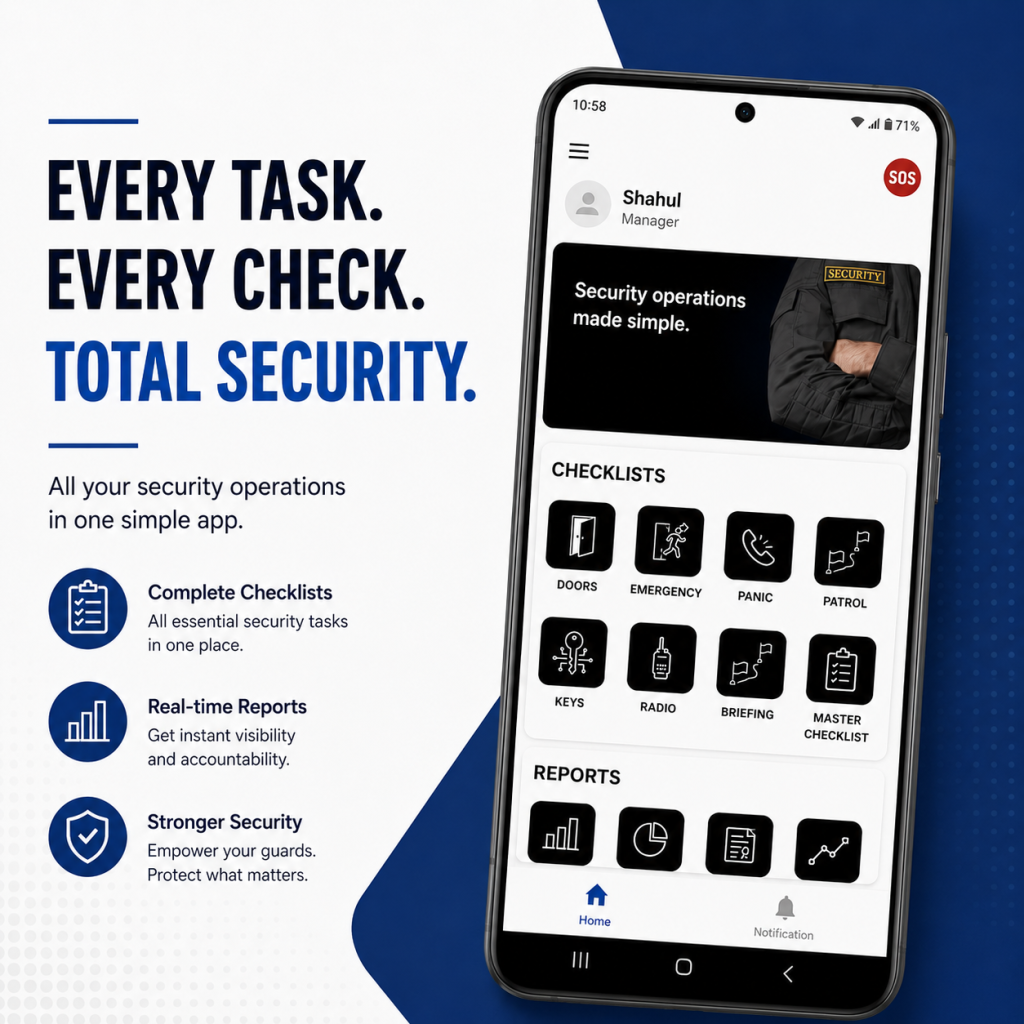
    Curious how AVES turns this same checklist into a digital patrol and occurrence log that guards actually use on shift? Book a walkthrough and see it on a real screen →

    CONTACT US

    Website: https://www.avessecurity.com

    LinkedIn: https://www.linkedin.com/company/aves-security-management-system/

    Instagram: https://www.instagram.com/avessecurity/
    FAQ

    Do I need a separate checklist for every site?

    Not a separate one exactly, more of an adjusted one. The five stages carry over no matter the site, since this security guard checklist is meant to be a base, not a rigid form. What changes underneath them is which specific items matter, since a warehouse and a retail store aren’t watching for the same things.

    Paper or phone, which one should guards actually use?

    Both get the job done day to day. Paper’s simple, and guards already know how to use it without training. The catch is what happens afterward: the paper shows the boxes got filled in, not that anyone was actually there when it happened. A phone-based version timestamps and locates the entry without anyone having to think about it.

    What’s the step guards skip the most?

    Getting the handover actually acknowledged by the incoming guard, rather than just talked through on the way out the door. Easy to skip, but it’s usually the one thing that decides whether the next shift can trust what’s on the page.

    Isn’t this the same thing as a duty roster?

    No roster tells you who’s working and when. This is what that person is meant to actually do once they’re on post. They sit next to each other, but one’s about staffing and the other’s about what happens during the shift itself.

    Does filling in a checklist actually prove the rounds happened?

    Not by itself. It shows boxes were ticked, not necessarily when or where. If you need something closer to actual proof, timestamped checkpoint scans tied to a location, that’s what guard duty verification covers.

  • Training Management System for Security Guards: The Essential Guide to Tracking Training and Records

    Training Management System for Security Guards: The Essential Guide to Tracking Training and Records

    A training management system is supposed to fix one simple problem: training that nobody wrote down might as well not have happened. Ask most security companies how they track guard training, though, and you’ll hear the same answer nine times out of ten. A folder somewhere. A supervisor’s memory. Maybe a spreadsheet nobody’s touched since spring.

    A guard sits through a class. Nobody logs it anywhere searchable. Fast forward three months, a client wants proof that every officer on their site completed fire safety training, and now you’re digging through old attendance sheets and screenshots from a group chat, trying to reconstruct something a proper training management system would’ve handed you in thirty seconds.

    Here’s what most companies don’t want to face: training nobody wrote down doesn’t count, not to a client, an auditor, or an insurance adjuster. That’s the exact gap a training management system exists to close, and before you convince yourself your current setup is “fine,” it’s worth understanding what a good one actually looks like.

    Why a Training Management System Matters More Than Most Companies Realize

    Two reasons this matters, and most companies only ever think about one of them.

    First, client trust. When a client asks whether your guards are trained for their site, handing them dates and records from a real system builds a lot more confidence than “yeah, we handle that.” Contracts these days increasingly expect proof upfront, not a vague promise that training happens somewhere in the background.

    Second, and this is the one that really catches people off guard: liability. If something goes wrong on a shift and training becomes a question, a training management system that shows exactly what an officer completed and when is the difference between a defensible position and pure guesswork. Lawyers and insurers don’t ask fuzzy questions. “We train our guards” won’t cut it. A dated record will.

    Without one behind you, both of those things ride entirely on someone’s memory holding up months, maybe years, after the fact. That’s a bad place to be standing when it counts.

    How a Training Management System Works in AVES

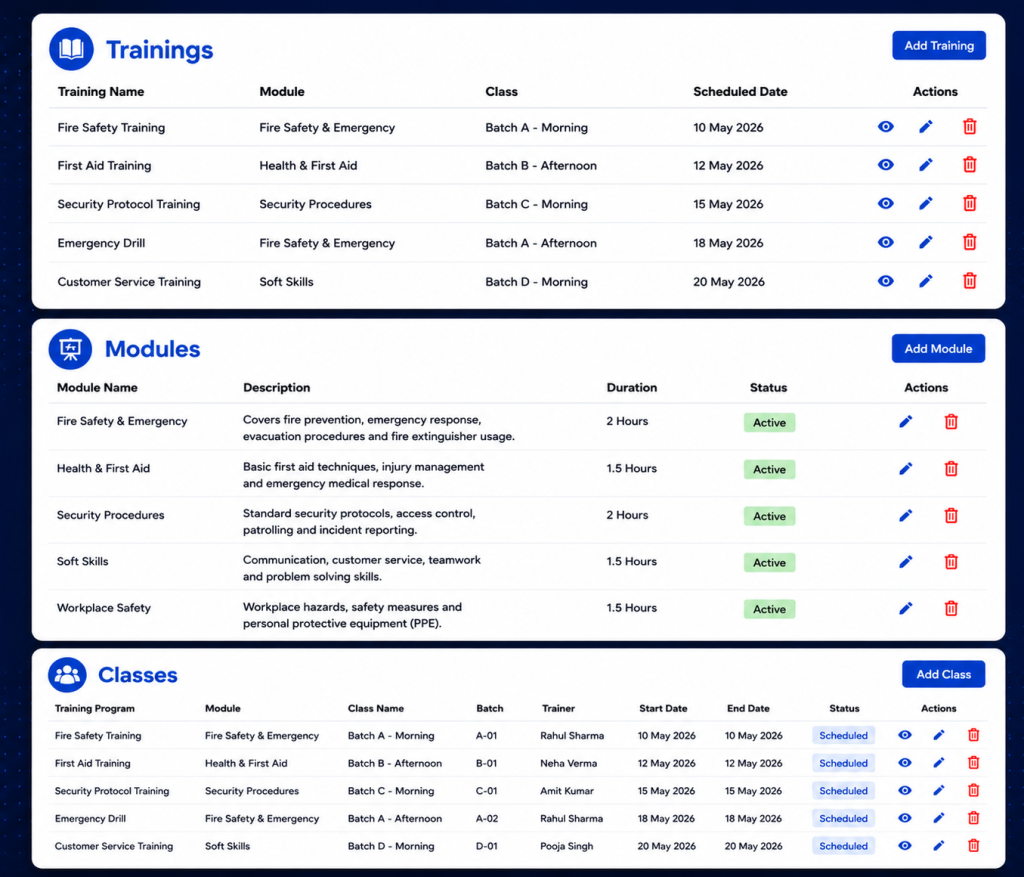
    AVES builds its training management system into the Staff Development section of the mobile app, right next to Performance Development Plan. Open Training and two paths show up: All Trainings and Records. They do very different jobs, so it helps to know which one you’re actually in.

    All Trainings is where sessions get built and managed. You can add or update training programs here, and, this part matters, assign them to specific users or departments instead of blasting them out to the whole team. Not every guard needs every training. Fire marshal certification might apply to one shift only. A first-aid refresher might just be for one department. Being able to target instead of broadcast keeps the list something people actually pay attention to, instead of noise they scroll past.

    Records, labeled Security Trainings, is the other half, and it works nothing like the first. Picture a calendar. You flip through months, land on a day, and see whatever got logged for that date. Nothing there? It just says so: no data available for that date. That’s the piece that turns a one-off event into something you can actually revisit later. Instead of asking a supervisor “hey, when was that class again,” you click the date and there’s your answer.

    One thing you won’t find here: a certification-expiry tracker, or anything resembling a compliance-scoring dashboard. If tracking exact expiry dates and renewal reminders matters to your business, that detail lives inside the individual training entry itself. The list and calendar views don’t surface it automatically.

    Getting Real Value Out of Your Training Management System

    A training management system is only as good as the habits around it. A few habits separate a training record that’s actually useful from one that just looks fine sitting there.

    Name your sessions like they mean something. “class1” tells you nothing six months later, not even to the person who typed it in. “Fire Safety Refresher, Site 4, Q3” tells a whole story the moment someone opens it.

    Only assign by department when the entire department genuinely needs it. It’s tempting to go broad “just in case,” but that buries the training under noise for everyone who didn’t need it, and makes it harder to spot who actually still has to complete it.

    Log it the day it happens. Records sorts by date, so a session entered three days late lands under the wrong day. It chips away at accuracy quietly, until you notice it during an audit and it’s too late to fix.

    Check Records regularly. Not just when a client comes asking. A monthly look catches gaps while you can still do something about them.

    The Mistakes That Undo a Training Management System

    Same handful of mistakes, over and over, even at companies with a solid system already sitting in their pocket.

    Vague naming tops the list. A training log full of “class1,” “class2” technically counts as a record. It just fails the actual point, which is answering a real question later, quickly and without guesswork.

    Over-assigning is next. Push a single-department training out company-wide and you bury the people who actually need to act on it under a pile of people who don’t.

    Then there’s confusing scheduled with logged, a subtler trap. A session sitting in someone’s calendar or a group chat thread isn’t proof of anything. Only an entry under Records, for that date, counts.

    And the big one: waiting for a client to ask before you check your own records. By then you’re not reviewing, you’re scrambling. Scrambling almost never produces a clean answer.

    Where a Training Management System Fits Into the Bigger Picture

    It doesn’t live on its own island. It ties directly into your duty roster and shift assignments, because whether a guard was actually qualified for a given post on a given shift depends partly on their training record. It sits right beside Performance Development Plan too, both feeding into a documented picture of how ready your team really is, not just how ready you assume they are.

    A training session nobody logged is a session you can’t prove happened. In this line of work, what you can prove tends to matter more than what you simply know to be true. AVES keeps checklists and dated training records in one training management system your guards already use for shifts and attendance, with the option to assign precisely instead of blasting everything to everyone by default.

    If you want to see how AVES handles this as a training management system in practice, you can explore the platform and request a demo at avessecurity.com.

    Frequently Asked Questions

    What is a training management system for security guards?

    A training management system for security guards is a software that helps you keep track of the training that security guards have completed. It is a place where you can log, assign and track the training of security guards, which’s better than using paper sign-in sheets or trying to remember who did what. This system gives you a record of who completed what training and when which’s very useful.

    Why do security companies need a training management system for security guards?

    Security companies need a training management system for security guards because clients and insurers often ask for proof of training. A training management system for security guards gives you the proof you need so you can give them an answer instead of just guessing.

    How is training assigned in a training management system like AVES?

    In a system like AVES training can be assigned to security guards or to entire departments. This means that each security guard only sees the training that’s relevant to them instead of seeing a long list of training that does not apply to their job or the site they work at.

    Does a training management system track certification expiry dates?

    Not all training management systems track certification expiry dates automatically. For example in AVES you have to look at the training entry to see the expiry and renewal details. So if you need to keep track of these dates for compliance you should check them directly.

    How often should I check my training management systems records?

    You should check your training management systems records at once a month. If you do this you can catch any gaps in the training schedule. Fix them before it is too late. This is better than finding out about the gaps during an audit when it is already too late to do anything about them.

    Can a training management system prevent liability issues?

    A training management system for security guards cannot prevent incidents from happening. It can help protect you after an incident occurs. If someone asks about the training that security guards received during an investigation a training management system for security guards gives you a record of the training that you can use to defend yourself. This is much better, than guessing what training was completed.

    CONTACT US

    Website : https://www.avessecurity.com

    Linkedin: https://www.linkedin.com/company/aves-security-management-system/

    Instagram: https://www.instagram.com/avessecurity/
  • Chaos to Clarity: The Security Reporting Software Advantage

    Chaos to Clarity: The Security Reporting Software Advantage

    You are asked for a monthly report and your stomach tightens a little. You know the numbers exist somewhere. You just do not know how long it will take to pull them together into something you can actually hand a client.

    That scramble is the exact problem the right security reporting software is supposed to remove. If you have ever built a report by copying numbers into a spreadsheet at eleven at night, this article is for you.

    Why This Feels Harder Than It Should

    Most security companies do not lose client trust because guards fail to show up. They lose it because nobody can produce a clean, professional record fast enough when a client asks for one.

    You already sense this, which is why you are reading about security reporting software instead of just accepting the status quo. You want something that produces a document you can hand over without apologizing for how it looks.

    The quiet fear underneath this search is simple. What if the tool looks fine in a demo, then falls apart the first time you actually need a real report under a real deadline? That fear deserves a straight answer, not a sales pitch.

    What Good Security Reporting Software Actually Does

    Strip away the marketing language and real security reporting software comes down to one core job. It needs to turn your operation’s activity into a branded, filterable document you can export and hand off, without you rebuilding it by hand every time.

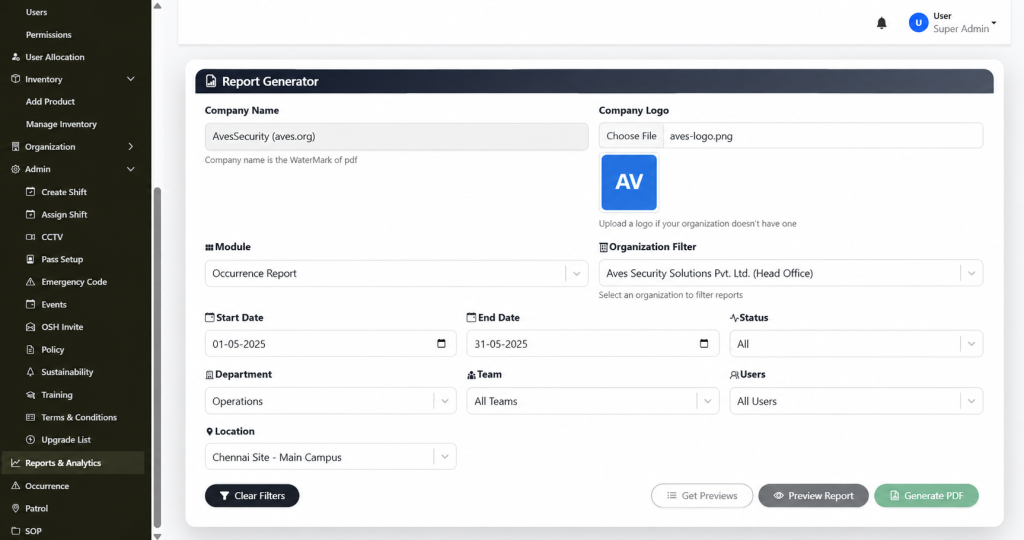
    A dedicated report generator is where this either works or falls apart. A real one lets you set your Company Name, which gets used as the watermark on the exported PDF. It lets you upload a Company Logo and falls back to a clean initials placeholder if you have not uploaded one yet. You pick a Module to define what the report covers. You apply an Organization Filter to scope it. You set a Start Date and End Date. You can narrow further by Status, Department, Team, Users and Location. Then you preview it and generate a branded PDF.

    That is what functioning security reporting looks like when it is built around real filters instead of a vague “export” button that dumps raw data with no formatting.

    The Mistake Most Buyers Make

    Here is something most comparison articles will not tell you. A lot of vendors advertise security reporting software as a headline feature, then the actual export screen turns out to be a single button with no filters, no branding and no date range control.

    The fix is to ask a blunt question before you commit to anything. Can I filter by module, department, team and date range and will the output actually carry my company name and logo? If the honest answer is no, that is not real security reporting software. That is a raw data dump with a nicer name attached.

    Another mistake worth naming. Buyers often assume that once a Generate PDF button exists, the tool is done being evaluated. It is not. You still need to know what that PDF actually looks like once it lands in your hands, because a cluttered, unbranded export creates almost as much extra work as building the report yourself.

    Being Honest About What Is Still Unproven

    Trust gets built through honesty, not perfect promises, so here is the part worth saying plainly. A filter-rich report generator is a strong sign of serious security reporting software, but a few things still need to be confirmed before anyone should treat this as a finished picture.

    It is not yet clear whether the Organization Filter supports comparing multiple organizations side by side in one report, or whether it is scoped to one organization at a time. It is not yet confirmed whether reports can be scheduled to run automatically, or whether every export has to be triggered manually. And the exact layout of the finished PDF, once generated, has not been reviewed yet.

    None of that changes the core value of what is confirmed. It just means anyone evaluating security reporting should ask these specific questions directly, rather than assuming the answer based on what a filter panel implies.

    What It Feels Like Once It Actually Works

    Picture the next time a client asks for a report. Instead of opening a spreadsheet, you open Reports & Analytics. You pick the module, set your date range, apply the department and location filters you already know matter and click Preview Report. Your company name is already watermarked in. Your logo is already sitting in the corner. You click Generate PDF and you are done.

    That is the practical payoff of choosing a tool built with real filtering and branding in mind, instead of treating export as an afterthought. The report stops being a task you dread and becomes something you produce in minutes.

    Over time this compounds. Clients start associating your reports with a professional, consistent look. New admins on your team can generate the same report without you walking them through it. Compliance requests stop turning into fire drills.

    Deciding If This Is Right For You

    You do not need to take a vendor’s word for how well their security reporting software actually performs here. Ask for a live demo where they generate a real PDF in front of you, with a real module, a real date range and their own branding applied. Watch whether the filters actually narrow the data or just sit there decoratively.

    If what comes out the other end is a clean, watermarked, properly filtered document, you are looking at security reporting software built around how reports actually get used, not just how they get advertised.

    You already know your operation needs faster, cleaner reporting than a spreadsheet built at the last minute. The question now is simply finding a version of security reporting software honest enough to show you exactly what the export looks like before you commit to it.

    Quick Answers Before You Move Forward

    Is security reporting software the same as a full analytics suite? No and it is worth being clear about that difference. A login dashboard style of security reporting software gives you a real-time summary. A full analytics suite adds scheduled exports and cross-site comparisons on top of that. Many teams only need the first one to start.

    How long does it take to see value from security reporting software? If the dashboard pulls from real activity already happening in your other modules, value shows up on day one. You are not waiting weeks for data to accumulate before the numbers mean anything.

    What should disqualify a vendor during a demo? If their version of security reporting cannot show you a live login with real counts and instead relies on screenshots or a promise that “it will look like this,” treat that as a warning sign rather than a minor gap.

    Ready to see it yourself? Book a live walkthrough and watch a branded report get generated in real time, filters and all.

    CONTACT US

    Website : https://www.avessecurity.com

    Linkedin: https://www.linkedin.com/company/aves-security-management-system/

    Instagram: https://www.instagram.com/avessecurity/
    What is security reporting?

    Security reporting software is a digital solution that helps security companies create, manage and export professional reports for incidents, patrols, attendance, audits and daily operations from a centralized platform.

    Do I need to upload a company logo to generate a report?

    No. The Company Logo field is optional reports still generate with the watermark from your Company Name even without a logo.

    Can I filter a report by department or team specifically?

    Yes. Department, Team and Users are all separate, optional filters, so you can narrow a report down to a specific group rather than pulling everything.

    How does security reporting software improve reporting efficiency?

    Security reporting software eliminates manual paperwork by allowing users to filter data, generate branded PDF reports and access records instantly, reducing reporting time from hours to minutes.

    Who can benefit from security reporting software?

    Security agencies, facility management companies, corporate security teams, hospitals, educational institutions, residential communities, manufacturing plants and commercial campuses can all benefit from security reporting software.

    How secure is the data stored in security reporting software?

    Reliable security reporting software protects data through user authentication, role-based permissions, encrypted storage and detailed activity logs to ensure only authorized users can access sensitive information.

    Why should I replace spreadsheets with security reporting software?

    Unlike spreadsheets, security reporting software automatically organizes data, reduces human errors, generates professional reports instantly and provides searchable digital records that improve productivity and client confidence.

    Can reports be filtered before exporting?

    Yes. Most advanced security reporting software lets users filter reports by module, date range, location, department, team, user, or report status before generating the final PDF.

    Is security reporting software suitable for multi-site security operations?

    Yes. Good security reporting software enables organizations to filter reports by location, department, team, or site, making it easier to manage multiple security operations from one platform.

    Is security reporting software the same as a full analytics suite?

    No and it is worth being clear about that difference. A login dashboard style of security reporting software gives you a real-time summary. A full analytics suite adds scheduled exports and cross-site comparisons on top of that. Many teams only need the first one to start.

  • Lone Worker App: 3 Steps to Duty of Care

    Lone Worker App: 3 Steps to Duty of Care

    A lone worker app exists to answer one question: if a guard on a night patrol, a technician on a remote site visit or a caregiver doing a solo home visit runs into trouble, how quickly does anyone else find out? Duty of care doesn’t mean eliminating that risk; it means building a system that notices quickly if something’s gone wrong and gets help moving before too much time passes.

    A lone worker app is built from three pieces: a way to check in, a way to raise an alarm and a clear path for what happens next.

    This piece walks through what each of those three pieces should do in a lone worker app and why the gaps between them are usually where duty-of-care programs actually fail not in any single feature, but in the seams connecting them.

    Why a lone worker app isn’t one feature

    It’s tempting to think of a lone worker app as a single button press it, help comes. In practice it’s a chain: something has to prompt a check-in or accept a manual alert, something has to notice if that check-in doesn’t happen, someone has to be notified and someone has to actually respond.

    A lone worker app that’s strong on the alert button but has no defined escalation path leaves a worker’s safety depending entirely on them successfully pressing a button while in distress which is exactly the scenario the app is meant to cover for.

    Check-ins: what a lone worker app should log

    The simplest and most common layer is a scheduled or location-triggered check-in a worker confirms they’re safe at set intervals or a system logs their presence automatically as they move through defined zones.

    Geofence-based attendance is one practical way to do this: a check-in is recorded automatically when a worker enters or exits a defined area, tied to their shift and location rather than relying on them to remember to tap something on a schedule.

    AVES supports this model today geo-verified attendance that ties a worker’s location to their roster, so presence at a site is a timestamped, auditable fact rather than a guard’s word.

    That’s a genuinely useful foundation for duty of care: it gives a supervisor a record of where someone was and when, which is the raw material any escalation decision depends on.

    What it doesn’t do on its own is tell anyone that a check-in was missed and automatically start a countdown toward escalation that’s a distinct piece of logic, covered below.

    Manual alerts: what a lone worker app needs beyond check-ins

    The second layer is the one a worker triggers themselves when they know something’s wrong a duress or SOS alert. AVES provides this as a standing feature: real-time SOS alerts and notifications that fire the moment someone raises them, rather than waiting for a shift-end report.

    This is the layer that matters most in the seconds after an incident, because it doesn’t depend on a scheduled check-in cycle catching up it’s immediate and it’s under the worker’s control.

    The honest caveat here is that a manual alert only works if the worker is conscious, free and physically able to reach a device which is precisely the situation that fails after a fall, an assault or a medical event.

    That’s the gap that automated detection layers (below) are built to close and it’s worth knowing whether that gap matters for your specific risk profile before assuming a manual SOS button alone is sufficient duty of care.

    What a lone worker app should escalate to and what’s confirmed here

    This is where a genuine duty-of-care program typically adds two more pieces and it’s also where we want to be precise about what AVES currently offers versus what’s standard across the broader lone-worker category:

    • Missed check-in escalation if a scheduled or expected check-in doesn’t happen, the system automatically notifies a supervisor or escalation contact after a defined grace period, without anyone having to notice the absence manually.
    • Man-down / no-motion detection using device sensors to detect a fall, an impact or a prolonged period without movement and triggering an alert automatically, with no action required from the worker at all.

    Both of these are common in dedicated lone-worker platforms and both close the gap that manual SOS alerts and simple attendance check-ins leave open.

    As of this writing, we haven’t found either of these confirmed as a current AVES feature the site documents SOS alerts and geo-verified attendance clearly, but doesn’t describe automated missed-check-in escalation or motion-based man-down detection.

    If your program specifically needs those two capabilities, that’s worth confirming directly rather than assuming they’re bundled in.

    What duty of care asks of a lone worker app

    Setting aside any specific product, a defensible lone worker app generally needs to be able to answer a few questions after the fact, not just in the moment:

    • Who was working alone, where and during what window? this is what shift and roster data, tied to geo-verified check-ins, gives you.
    • Was there a way for that person to raise an alarm and did it reach someone in real time? this is what an SOS/alert feature answers.
    • If they couldn’t raise an alarm themselves, would anyone have known? this is the question that missed-check-in escalation and man-down detection exist to answer and it’s the one worth pressure-testing against whatever system you’re evaluating.
    • Is there a record of all of it afterward? for compliance and for reviewing what worked or didn’t after an incident.
    • Duty of care for lone and isolated workers isn’t just good practice in many jurisdictions it’s a legal obligation. In the US, the OSHA General Duty Clause requires employers to provide a workplace free from recognized hazards, which extends to workers operating without direct supervision.
    • In the UK, the HSE’s guidance on lone workers sets out specific expectations for risk assessment and monitoring. A lone worker app is one way to operationalize that obligation but the obligation exists independent of whichever tool you choose to meet it.

    Building the escalation path into a lone worker app

    Whatever combination of check-in and alert features a lone worker app provides, the escalation path itself is a policy decision that sits on top of the tooling, not inside it:

    • Define the grace period how long after a missed check-in before someone is notified. Too short and you get alert fatigue; too long and the point of the system is lost.
    • Name a real escalation contact, not “security” as an abstraction a specific role that’s staffed and reachable during the hours lone workers are actually out.
    • Set a secondary escalation tier if the first contact doesn’t acknowledge within a set window, who’s next.
    • Decide what “resolved” looks like a check-in resuming, a supervisor physically confirming the worker’s status or an explicit stand-down. Don’t leave an open alert quietly aging out.

    Where this leaves you

    If your lone worker exposure is mostly about knowing where people were and giving them a fast way to call for help, geo-verified check-ins paired with real-time SOS alerts both of which AVES supports today cover a meaningful part of that duty-of-care picture.

    If your risk profile specifically requires automatic detection when someone goes silent or goes down without pressing anything, that’s a distinct capability worth confirming directly before you build a program around the assumption it’s already there.

    FAQ

    What is a lone worker app?
    It’s software that keeps tabs on employees working alone a night guard, a field technician, someone doing a solo home visit. Check-ins, an alert button and someone on the other end who actually responds.

    What features matter most?
    A way to log that someone’s okay (usually location-based check-ins), a button they can press if something’s wrong and a plan for what happens if neither of those things checks out.

    Can the app handle everything on its own?
    Not really. The app can send alerts, but someone still has to decide the grace period, who gets called first and when an alert counts as closed. That part’s on the organization.

    Is this legally required?
    Often, yes. OSHA’s General Duty Clause in the US and HSE guidance in the UK both put the responsibility on employers to protect workers who aren’t directly supervised.

    Does AVES have this?
    AVES does geo-verified check-ins and real-time SOS alerts. Automatic missed-check-in escalation and man-down detection we’d check with AVES directly before assuming those are included.

  • AVES Occurrence Log Walkthrough: How Daily Occurrence Reporting Works

    AVES Occurrence Log Walkthrough: How Daily Occurrence Reporting Works

    Every security site racks up dozens of small, easy to forget moments in a single week. A jammed door. A strange vehicle circling the lot twice. A guest who wandered somewhere they shouldn’t have.

    None of it is a full blown incident on its own. But it all matters. Without occurrence reporting software, these details end up living in a supervisor’s memory, a scribbled note, or nowhere at all. Ask what happened last Tuesday night three weeks later and good luck getting a straight answer.

    That’s the real cost of paper based occurrence tracking. It’s not one dramatic failure. It’s a slow leak of institutional memory, one shift at a time. Occurrence reporting software exists to plug that leak. A security occurrence logging system that actually sits inside a guard’s daily dashboard, rather than a side notebook nobody can find, turns “I think someone mentioned that” into something you can actually pull up and read.

    What Occurrence Reporting Software Actually Replaces

    Before any of this existed, most sites ran on an occurrence book. A physical logbook handed from shift to shift. It worked, more or less, right up until the book went missing, a page tore out, or the night guard’s handwriting turned out to be unreadable by morning.

    Occurrence book software solves the exact problem the paper version was built for, minus the physical object that gets lost, spilled on, or left in the wrong guard shack.

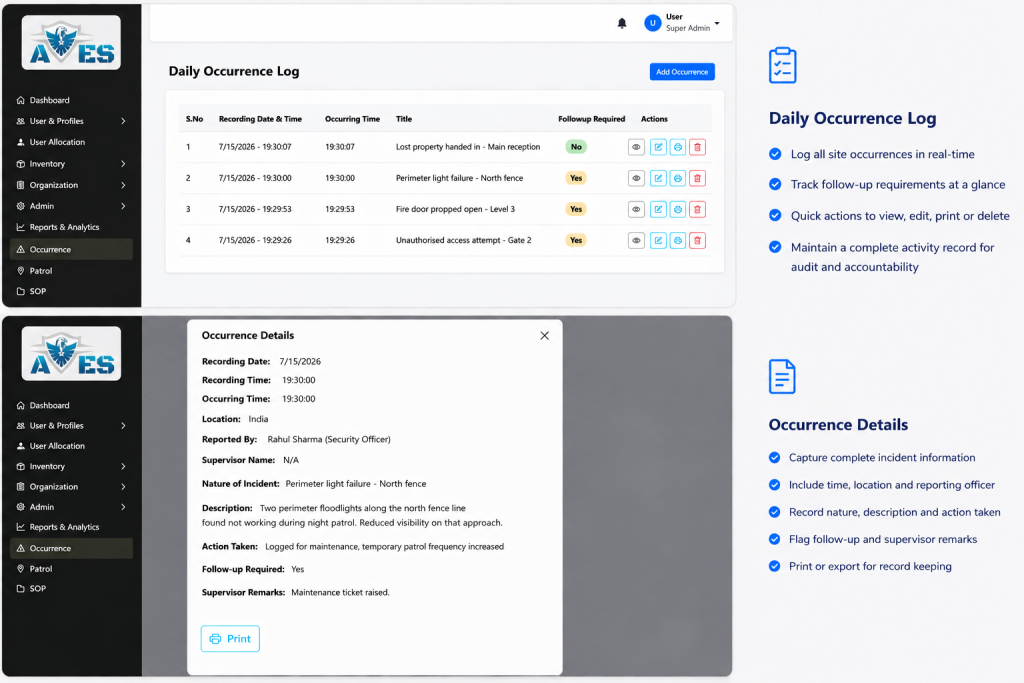
    In AVES, all of this lives under one module, simply called Occurrence, reached from the sidebar via Occurrence → Daily Occurrence Log. Worth saying plainly, this is occurrence reporting software in its most stripped down form. It’s not trying to be an escalation engine or some severity scoring dashboard. It’s a structured place to log what happened, who logged it and whether it needs a second look.

    How the Occurrence Log Actually Works

    Here’s security occurrence logging in practice, the actual steps, as they run inside the AVES dashboard.

    Go to Occurrence → Daily Occurrence Log. Click Add Occurrence, top right. Fill in the form: Occurring Time, Location (pulled from a dropdown of existing locations, not free text), Reported By, Nature of Incident, Description, Action Taken, Follow-up Required (a Yes/No dropdown) and Supervisor Name Remark. Click Submit.

    The entry lands in the Daily Occurrence Log table with a Serial Number, Recording Date & Time, Occurring Time, Title, Follow-up Required status and an Actions column.

    From there, Actions gives a supervisor three moves. View Details on the full record. Edit any field. Or Delete the entry outright. A confirmation prompt fires first, so nothing vanishes by accident. That’s the whole lifecycle of one entry in this occurrence reporting software. Log it, review it, act on it if it needs acting on.

    Two Fields That Do Different Jobs

    Here’s a small detail in this event logging software for security teams that trips people up. Nature of Incident and Description look similar, but they’re not meant to duplicate each other.

    Nature of Incident is the short label, a quick tag for what kind of thing happened. Description is the fuller account, in the reporting guard’s own words.

    Treat them as interchangeable and you’ll under-use the whole feature. Fill in both properly and the log turns into something a supervisor can actually scan a week later without opening every single record one by one.

    Why a Security Event Recording System Beats a Notebook

    The case for a real security event recording system over a paper occurrence book was never about looking modern. It’s about what happens when something goes sideways three weeks later and someone asks, “didn’t we have trouble at that gate before?”

    A notebook only answers that if someone remembers which page to flip to. A structured log answers it in seconds. Every entry carries the same fields, in the same order, searchable by date, location, or supervisor name.

    That consistency is really the whole point. Occurrence reporting software doesn’t make guards write more. If anything, a dropdown driven form is usually faster than freehand notes. What it does is make what they write usable later.

    Built this way, a security event recording system turns a shift’s worth of scattered observations into one clean, chronological table any admin can pull up from the dashboard. No filing cabinet required.

    What This Occurrence Reporting Software Doesn’t Claim to Do

    Honesty matters more than a padded feature list here. This occurrence book software isn’t an escalation platform. There’s no severity scale attached to an occurrence, just the Follow-up Required Yes/No flag. Marking it Yes doesn’t automatically ping a supervisor.

    It’s a manual review signal, not an automated routing trigger. Any site rolling this out should train guards and supervisors around that fact. Follow-up Required is the only signal in the record that something needs a second look, so defaulting it to No without genuinely reviewing each entry kind of defeats the point of having the flag.

    Getting the Most Out of Security Occurrence Logging

    A few habits make this style of security occurrence logging actually worth the effort.

    Use the Location dropdown on purpose. Since it pulls from pre-set locations rather than free text, consistent location data is what makes searching the log later actually useful.

    Don’t skip Action Taken. It’s easy to log what happened and forget what the guard actually did about it, but that’s often the one detail a client or supervisor cares about most.

    Review Follow-up Required entries on a set schedule, not just whenever someone happens to open the log. There’s no automated escalation here, so the flag only earns its keep if someone’s actually checking it.

    Choosing Occurrence Reporting Software for Your Site

    If you’re sizing up occurrence reporting software for the first time, don’t judge it by how many extra features get bundled in.

    The real test is simpler than that. Does it capture Occurring Time, Location, Reported By, Nature of Incident, Description, Action Taken and Follow-up Required without friction and can you actually find that record again later?

    A security event recording system that nails those basics will beat a bloated one that half does everything, every time. Same goes for occurrence book software sold with dashboards and analytics it can’t really back up. Ask to see the actual entry form before you sign anything.

    The Bottom Line

    Security teams don’t need more paperwork. What they need is occurrence reporting software that turns five minutes of typing into a record that’s still worth something six months from now.

    Call it occurrence book software, call it a security event recording system, or just call it event logging software for security operations. The job underneath is the same. Capture what happened, in a consistent shape, before it disappears into someone’s memory.

    Get that right and “no more lost records” stops being a slogan and starts being how the site actually runs.

    Every site already has these small moments happening every shift. The only question is whether they disappear into someone’s memory or end up somewhere you can actually pull up six months from now.

    Want to see the Daily Occurrence Log in action, the actual form, the actual dashboard in AVES? Book a walkthrough of AVES and watch it happen on a real screen →

    CONTACT US

    Website : https://www.avessecurity.com

    Linkedin: https://www.linkedin.com/company/aves-security-management-system/

    Instagram: https://www.instagram.com/avessecurity/
    What exactly is occurrence reporting software?

    Basically a digital stand-in for the old paper occurrence book. Instead of a guard scrawling something in a notebook that might get lost or torn, they fill in a form, time, location, who reported it, that kind of thing and it just sits there in a searchable table instead of a drawer somewhere.

    Isn’t this basically the same as an incident report?

    Not quite. This is for the smaller stuff. A jammed door, a car circling the lot twice, someone wandering somewhere they shouldn’t. No severity rating or anything like that, just a Follow-up Required flag if something’s worth a second look.

    Can you fix or delete an entry after it’s already submitted?

    Yeah. There’s a View Details option, an Edit option and a Delete option, though deleting asks you to confirm first so you don’t lose something by accident.

    Is “occurrence book software” a different thing from this, or basically the same?

    Same thing, different name. Occurrence reporting software, occurrence book software, event logging software for security, people just call it different things depending on who’s selling it. The job underneath doesn’t change.

    Does this mean guards don’t need to write much anymore?

    Not exactly, it just gives their notes somewhere useful to go. People skip the Action Taken field a lot, honestly and that’s usually the one thing a client actually wants to know.

    Why does Location use a dropdown instead of just letting guards type it in?

    Because if ten different guards type “front gate” ten different ways, good luck filtering by location six months from now. The dropdown keeps things consistent enough to actually search later.

    Nature of Incident vs Description, what’s actually different there?

    People mix these up constantly. Nature of Incident is more of a quick label, like a category. Description is the real story in the guard’s own words. You need both filled in properly or the log ends up half useful.

  • Defect and Damage Reporting: Stop False Claims, Win Trust

    Defect and Damage Reporting: Stop False Claims, Win Trust

    A guard walks past a cracked window on Tuesday. Nobody writes it down. Three weeks later, a tenant claims the crack happened during a break-in that never occurred and there is no record proving otherwise.

    This is the scenario that keeps security company owners up at night. Not the incident itself, but the complete absence of proof on the days before it.

    If you are researching a defect and damage reporting tool right now, you already know this fear. You are not looking for a generic maintenance app. You are looking for a way to protect your company the next time someone tries to blame your guards for damage that was already there.

    This guide is written for exactly that. No fluff, no recycled definitions. Just what a defect and damage reporting tool actually solves, what it costs to skip and how to choose a defect and damage reporting tool that holds up when a client or a lawyer starts asking questions.

    What a Defect and Damage Reporting Tool Actually Means

    A defect and damage reporting tool is how a security team documents the physical condition of a site, cracked glass, broken locks, damaged fencing, faulty equipment, before, during and after a shift. It exists to answer one question clearly: was this already broken, or did it happen on our watch?

    Done on paper, this looks like a maintenance note scribbled at the end of a shift, if it gets written at all. Done properly through a defect and damage reporting tool, it becomes a timestamped, photo-backed record that either clears your guards or flags a real issue immediately.

    The gap between those two versions is exactly where false damage claims against security companies come from.

    Why Skipping This Quietly Costs You Later

    Most security companies don’t decide to skip damage documentation. They simply never build a habit around it, so it only happens when someone remembers.

    Here’s what nobody tells you until a claim lands on your desk.

    No baseline means no defense. If nobody documented the site’s condition at shift start, you have no way to prove damage existed before your guard ever arrived.

    Verbal reports disappear. A guard mentioning something to a supervisor in passing is not a record. By the time a claim surfaces weeks later, that conversation is gone.

    Maintenance issues get discovered too late. A faulty gate or broken camera that never gets logged stays broken until it causes a bigger problem, often right when you need it working most.

    Clients lose confidence fast. A client who receives a vague “we’ll look into it” instead of a documented defect and damage reporting tool response starts wondering what else isn’t being tracked.

    The Real Cost of Getting This Wrong

    Let’s talk about what this actually costs, not just the theory.

    A single disputed damage claim without documentation can cost thousands in a settlement your company didn’t actually cause. A pattern of undocumented site conditions can cost you the entire contract when a client decides they can’t trust your reporting.

    A defect and damage reporting tool is not a nice-to-have add-on. It is the record that stands between your company and a claim you cannot disprove. Treat a defect and damage reporting tool as optional paperwork and you are gambling with money you will eventually lose.

    What Buyers Get Wrong When Choosing a Solution

    If you are comparing options, here is where most first-time buyers get stuck.

    Mistake one: assuming photos alone are enough. A photo without a timestamp, a location and a guard’s name attached is easy to dispute in a real conversation about liability. A proper defect and damage reporting tool captures all of it automatically, which is the whole point of using a defect and damage reporting tool instead of a plain camera roll.

    Mistake two: treating this as a one-time inspection instead of an ongoing habit. Documenting site condition once at contract start is not the same as capturing it every shift. Damage happens over time and your records need to as well.

    Mistake three: choosing damage claim reporting software with no searchable history. If you can’t pull up every defect logged at a site over the last six months in seconds, the tool isn’t actually protecting you when a dispute happens.

    Mistake four: not connecting this to your broader operation. A standalone damage log that lives outside your guard’s daily workflow gets used inconsistently, which defeats the entire purpose.

    Knowing these traps in advance puts you ahead of most buyers who learn them the hard way.

    What a Properly Built System Looks Like

    A modern defect and damage reporting tool, tied to a real security operation, handles the full picture in one place. The best defect and damage reporting tool makes logging a broken lock or a cracked window faster than ignoring it.

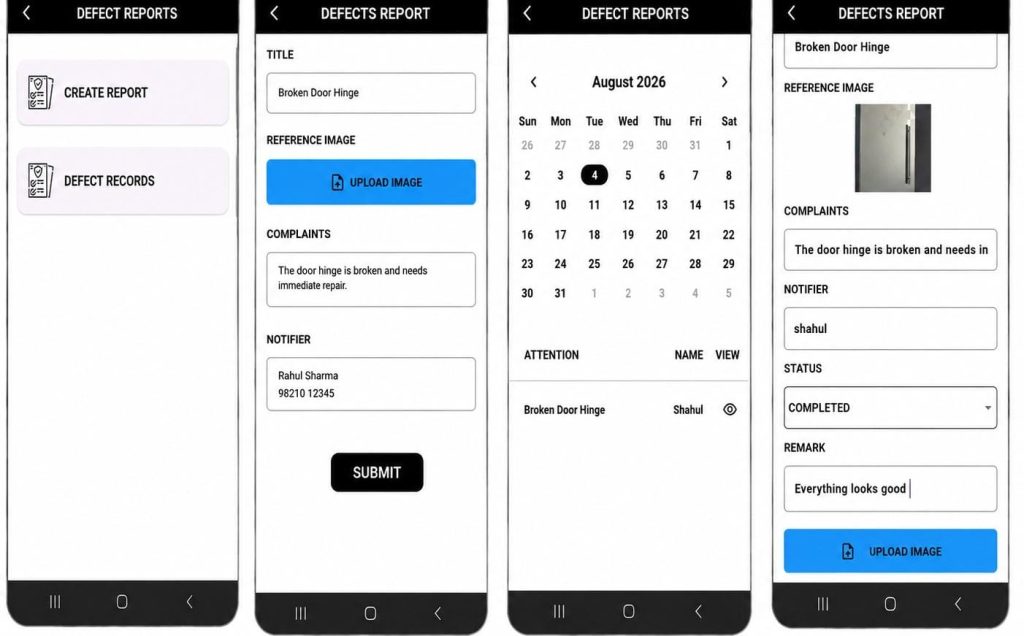
    • Capture defects with photo evidence so every issue is documented with visual proof from the field.
    • Record complete incident details including defect title, description and reporting officer in one place
    • Monitor repair progress with status updates from reported to completed, ensuring nothing is overlooked.
    • Maintain an audit trail that helps resolve disputes and proves when issues were reported and closed.

    This is not about turning your guards into inspectors. It’s about making sure the condition of a site is never a matter of memory or opinion.

    Why This Fits Inside a Bigger Security Guard Management System

    A defect and damage reporting tool rarely works well as an isolated app. It needs to sit inside a complete security guard management system, alongside patrol verification, occurrence recording and incident reporting.

    Here’s why that matters. A disputed damage claim is rarely answered by one piece of evidence alone. A logged defect, a patrol record showing who was on site and a timestamp from the same shift together tell a story that a single photo cannot.

    When damage claim reporting software lives inside the same security guard management system as patrol tracking and occurrence logs, pulling together a full defense against a false claim takes minutes instead of a frantic search across disconnected tools.

    This is the same reason established guard management software providers, from GuardsPro to Novagems to SGMS, build this kind of documentation directly into their core platform rather than leaving it as a separate purchase. Preventing fraudulent damage claims isn’t a side feature. For a lot of security companies, it’s the single most financially important thing the software does all year.

    Honest Limitations to Expect

    No system is magic and you deserve a straight answer here.

    A defect and damage reporting tool still depends on guards actually taking the time to log what they see. It won’t catch damage nobody happened to notice and no defect and damage reporting tool replaces a genuine walk-through at shift start.

    Offline coverage typically covers core actions, with photos and notes syncing once the device reconnects. Plan for a short delay in low-signal areas rather than assuming instant upload every time.

    And building the habit takes a few weeks. Guards used to only reporting the big, obvious problems will need practice logging the smaller stuff before it becomes second nature.

    Making the Decision With Confidence

    If you’ve read this far, you already understand more about choosing a defect and damage reporting tool than most people evaluating a defect and damage reporting tool for the first time.

    You know what it actually covers, why undocumented site conditions quietly become expensive claims, what mistakes to avoid and what a properly built system should include.

    The next step is simple. Ask your current process one direct question. If a client disputed damage at one of your sites today, could you produce a timestamped record proving the condition beforehand? If the honest answer is no, that’s exactly where a real defect and damage reporting tool, connected to your broader security guard management system, earns its place. That single gap is what a defect and damage reporting tool exists to close.

    Want to see how a defect gets logged, tracked and cleared in AVES? Book a live walkthrough →

    CONTACT US

    Website : https://www.avessecurity.com

    Linkedin: https://www.linkedin.com/company/aves-security-management-system/

    Instagram: https://www.instagram.com/avessecurity/
    What exactly is defect and damage reporting?

    It’s your guards keeping track of what a site actually looks like. Cracked glass, a busted lock, torn-up fencing, that kind of thing. Photo, timestamp, whoever’s name is on the shift. So nobody’s arguing later about when it happened.

    Isn’t that basically incident reporting?

    Different animal. Incident reports cover things that happen, a break-in, someone getting hurt. This is about the property itself, its condition. A cracked window might get its own quick entry, or it might show up as a line inside a bigger incident report if things escalate.

    Can a photo by itself settle a dispute?

    Not on its own, no. A photo with a timestamp and location stapled to it and a name attached, that’s what actually means something when a client pushes back or a lawyer gets involved.

    Once it’s fixed, does the record just vanish?

    No. You close it out, add a line about what got done and it stays in the history. First flagged, what happened, when it closed. All in one thread instead of getting wiped.

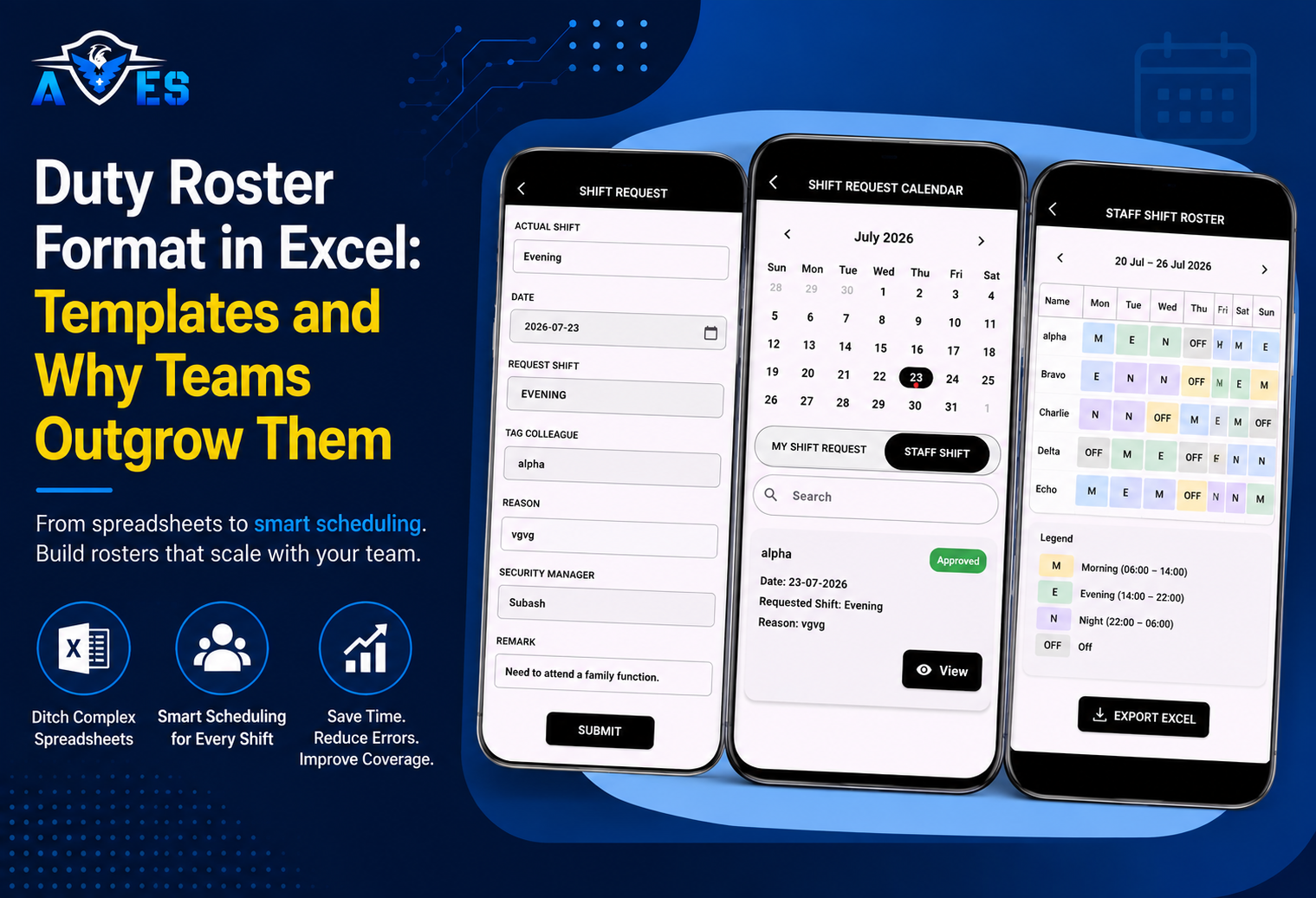
  • Duty Roster Format in Excel: Templates and Why Teams Outgrow Them

    Duty Roster Format in Excel: Templates and Why Teams Outgrow Them

    By NITHISH, AVES Security

    A duty roster Excel file is usually the first thing any growing security team builds and also the first thing that quietly starts causing problems. A supervisor I know keeps three versions of the same one on her laptop: “Roster Final,” “Roster Final v2,” and one just called “Roster Final USE THIS ONE.” She’s not disorganized. She’s just been burned enough times by an overwritten cell that she started keeping backups out of habit.

    That’s basically the story of every duty roster Excel sheet once it’s been in use for more than a few months. It works, mostly, until the day it doesn’t and then everyone remembers why they should have saved a copy.

    Here’s a format that holds up better than most and the honest version of where it eventually stops being enough.

    Duty Roster Excel Columns That Actually Matter

    Skip the fancy templates for a second. Most duty roster Excel templates you’ll find online look great in a preview and fall apart the first time a relief guard needs to check them at 5:45 in the morning, half asleep, on a phone screen.

    What actually needs to be in there:

    Guard name and ID first names alone get confusing fast, especially once you’ve got two or three guys named Kumar on the same site roster.

    Which post or gate are they assigned to? Sounds obvious. It keeps getting skipped and no one’s sure who was supposed to be covering the loading dock last Thursday.

    The date and the shift code, plus the actual start and end times written out. Please don’t ask anyone to decode “B2” from memory.

    A column for the relief guard, if there is one. Handovers that only exist in someone’s head tend to fall apart exactly when you need them not to.

    Leave, weekly off, overtime, one column, clearly marked. This alone stops a good chunk of payroll arguments before they start.

    And somewhere, a sign-off from a supervisor. Even something as basic as a checkbox saying “reviewed” catches mistakes before they become someone’s underpaid paycheck.

    Use color if you want, shift types in blue, night shifts in grey, whatever makes sense to your team. Just don’t rely on it alone. Somebody’s going to open this on a phone in bad lighting and need the text to tell the real story.

    Keep Your Duty Roster Excel Layout Boring

    The rosters that actually survive week to week are the boring ones. Guards down the side, dates across the top, shift code in each box, a little legend underneath explaining what everything means.

    That’s genuinely it.

    Where things go sideways is when someone gets clever. Formulas that try to auto-balance the shifts. Conditional formatting was stacked five layers deep because it looked neat in a tutorial video. A macro that only the person who built it two years ago actually understands and that person is now on maternity leave.

    A roster needs to make sense to a tired supervisor who just walked in at 6am. It doesn’t need to impress anyone with spreadsheet wizardry.

    Duty Roster Excel Mistakes That Show Up Almost Every Time

    If you’re setting up a duty roster Excel sheet for the first time, a few mistakes show up again and again.

    One master file, no backups, no version history. Someone types over last Tuesday’s entry and three weeks later, there’s no way to prove what the roster actually said when a guard disputes their hours.

    Confusing the roster with attendance. These are not the same thing, even though they are treated like they are constantly. The roster says who’s supposed to show up. It has zero connection to who actually did it.

    No legend or an outdated one. A new supervisor inherits the file and has no idea what “C2” or “N1” means, so they either guess or bother someone to explain it.

    Every site builds its own version separately. Nobody standardizes early and six months in, none of the sheets match up when someone tries to pull it all together.

    Where a Duty Roster Excel Sheet Actually Breaks Down

    None of this is really Excel’s fault, to be fair to it. It just wasn’t built to be a live operational record. It’s a planning tool and it does that part fine. The trouble starts when a growing operation quietly starts asking it to do more.

    There’s no audit trail once a cell gets overwritten. That old value is just gone. So when a guard says, “I worked that Saturday night,” and the current version of the sheet says he didn’t, there’s no way to check who’s right. That’s not a comfortable spot to be in when a client’s asking the same question.

    The sheet also has no idea what’s happening right now. It’ll show you the plan, sure, but it has no clue that the guy scheduled for the 10 pm gate shift hasn’t actually turned up yet. Somebody usually finds that out the hard way, after the gap has already existed for a while.

    And attendance is a whole separate problem; the roster was never built to touch. Who was scheduled and who actually clocked in are two different questions and in most Excel setups, somebody’s manually cross-referencing two files at the end of the month trying to make the numbers agree.

    When You’ve Outgrown a Duty Roster Excel Sheet

    There’s no magic number of guards where this suddenly becomes a crisis. It depends more on how many sites you’re juggling and how much proof clients expect from you these days.

    A few things worth paying attention to:

    You’re keeping the roster, the attendance log and the leave tracker as three separate files and matching them up by hand every month.

    A client asked who was on duty on a specific night and the honest answer is it took you longer than it should have to be sure.

    Shift swaps are happening over WhatsApp faster than anyone is updating the actual file.

    There’s been more than one payroll argument that traced back to “well, the sheet said something different.”

    If none of that rings a bell yet, stick with the duty roster Excel format above. It’ll do the job for a while longer.

    If it does sound familiar, the fix isn’t really about ditching Excel. It’s about the three things it was never going to be able to give you on its own: a real audit trail, a live picture of who’s actually covering a post right now and a direct link between the plan and what’s actually happening on the ground. This is exactly the gap AVES closes for security teams who’ve outgrown a spreadsheet.


    For the full breakdown on shift patterns and statutory rest rules, see security guard duty rosters. To see what a live coverage view actually looks like, check out geofence attendance or the AVES Security Guard Management System.

    Frequently Asked Questions

    1. What is a duty roster in Excel, really?

    Just a spreadsheet showing who’s working, when and where. That’s it. Small teams gravitate toward it because everyone already has Excel open half the day anyway.

    2. Does Excel actually hold up for security guard scheduling?

    For a small crew on one site, sure, it does the job. Things start slipping once you’ve got more guards, more sites, more moving pieces. Someone forgets to save the latest version, another supervisor edits a different copy and suddenly nobody’s sure which file is current.

    3. What actually needs to be in the template?

    The basics, nothing fancier:

    • Name and ID
    • Date, shift timing
    • Which post are they covering
    • Relief guard, if there’s one
    • Leave or weekly off
    • Overtime
    • A sign-off from whoever’s supervising

    That’s genuinely all it needs. People overbuild these things and it backfires.

    4. Isn’t the roster basically the attendance sheet?

    No and mixing these two up causes more headaches than people expect. The roster is the plan. Attendance is what actually happened. A guard being scheduled doesn’t mean he showed up and that gap is exactly where a lot of payroll arguments start.

    5. Why do companies eventually ditch Excel?

    Usually not because Excel did anything wrong. It’s more than the operation grows past what a spreadsheet can reasonably track. A few supervisors editing the same file, shift swaps happening every other day, a client asking who was posted last Tuesday and needing an answer fast. Excel just wasn’t built for that pace.

    6. Can one file cover multiple sites?

    You can try. In practice, it gets messy. Every site tends to build its own version and six months in, none of them match. If you’ve got more than one location, standardizing the format sooner rather than later saves a lot of pain.

    7. How often should it be updated?

    Weekly or monthly for the regular schedule. But leave approvals, emergency swaps, last-minute replacements? Those need updating right away. Sitting on it even for a day creates confusion nobody asked for.

    8. When’s it time to stop using Excel altogether?

    If you’re spending real time untangling version conflicts, chasing payroll disputes or digging through old files just to answer “who was on shift that night,” that’s usually your answer. That’s the point where a proper system with live tracking starts paying for itself.

    9. Does going digital actually help with compliance?

    It does more than people expect when they go in. You get an actual history of changes instead of a memory of what probably happened. When a client or auditor wants proof, you’re not stitching it together from three different files at the last minute.

    10. Is a duty roster the same as shift scheduling?

    Close, but not quite. Scheduling is the thinking part, working out who covers what and when. The roster is what you end up with once that thinking is done: the actual document that says who’s where.

    For more details, visit our LinkedIn AVES

  • security pass Management System: Stop Risk, Build Control

    security pass Management System: Stop Risk, Build Control

    Every security manager remembers the moment it went wrong. A visitor walked out with a laptop that was never logged in. A contractor overstayed a pass by six hours and nobody noticed. A client asked for last month’s entry records and the answer was a shrug.

    If you are researching a security pass management system right now, you already know this feeling. You are not looking for theory. You are looking for a way to stop the next incident before it happens.

    This guide is written for exactly that. No fluff, no recycled definitions. Just what a security pass management system actually solves in 2026, what it costs to get wrong and how to choose one that works in the real world for a security team, not a corporate front desk.

    What a Security Pass Management System Actually Means

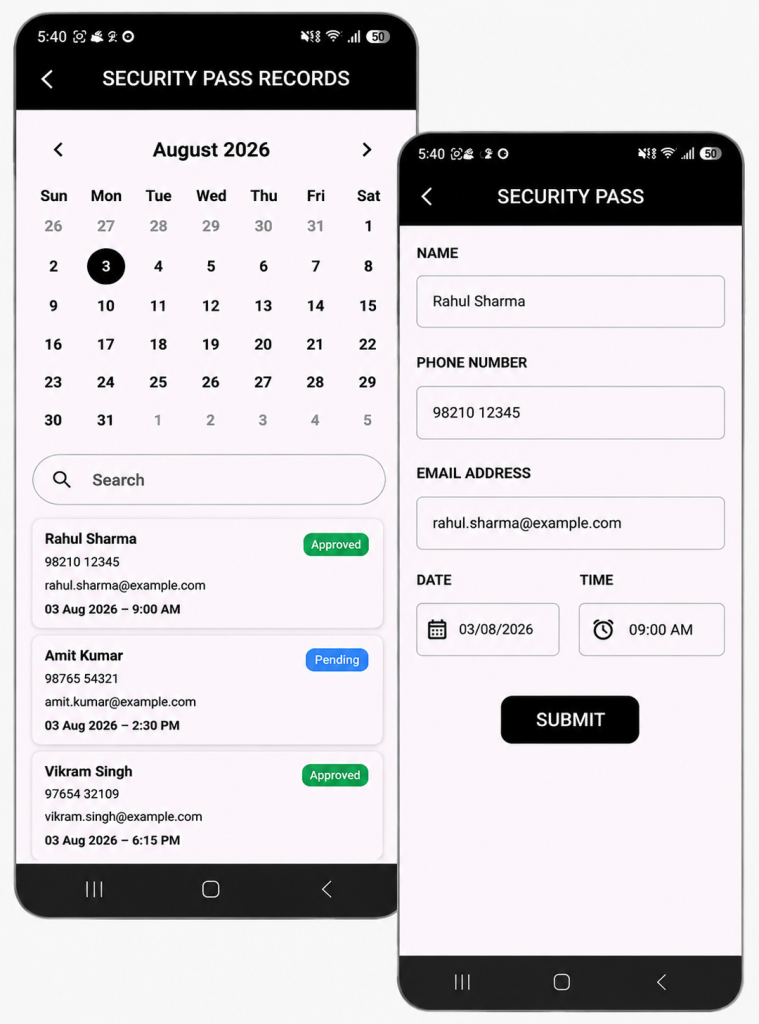
    A security pass management system is the process and the software behind creating, approving, tracking and revoking recurring, standing access for anyone who is not a permanent employee but who is on site repeatedly over days or weeks: long-term contractors, vendors on a service contract, agency staff and rotating temp workers. That is a different problem from a one-off visitor arriving for an afternoon, which our visitor management system guide covers, or a single load of material crossing the gate, which our gate pass management guide covers.

    Worth being precise about this, because the three overlap in casual conversation. A visitor pass is issued once and expires the same day. A gate pass moves an asset or vehicle across the boundary. A standing security pass persists across many visits until someone actively revokes it, which is exactly why it is the one paper systems lose track of first.

    Done on paper, it looks like a logbook at the gate. Done properly through a security pass management system, it is a live, searchable record of who entered, who approved them, how long they stayed and what they were allowed to access.

    The gap between those two versions is where most security failures happen and clients in 2026 are asking about that gap more often than ever.

    Why Paper-Based Pass Systems Quietly Fail

    Most companies do not choose to fail here. They just never upgrade to a proper security pass management system after the business grows past what a logbook can handle.

    Here is what nobody tells you until it is too late.

    Handwriting is not evidence. When a client or auditor asks for proof of who was on site during a specific incident, an illegible paper trail is not proof. It is a liability.

    Manual approvals create bottlenecks. Without a security pass management system, a supervisor has to physically sign off every pass and the front gate becomes the slowest part of your operation during peak hours.

    Nobody tracks overstays. A pass meant to expire in two hours often sits open for the entire day because there is no automatic flag when time runs out.

    Multi-site visibility does not exist. If you run more than one site, paper logs mean your head office has zero real-time view of who is where.

    These are not edge cases. They are the default outcome of running visitor and contractor traffic without a security pass management system behind it.

    The Real Cost of Getting This Wrong

    Let’s talk numbers instead of fear.

    A missed pass revocation can mean a former contractor still has building access weeks after their contract ended. A lost paper log can mean your team spends two full days manually reconstructing entry history for an insurance claim.

    A client audit that fails because your gate pass management system cannot produce a clean report can cost you the entire contract, not just one site.

    A security pass management system is not an administrative nice-to-have. It is risk management with a paper trail that either protects you or exposes you. Treat a weak security pass management system as a cost center and it will eventually prove you right.

    What Buyers Get Wrong When Choosing a Solution in 2026

    If you are comparing options, here is where most first-time buyers get stuck.

    Mistake one: choosing based on price alone. The cheapest security pass management system often lacks approval workflows, audit trails, or mobile access, which means your team ends up doing manual work anyway.

    Mistake two: assuming every security pass management system is built the same way. A generic front-desk visitor tool stops at check-in. A security-grade security pass management system covers visitors, contractors, employees and materials, with approval and revocation built in.

    Mistake three: not checking multi-site support. If you manage several locations, a single-site tool will force you back into spreadsheets within six months.

    Mistake four: ignoring offline reliability. Gates do not stop working when the internet drops. Your security pass management system should not either, even if only for core actions until the connection returns.

    Knowing these four traps in advance puts you ahead of most buyers who learn them the hard way.

    What a Properly Built System Looks Like

    A modern security pass management system, like the pass and permit workflow built into AVES, handles the full lifecycle in one place.

    • Create and issue passes for visitors, employees and workers from a single dashboard
    • Route approval or rejection to the right supervisor automatically
    • Timestamp every entry and exit for an audit-ready record
    • Flag overstays before they become a liability
    • Give head office real-time visibility across every site

    This is not about replacing your guards. It is about giving them a tool that catches what a rushed handwritten log cannot.

    Combine that with a connected gate pass management system for vehicles and materials and you close the two biggest gaps most sites carry today: who came in and what left with them.

    Why This Fits Inside a Bigger Security Guard Management System

    Passes rarely work well as an isolated tool. They need to sit inside a complete security guard management system, alongside patrol verification, incident reporting and shift scheduling.

    Here is why that matters. A pass-related incident is rarely just a check-in problem. It usually involves a patrol log, an incident report and a shift record all at once. If those pieces live in separate tools, reconstructing the full picture after something goes wrong takes hours.

    When your security pass management system, patrol tracking and incident reporting sit inside the same security guard management system, that reconstruction takes minutes and every record lines up automatically.

    This is the same reason established guard management software providers, from GuardsPro to Novagems to SGMS, all build pass and permit handling directly into their core platform instead of selling a standalone front-desk tool. It is also why security guard services that take liability seriously ask about this feature before signing a contract, not after.

    Honest Limitations to Expect

    No system is magic and you deserve a straight answer here.

    A digital system still needs a device at the gate and a guard trained to use it. It will not fix a team that refuses to follow process. It reduces friction and risk, but it does not remove the need for good supervision.

    Offline coverage is usually limited to core actions, with full sync happening once connectivity returns. If your site has zero connectivity for extended periods, plan around that reality instead of assuming full offline functionality.

    And migration takes a short adjustment period. Guards who have logged passes on paper for years will need a week or two to build the new habit. That is normal, not a sign your security pass management system rollout is wrong for you.

    Making the Decision With Confidence in 2026

    If you have read this far, you already understand more about choosing a security pass management system than most people evaluating one for the first time.

    You know what it actually covers, where paper systems break down, what mistakes to avoid and what a properly built platform should include. You also know the honest limitations, which means nothing here will surprise you later.

    The next step is simple. Look at how your current process handles a visitor or contractor pass from creation to expiry. If there is a gap anywhere in that chain, that is exactly where a real security pass management system, connected to your broader security guard management system, earns its place going into 2026.

    You are not starting from zero. You are finally choosing the platform that matches the operation you are already running.

    CONTACT US

    Website : https://avessecurity.com

    Linkedin: https://www.linkedin.com/company/aves-security-management-system/

    Instagram: https://www.instagram.com/avessecurity/
    What is a security pass management system, exactly?

    Strip away the sales language and it’s the process and software behind creating, approving, tracking and revoking access for anyone who isn’t a permanent employee. Visitors, contractors, vendors, delivery staff, temporary workers. All of them fall under this umbrella.

    How is security pass management different from a paper logbook?

    A logbook is a static record chained to a desk at the gate. Security pass management is live and searchable. It shows who entered, who approved them, how long they stayed and what they were allowed to touch. That gap is where most security failures live.

    What does it actually cost a company to skip security pass management?

    A missed pass revocation means a former contractor still badges in weeks after his contract ended. A lost paper log means two full days rebuilding entry history by hand for an insurance claim. A failed client audit, because your gate pass management system can’t produce a clean report, can cost you the entire contract, not just one site.

    What should a properly built security pass management system include?

    It should let you create and issue passes from a single dashboard, route approvals automatically to the right supervisor, timestamp every entry and exit for an audit-ready record, flag overstays before they become a liability and give head office real-time visibility across every site.

    Does security pass management work as a standalone tool?

    Rarely and it shouldn’t have to. It works best sitting inside a full security guard management system, alongside patrol verification, incident reporting and shift scheduling. A visitor incident usually touches all three at once and keeping them separate turns reconstruction into hours of work instead of minutes.

  • Best Access Control Security Software:Gate Pass,Shift Request

    Best Access Control Security Software:Gate Pass,Shift Request

    Here’s the truth. You’re not searching for access control software because you’re curious. You’re searching because something already went wrong.

    A visitor walked in without a pass. A guard couldn’t find a key. A shift request got buried in a chat and nobody covered the gate. Sound familiar? That’s usually how this starts. Not curiosity. A problem that just exposed how much of your operation runs on spreadsheets and good intentions.

    And if you’re hunting for the best access control software for a real security operation, you’ve probably got a few nagging worries too. Will this be too complicated for guards who barely have time to read a manual, let alone a training deck? Will it actually fix gate passes and keys or just add another login nobody bothers opening? Will you spend money on access control software and end up right back here in six months, typing the same search into Google?

    Fair questions. All of them. So let’s answer them properly, using what actually matters when you’re evaluating access control software for a working security team, not some polished demo environment built to impress.

    What Access Control Software Actually Needs to Do

    Most access control software gets marketed around badges and doors. That’s only part of the job. Treat it as the whole job and you’ll find out the hard way that it isn’t.

    For a security company running multiple sites, access control software has to juggle three things at once: who’s allowed where, who requested access and when and who’s holding the physical keys that open everything else. Miss one of those and the other two barely matter. Picture a three-legged stool. Two solid legs and one missing and it still tips over the moment someone leans on it.

    That’s exactly why so many buyers feel burned after picking access control software that looked sharp on a sales call. Badges? Handled. Gate passes, key custody, request approvals? Never really touched.

    Software for Access Control Should Cover the Gate, Not Just the Door

    Here’s something most product pages conveniently leave out. Software for access control that only manages internal doors leaves your biggest exposure point wide open: the gate.

    Think about it. Visitors, delivery drivers, contractors, vendors, they all pass through a gate before they ever reach a door. If your software for access control skips a proper gate pass management system, you’re still tracking that traffic on a clipboard or worse, a WhatsApp message to whichever guard happens to be on duty.

    A real gate pass management system lets a guard issue, verify and log a visitor pass in seconds, straight from a phone, no phone calls, no waiting on approval. That one change kills the single most common complaint clients raise about security vendors: “why did it take fifteen minutes just to let my delivery in?”

    Gate Pass Management System: What Buyers Discover Too Late

    Most people evaluating a gate pass management system assume it’s basically a digital sign-in sheet. It’s not, and assuming otherwise is a mistake you’ll only notice later, during an audit or a furious client call, exactly when you can least afford it. For the full breakdown of pass types, approval chains and audit reporting, see our dedicated gate pass management guide.

    A proper gate pass management system should:

    • Log entry and exit times automatically, not from memory
    • Attach a photo or ID scan to each visitor record
    • Flag expired or unauthorised passes before a guard waves someone through
    • Give supervisors a searchable record across every site, not just one

    Skip this and you’re stuck reconstructing what happened after an incident, instead of pulling up a report that already has the answer sitting there. That gap? That’s exactly where client trust quietly erodes, one delayed answer at a time.

    Request Management System: Why Shift Chaos Usually Starts Here

    A request management system sounds small. Boring, even. Until you’re the one covering a shift nobody assigned you, because a swap request got lost somewhere in a text thread.

    Here’s what beginners tend to miss. Guard shortages rarely happen because there aren’t enough guards. They happen because a request management system or the lack of one, fails to route a simple leave or swap request to the right supervisor in time.

    The best access control software treats requests the same way it treats access itself, as something that needs approval, a timestamp and a record. A working request management system, like the one inside AVES’s scheduling module, lets a guard submit a leave or shift-swap request from their phone and get an answer the same day, with a supervisor approving or rejecting it in one tap.

    Call it a minor convenience if you like. It’s really the difference between a site running short-staffed and a site staying fully covered.

    Key Management Solutions: The Gap Almost Nobody Talks About

    Search for access control software today and most results talk about badges and cameras. Almost nobody talks about the keys.

    That’s a genuine blind spot. Key management solutions matter because physical keys are still how most buildings actually get opened, long after the badge system has already logged someone in and moved on.

    Without proper key management solutions, you’re relying on a logbook or worse, someone’s memory, to know who’s holding a master key overnight. That’s a liability every security company eventually has to explain to a client, usually right after something’s gone missing.

    Good key management solutions track who checked out which key, when it’s due back and fire off an alert the moment it’s overdue. Sounds simple, doesn’t it? But it closes a gap spreadsheets have never actually closed.

    What to Look for Before You Buy Access Control Software

    Skip the vendor with the longest feature list on their homepage. Look past the marketing and focus on whether the platform actually covers the full picture.

    When comparing access control software, check for:

    • A gate pass management system built in, not bolted on as an afterthought
    • A request management system guards can genuinely use from their phone
    • Key management solutions that log custody, not just issue a key once and forget it
    • One dashboard across every site, not five separate logins
    • Reports that are ready for a client or auditor without extra formatting

    Missing more than one of these? You’re not buying access control software. You’re buying a badge reader with a nicer interface, nothing more.

    Why AVES Was Built Around This Exact Gap

    AVES Security Management System came out of watching the same pattern repeat, over and over, across growing security companies. Gate passes handled on paper. Keys tracked in someone’s head. Shift requests lost in a group chat nobody checks after hours.

    AVES brings gate pass management, key management and request management into one platform instead of several disconnected tools. A guard logs a visitor at the gate, checks out a key or submits a shift request, all from the same app and a supervisor sees every bit of it from one dashboard.

    That’s the real difference between access control software that looks complete on a sales page and software that actually holds up on a Tuesday night when three things go wrong at once.

    Making the Decision With Confidence

    You don’t need to overhaul everything overnight. Start by mapping out where your process actually breaks down most, whether that’s the gate, the key cabinet or shift coverage.

    Once you know that, choosing between access control software options gets a lot simpler. You stop comparing feature lists. You start checking whether a platform actually closes the specific gap costing you time and trust right now.

    If gate passes, keys and requests are still the parts of your operation running on paper or good faith, AVES was built to close exactly that gap. You can see how it works on a real site with a short demo, no long-term commitment needed to take a look.

    Frequently Asked Questions (FAQ)

    What makes access control software “the best” instead of just adequate?

    The best option covers gates, keys and requests together, not badges alone. If a platform only handles one of those, it’s a partial fix, not a complete one.

    Is access control software difficult for guards to learn?

    Not if it’s built correctly. A good platform should take a guard less than a day to learn, since most of the work happens through simple taps, not manual data entry.

    Does this kind of platform replace physical security guards?

    No. It supports guards by removing paperwork and guesswork. It doesn’t replace the judgment a trained guard brings to a gate or a checkpoint.

    How is a gate pass management system different from a normal visitor log?

    A gate pass management system automates verification and flags problems in real time. A paper visitor log only records what happened after the fact, with no way to catch an issue before it becomes one.

    CONTACT US

    Website: https://avessecurity.com/

    Linkedin: https://www.linkedin.com/company/aves-security-management-system/posts/?feedView=all

    Instagram: https://www.instagram.com/avessecurity/