
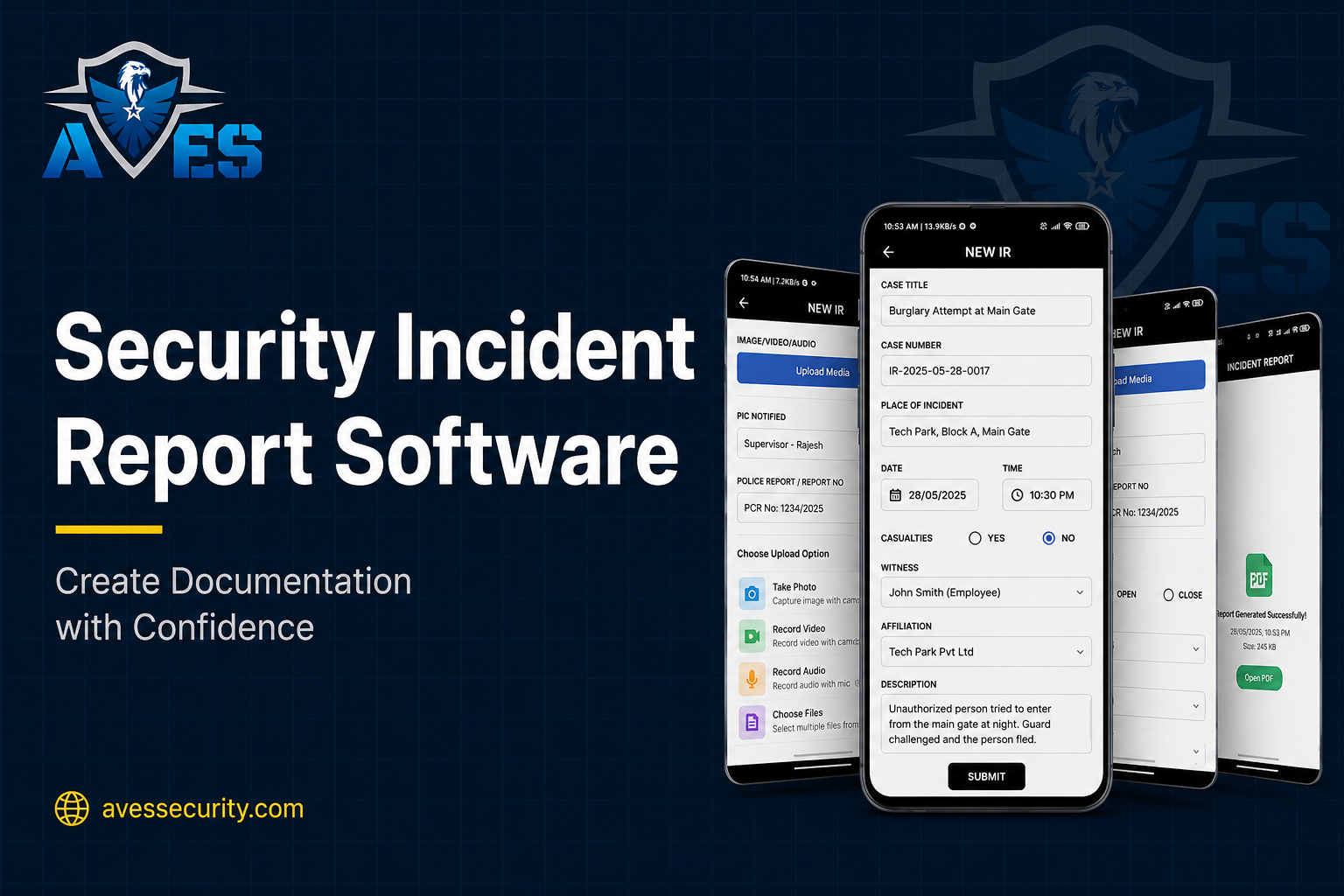
Security Incident Report Software helps security companies create accurate, legally defensible documentation with timestamps, photos and centralized records. Yet many firms still rely on handwritten reports that expose them to legal disputes and compliance risks
Most security firm owners will tell you their incident reporting is fine. It usually isn’t and they don’t find out until they’re already in the middle of a mess.
Here’s how it goes wrong. Something happens on site. An hour maybe two hours later a guard sits down and writes it up from memory. On paper. Paper gets lost. It gets smudged. It gets contradicted the second the client tells a different version of the same story. Three months pass. That sheet of paper is now the only thing standing between the company and a lawsuit.
That’s not a hypothetical by the way. It happens constantly and it’s one of the most overlooked risks in the whole security industry. Most firms only wake up to it after they’ve already been burned once.
Below is the real breakdown: what legally defensible documentation actually requires where reporting quietly falls apart at most companies and how security incident report software closes that gap before it ever costs anyone anything.
Why Security Incident Report Software Is More Than Just Having a Process
Ask any owner and they’ll say documentation’s handled. A form a notebook a quick text to the supervisor once the shift wraps.
Skipping documentation was never really the problem. The problem is that what does get written down usually can’t survive five minutes of real questioning.
A lawyer looks at a report typed from memory an hour later and sees an opening. No timestamp attached to it? Bigger opening. No photo no video? Now there’s nothing but two conflicting versions of events and no way to settle which one’s true.
None of it feels urgent until a client an insurer or an actual attorney asks to see the paperwork. Right there is where weak processes get exposed and by then there’s no fixing anything.
How Security Incident Report Software Creates Legally Defensible Documentation
The phrase gets used constantly and defined rarely so here’s the actual definition.
Legally defensible documentation is a report that stands entirely on its own. Industry best practices published by ASIS International emphasize accurate timely and evidence-based incident documentation for professional security operations. No follow-up call needed. No guard explaining after the fact what they “really meant.” It answers who, what, where, when and how, with evidence tying each part together.
Four things have to be true for any of that to hold.
The timestamp can’t be touchable for one. The instant a report can quietly get edited or backdated its credibility is done. There’s no partial version of this rule.
There needs to be visual proof too a photo or short video grabbed whenever it’s physically possible. A paragraph describing damage carries nowhere near the weight of a picture taken at the scene. This single detail arguably more than anything else on the list tends to decide whether a claim gets accepted quietly or turns into a fight.
Every report needs a specific guard a specific location a specific shift attached to it. “Handled by security” is exactly the kind of vague line a lawyer picks apart in under a minute.
And someone has to be able to pull the report up fast. Two days spent digging through file boxes to produce documentation for a client or insurer makes the whole operation look unreliable regardless of how solid the report underneath actually was.
Where Most Incident Report Documentation Breaks Down
Owners rarely think about this until they’re sitting across from a lawyer.
Using Security Incident Report Software helps eliminate delays improve consistency and ensure every incident is recorded with the required details from the moment it occurs
Delay quietly kills credibility. The wider the gap between an incident and the write-up the easier it becomes to argue the details were reconstructed rather than genuinely recorded live. Something written on the spot simply holds up better than something typed out at the end of a long shift.
Consistency matters more than detail and that surprises most people. A single flawless exhaustive report can actually look suspicious sitting beside a pile of thin vague ones from that same guard. Courts and insurers put more weight on a consistent pattern than they do on one polished exception.
Then there’s paper itself which is its own liability. Every hand a physical report passes through on the way to a client is one more place it could get lost altered or quietly vanish altogether.
These aren’t theoretical concerns. They’re the exact weak points that surface the moment a real dispute actually lands on somebody’s desk.
Digital patrol verification also improves reporting accuracy when combined with GPS Patrol Tracking Software.
The Mistake Nearly Every Security Firm Makes
Most companies treat incident reporting as a chore rather than a legal safeguard. Whoever’s free at the moment gets handed the job and almost no real structure guides how it gets done.
That works fine until the one incident that actually matters and at that point whatever quality the reporting process had or didn’t have decides whether the company is protected or fully exposed. Nobody gets to go back and rewrite a bad report once it’s already out in the world.
Firms that get this right treat every single incident report as though it might land in front of a judge one day. Most never will. That standard more than any tool a company buys is what actually creates protection.
What Good Security Incident Documentation Best Practices Look Like
Anyone rebuilding this process should treat the following as non-negotiable.
- Reports start immediately ideally right from the guard’s phone at the scene
- Photos or short videos get attached whenever it’s physically possible
- Every report is timestamped automatically and tied to a specific guard ID
- Reports sync to a central system the instant they’re submitted not typed up hours later
- Supervisors can flag anything incomplete that same day not weeks down the line
Barely any of that works reliably on paper. Not because paper is inherently bad. It’s because the whole thing depends on human memory and discipline holding up right in the exact moments both tend to fail.
The Hesitation Most Owners Feel Here
Some of that probably sounds like a lot of new process to enforce and that reaction makes sense.
Here’s the honest part though: structured software-based reporting doesn’t pile more work onto guards. Done properly it ends up faster than writing a report by hand since guards are filling in structured fields and snapping photos from their phone in the moment rather than reconstructing a narrative from scratch later.
The real shift isn’t about effort at all. It’s about timing discipline and software enforces that automatically just by making a report visible to a supervisor the second it’s submitted.
How Aves Security Incident Report Software Helps Security Companies
This is precisely the gap Aves Security Management was built to close.
Aves lets guards attach photos and videos straight from their phone the moment an incident happens producing a timestamped guard-specific record that supervisors can review that same day instead of two weeks later.
Every report lives in one central system rather than being scattered across paper files somewhere. When a client insurer or lawyer asks for documentation pulling it up takes minutes rather than days of searching.
Guards aren’t being asked to do more work here. They’re getting a faster, cleaner way to do the same job backed by security incident report software built to produce documentation that actually holds up when it’s questioned.
Investing in Security Incident Report Software is one of the most effective ways for security companies to strengthen documentation improve accountability and reduce legal risks without adding unnecessary administrative work.
Where to Go From Here
Nobody needs to overhaul an entire operation overnight to fix this. Start small instead.
Pull the last five incident reports written and take an honest look at them. Check the timestamp gap. Check whether photos exist. Ask whether each report stands on its own or whether someone would still need to call the guard just to understand what actually happened.
If those five reports wouldn’t hold up under real scrutiny that’s not cause for panic. It’s simply the clearest signal available that the process needs a stronger foundation before the next incident actually puts it to the test.
Related reading: for the fields a report should capture, see security incident report format. For the smaller day-to-day events that sit below an incident, see occurrence reporting software. And for reconstructing a full timeline after the fact, see security investigation timeline.
What is Security Incident Report Software?
Security Incident Report Software is a tool that helps security companies make reports of incidents. These reports include timestamps, photos, videos and all the records are stored in one place.
Why is Security Incident Report Software important for security companies?
Security Incident Report Software is important because it makes reporting more accurate. It also reduces paperwork. This helps security companies create reports that can be used in audits, disputes with clients and investigations.
How does Aves Security Incident Report Software improve incident reporting?
Aves Security Incident Report Software helps guards submit reports away from their mobile devices. They can add photos or videos to the reports. All reports are stored automatically in one system so they can be accessed quickly.
What features should Security Incident Report Software include?
When looking for Security Incident Report Software it should have the following features:
* timestamps
* Reporting from devices
* Ability to add photos and videos
* Identification of guards
* Secure storage in the cloud
* Review capabilities by supervisors
Can Security Incident Report Software help with compliance?
Yes Security Incident Report Software can help. It keeps timestamps, digital evidence and complete records of all activities. This supports documentation that can be used in matters and helps meet compliance requirements.
Why choose Aves Security Incident Report Software?
You should choose Aves Security Incident Report Software because it helps security companies make incident reporting easier. Reports can be submitted in time. All documentation is stored in one place. Records are automated. This allows for access, to reports when clients, auditors or insurers need them.