The AVES Security Guard Management App is a powerful security workforce management solution designed to simplify guard scheduling, attendance tracking, patrol monitoring, and incident reporting. In 2026, businesses are adopting AVES Security Guard Management to improve efficiency and strengthen security operations.
Here’s a strange truth about security operations: the oldest technology in the building is usually the least accounted for. Cameras get firmware updates. Access cards get reissued the moment someone leaves the company. Alarm panels get swapped out every few years. And yet the master key to the server room? Still living on a nail behind the guard desk, tracked by a laminated sign-out sheet that half the shift forgets to touch. AVES’s Keys module exists because of that gap, plain and simple.
The Problem Nobody Talks About
Ask any ops manager what keeps them up at night and they’ll mention cameras, alarms, maybe access control software. Almost nobody says “keys.” That’s exactly the problem.
Take a mid-size site, a warehouse or a gated community, and count how many keys move hands in a single week. Guards, supervisors, tenants, contractors, the maintenance guy who shows up twice a month. All of it usually runs through a paper register. Sign it out, write the time, sign it back in at shift’s end. Simple in theory.
In practice it falls apart fast. A key gets passed between two guards mid-shift-change and nobody writes it down. The register gets skipped entirely because an alarm went off, a delivery truck showed up, or a visitor needed escorting and the logbook just wasn’t top of mind. A key goes missing for a full day before anyone even notices, usually right when someone needs that exact door open.
None of these gaps look dramatic on their own. But stack enough of them up and the register stops being a record of what happened. It becomes a guess. And a guess is a bad foundation when the entire point of a key log is answering, with certainty, who had access to what space at what time.
There’s also a quieter cost that rarely makes it into the conversation: time. Guards and supervisors spend real hours every month hunting for a missing key, tracking down whoever had it last, sometimes re-keying an entire lock because a master key vanished. Nothing about that is exciting. It’s just waste.
What Keys Actually Does
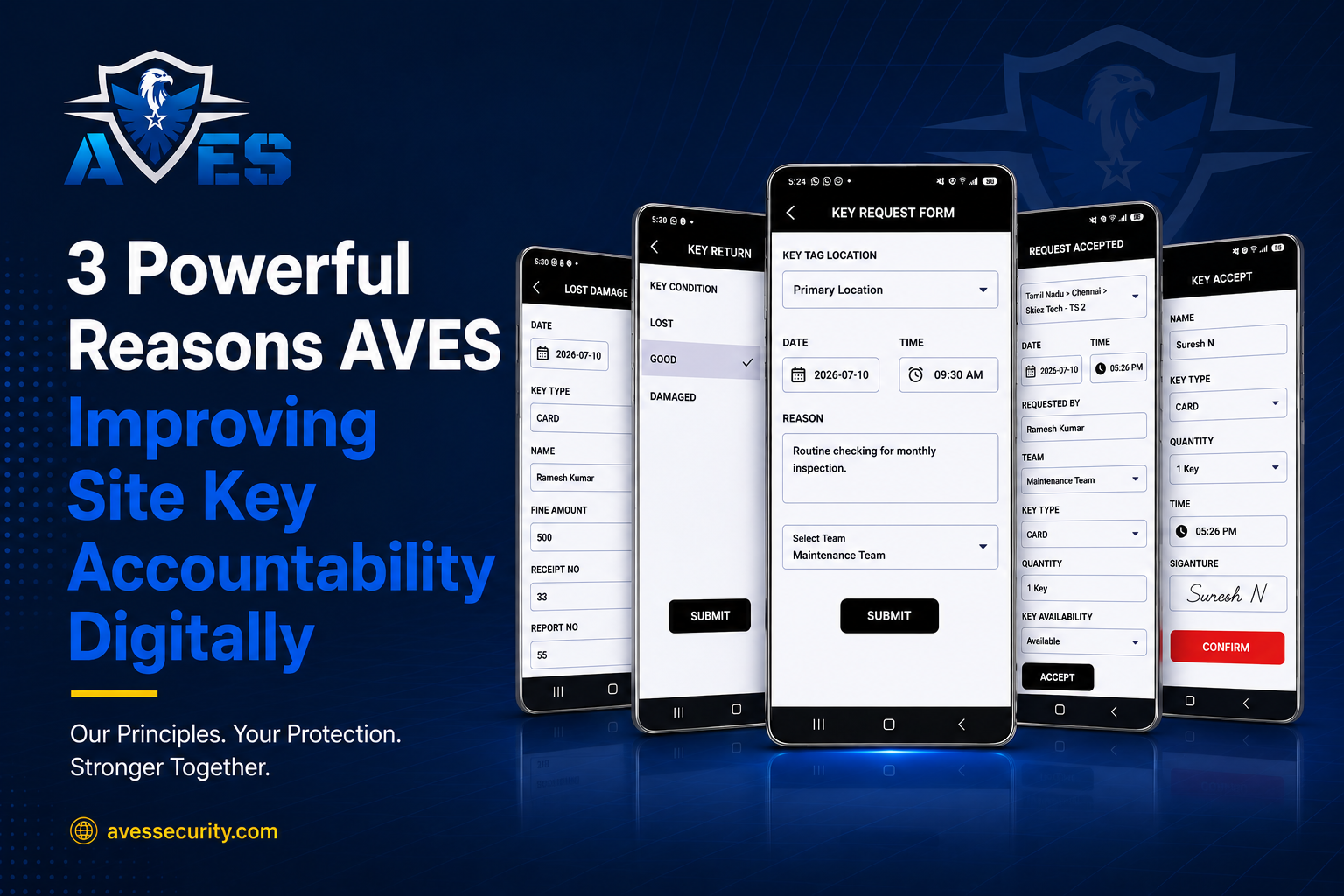
The Keys module takes that whole process and moves it off paper. Every issue, every return, gets logged the moment it happens, closing the gaps that come standard with a handwritten register. Guard checks out a key at shift start, hands it to a supervisor for a specific task, returns it at the end. All of it timestamped. Who, when, and what.
No more single shared notebook that can be lost, skipped, or filled in from memory an hour later. AVES builds a continuous digital trail for every key in circulation, and because it’s captured at the moment of the transaction, nobody can quietly backdate an entry to cover a gap. The record shows what happened, not what someone remembers happening after the fact.
Suddenly a task everyone treated as background admin work becomes something you can actually govern. A record that’s current the second you need it, not reconstructed after a problem already occurred.
Why It Sits in “Core Operations”
AVES groups six modules as the backbone of a well-run deployment: Patrol, Incident Report, Pocket Book, Briefing, Occurrence, and Keys. None of these are tucked away as optional extras. They’re the tools that shape guard accountability and shift discipline on an hour-by-hour basis.
Keys belongs on that list because access control starts with a physical key long before any electronic system enters the picture. You could have cameras on every entrance and card readers on the front doors and still be wide open if a master key to a rooftop or a storage room can’t be accounted for during a single shift. It’s the low-tech piece that gets overlooked precisely because it feels too ordinary to matter, right up until it does.
It also connects naturally to the other modules. A missed patrol checkpoint, or a strange entry in an Occurrence log, usually raises one question: who could have gotten into that space, and when. With a clean key record, that question has an actual answer instead of a shoulder shrug.
Where the Business Value Shows Up
The payoff of a full digital trail becomes obvious the first time something goes wrong. Restricted area gets accessed without authorization? Client wants to know who held a particular key on a particular night? A company running AVES answers that immediately, down to the guard and the minute, instead of flipping through a paper register that may or may not have been filled out for that shift.
A few places where that shows up directly:
Disputes get resolved faster. If a tenant claims their unit was entered without permission, having a clear record of which keys were out and who held them turns a drawn-out argument into a five-minute conversation.
Guard behavior improves on its own. Once guards know every handoff is logged automatically rather than left to memory, they naturally get more careful with how keys move. The accountability is baked into the process instead of added on top of it.
Daily friction drops. Fewer lost keys means less searching, less emergency re-keying, fewer disruptions. And because the system flags a key that hasn’t come back on schedule, problems surface in hours instead of days.
Audits stop being a scramble. Sites under regulatory or contractual obligations, factories, secure facilities, gated communities, often need exactly this kind of documentation. Having it ready on demand beats reconstructing it manually the night before an audit.
The Bigger Picture
Keys lives inside AVES’s Core Operations layer next to Patrol, Pocket Book, and Briefing, the modules covering the everyday tasks a guard runs through on a normal shift. Put together, they replace the entire paper trail of a guard’s workday.
Think about it like this: Patrol proves a guard physically covered the site. Keys proves the site’s access points stayed controlled during that same window. One tracks movement, the other tracks access. Different halves of the same accountability story.
That’s really the shift AVES is going for. Moving a company from “we believe this happened” to “here’s the record proving it happened.”
A Small Feature, A Bigger Impact Than It Looks
It’s easy to write off key management as boring compared to surveillance systems or emergency protocols. But a key is often the most direct access control point a site has. More immediate than a camera. More physical than an alarm going off after the fact. A key in the wrong hands, or one nobody can locate, is a live vulnerability no matter how advanced everything else on-site looks.
That’s the case for Keys, really. No new hardware, no new locks, no complicated rollout. Just a process every site already runs, issuing and returning keys, made visible and permanent instead of scribbled on a sheet nobody double-checks. For any security company deciding where to start with digital transformation, this unglamorous little process is a good place to begin.
Contact Us: www.avessecurity.com
How does AVES prevent guards from lying about checkpoint visits?
AVES uses GPS to make sure guards are actually at the checkpoints. They have to be standing at the location to log it. This way guards cannot pretend they were somewhere they were not. AVES makes sure guards are honest about their checkpoint visits.
Can supervisors see what’s happening during a patrol or after the fact?
Supervisors can watch patrols happen in time with AVES. They do not have to wait for a report that may not even be read. If a guard misses a zone supervisors will know about it within minutes. They will not have to wait for a client to call and complain about the missed zone.
What if a guard says they checked a location. It looks doubtful?
AVES solves this problem with photos and videos. Every checkpoint can have a photo that is taken at the time of the visit. This photo proves the guard was actually at the location. If the photo is blurry, it will not be accepted as proof. AVES uses photo and video proof to make sure guards are telling the truth about their visits.
Do supervisors have to chase guards down to know if something’s wrong?
No they do not. AVES will automatically alert supervisors if a guard is late, absent or off-route. Supervisors do not have to spend their time chasing down guards to find out what is going on. AVES makes it easy for supervisors to know if something is wrong.
Why does this matter more than it look like it should?
This matters because it is about being honest and transparent. Guards do a job when they know someone is watching. Supervisors can manage better when they have all the information. Clients trust the guards more when they can see the proof for themselves. AVES is about making sure everyone is honest and doing their job.