
Most accountability failures on a security site don’t happen during a shift. They happen in the ninety seconds between shifts.
Staff a sharp guard on days, an equally sharp one on nights you can still end up with a gap nobody can explain. A missing key. A pending incident nobody flagged to the next person. A visitor who signed in and nobody remembers signing out. Neither guard was careless here. That’s exactly the gap a shift handover checklist is built to close. The handover itself just has no structure, so whatever gets said in that ninety-second exchange is whatever the outgoing guard happens to remember right then.
A shift handover checklist fixes exactly this. Not the shift. The changeover.
Why the Handover Moment Is the Real Risk Point
Think of a relay race. Two fast runners can still lose if the baton drops during the exchange, doesn’t matter how clean each leg was run individually. Races get won or lost in the handoff, every single time.
Guard duty’s no different. Morning shift runs clean, night shift runs clean and the site still ends up exposed because the exchange between them was verbal, rushed or just skipped when the incoming guard rolled in two minutes late.
A shift handover checklist that isn’t written down isn’t really a handover. It’s a conversation one person may or may not remember correctly six hours later, when a client wants to know exactly what happened.
What Actually Belongs on a Shift Handover Checklist
A good handover checklist isn’t long, it’s specific. Four things need to move from outgoing guard to incoming guard, every single time and none of them should ride on memory. Skip any one of these on your shift handover checklist and you’ve built a hole straight into it.
Keys and access items. Every key, fob or access card checked out at shift start gets checked back in or physically handed over, with both people confirming the count matches. Sounds obvious, until you’ve chased a missing master key three weeks later and nobody can say which shift lost it. Some teams run this as its own key control checklist inside the larger handover works fine, as long as it still gets logged and timestamped. This is item one on every shift handover checklist, for good reason.
Pending incidents. Something happened during the shift and it hasn’t been closed out, resolved or escalated? It doesn’t just vanish when the shift ends. Write it down. Hand it over as an open item, with enough detail that the next guard actually knows what to watch for. No shift handover checklist is complete without this logged.
Visitor logs. Anyone who entered during the shift and hasn’t formally exited needs flagging. Matters even more at sites running contractors or maintenance crews outside normal visitor hours they’re the ones who slip through a verbal handover every time.
Equipment condition. Radios, torches, patrol devices, whatever hardware the post depends on. Something’s low on battery, damaged or missing? The incoming guard needs to know before the round starts, not halfway through when the radio dies on them mid-patrol. Equipment checks close out the shift handover checklist and it’s usually the first thing forgotten.
Those four form the core of any real security handover register. Weather notes, general site observations that’s optional context. These four aren’t.
How AVES Turns This Into a Register, Not a Guessing Game
Here’s what most people get wrong: writing your shift handover checklist on a paper register doesn’t solve the problem, it just delays it. Pages go missing. Logs get lost. And there’s no way to prove after the fact that a handover even happened, let alone what got said during it.
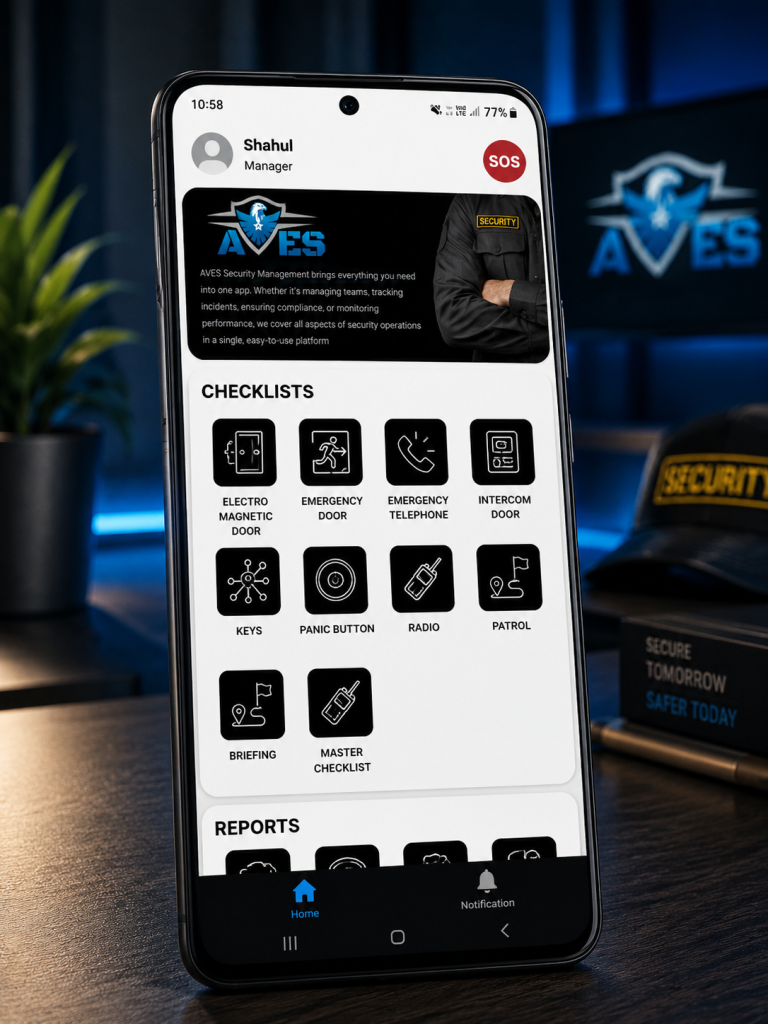
AVES is built to make your shift handover checklist enforceable, not just documented. That happens through its digital Books and Checklist modules. Officers log handover entries right through the app and every entry gets timestamped automatically the second it’s created. That timestamp is what actually makes the register useful during an audit or a client dispute nobody’s relying on anyone’s word for when something got logged.
The Reports module ties in for pending incidents specifically. An incident that hasn’t closed out by end of shift stays visible in the system instead of living only in someone’s memory and it can carry photo or video evidence attached from when it was first logged. The Pass & Permit module handles visitor tracking the same way a searchable record of who entered and whether they’ve formally exited, instead of a paper sign-in sheet that only tells you half the story.
None of this is about extra paperwork. It’s about making the handover something you can actually check, not something you just have to trust blindly.
Mistakes That Quietly Break a Handover
A few habits quietly break even a well-designed shift handover checklist.
The handover happens verbally, nothing written down anywhere, so the only record of what was said is whatever both guards happen to remember. That record disappears the second either one forgets.
The incoming guard skips physically verifying keys and equipment, just takes the outgoing guard’s word for it. This right here is how a missing item goes unnoticed for days.
Pending incidents get mentioned in passing instead of logged as open items, so they fall straight off the radar the moment the outgoing guard walks out the door.
And the classic one: the handover gets rushed because the incoming guard is running late, so both of them cut corners on the exact checklist built to stop corners from being cut.
None of this is complicated to fix. It just means treating the handover as its own step, with its own checklist, not an afterthought wedged between two shifts.
Frequently Asked Questions
What is a shift handover checklist?
A shift handover checklist is a fixed set of items an outgoing guard confirms and logs before leaving post keys, pending incidents, visitor status, equipment condition so the incoming guard starts with the full picture instead of a verbal summary.
Why does the handover matter more than the shift itself?
Because it’s the one point where information can actually get lost and once it’s lost, the incoming guard has no idea what they’re missing. A clean shift followed by a sloppy handover still leaves the site exposed.
What’s the difference between a handover checklist and a handover register?
The checklist is what gets confirmed at handover. The register is the ongoing record of every handover that’s happened timestamped, searchable, the thing that actually gets pulled up during an audit.
Can a handover checklist be done on paper?
Sure, but paper registers get lost easily and can’t be timestamped reliably. A digital log through something like AVES gives you the same checklist backed by a record you can actually verify later.
Who is responsible for confirming the handover happened correctly?
Both guards. Outgoing guard logs everything accurately. Incoming guard verifies it physically instead of just nodding along to a verbal summary.
Where This Leaves You
A shift handover checklist isn’t about piling on process for its own sake. It’s about closing the one gap in your operation that has nothing to do with how good your guards are individually and everything to do with what happens in the handoff between them.
Get that ninety-second exchange right, backed by a real security handover register and most of the accountability gaps plaguing 24/7 sites just stop happening on their own. This connects directly to how your rotation gets structured in the first place and it runs alongside live key control at the post too worth looking at both together rather than separately. Build your shift handover checklist once, enforce it every shift and the gaps stop showing up.
Want to see how AVES handles handover logging, incident tracking and visitor management in one dashboard? Visit AVES Security Guard Management and request a demo.
CONTACT US
Website : https://www.avessecurity.com
Linkedin: https://www.linkedin.com/company/aves-security-management-system/
Instagram: https://www.instagram.com/avessecurity/