
You already know the feeling. It’s 6 AM, the shift just changed and somewhere in the back of your mind is a question you don’t want to ask out loud: was the panic button actually tested last night, or did someone just sign the sheet?
That doubt is exactly why a digital inspection checklist exists and if you’re reading this, you’ve probably already lived through the moment where a paper checklist let you down.
Maybe it wasn’t a disaster. Maybe it was just a client walkthrough where the emergency phone didn’t ring and the log said it was “checked” three hours earlier. Either way, you felt it. That small, sinking realization that your paperwork and your reality had quietly stopped matching.
That’s the exact question a digital inspection checklist exists to answer, before a client or an insurer ever has to ask it.
The Fear Nobody Says Out Loud
Security operators don’t lie awake worrying about the equipment itself. They lie awake worrying about the gap between what the paperwork says and what actually happened on site.
A paper form can be filled out from memory at the end of a shift. It can be backdated. It can say “all clear” on a piece of equipment nobody actually walked over to touch. That’s not a guard problem. That’s a systems problem and it’s exactly the gap a digital inspection checklist is built to close.
If you’ve ever had to explain to a client why a piece of safety equipment failed during the one moment it mattered, you already understand why this matters more than almost anything else on a guard’s shift list.
What a Digital Inspection Checklist Actually Solves
Here’s the part most people get wrong when they first look into this. They think a digital inspection checklist is just a fancier form. It isn’t.
The real value of a digital inspection checklist is the timestamp. A record that gets created the moment a guard is standing in front of a panic button, testing it, not the moment they get back to the desk and remember to write it down.
That single shift, from memory-based logging to real-time logging, is what makes a digital inspection checklist worth adopting in the first place. It’s not about looking more modern. It’s about closing the exact gap that keeps security managers up at night.
Six Things That Actually Need Checking, Every Single Shift
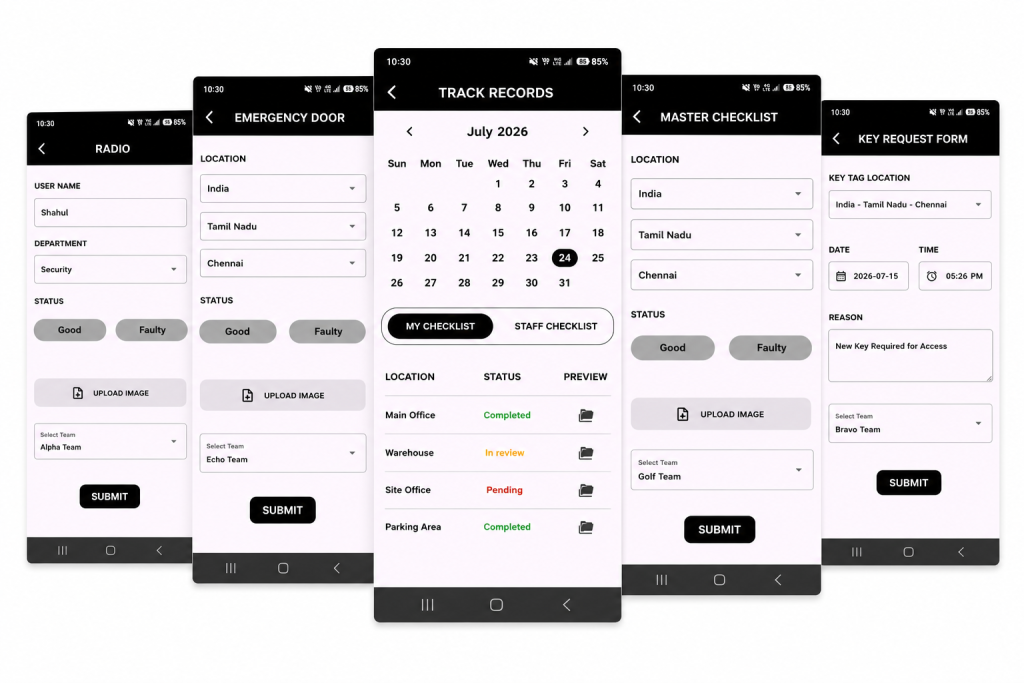
A good digital inspection checklist doesn’t try to cover everything under the sun. It focuses on the equipment that matters most in an actual emergency:
- Emergency telephones, confirmed operational and connected
- Emergency doors, checked for unobstructed operation
- Panic buttons, tested and confirmed active
- Intercom doors, verified and logged
- Electromagnetic doors, verified and logged
- Radios, verified and logged
Notice what’s on that list. None of it is decorative. Every item is something that, if it fails silently, turns a manageable situation into a genuinely dangerous one.
This is the part that separates a serious digital inspection checklist from a generic to-do app repackaged for security teams. It isn’t trying to track everything. It’s trying to make absolutely sure the handful of things that matter most never get skipped.
The Doubt You’re Probably Carrying Right Now
If you’re evaluating whether to move to a digital inspection checklist, you’re probably carrying a few quiet doubts. Let’s name them honestly instead of pretending they don’t exist.
“What if my guards just fake the digital version too?”
Fair concern. The difference is that a digital inspection checklist creates a record that can’t be backdated or edited after the fact the way a paper form can. A guard can still choose not to test a panic button, but they can’t quietly write “9 PM” on a form at 11:45 PM and make it look accurate. The system captures when the entry was actually made.
“Is this going to be complicated to roll out?”
This is where a lot of people overthink it. A digital inspection checklist doesn’t require retraining your entire operation. Guards are already doing the physical check. The tool just changes what happens after they touch the equipment, not the check itself.
“What if the software becomes another thing I have to babysit?”
This is the most reasonable fear on the list about any digital inspection checklist and it deserves an honest answer, not a sales pitch. Any digital inspection checklist is only as good as whether your team actually opens it every shift. The ones worth choosing are the ones simple enough that a tired guard at 3 AM can use it without friction. That’s the real test, not the feature list.
What Good Actually Looks Like
Picture the version of your operation where this works the way it’s supposed to.
A guard starts their shift. They walk the fixed equipment list, physically testing each item. Each check gets logged the moment it happens, not reconstructed later from memory. By the time your morning report lands, you already know whether every panic button, door and radio on site was actually verified, not just claimed to be verified.
That’s the entire promise of a digital inspection checklist. Not more paperwork. Less uncertainty.
When a client asks you to prove equipment was checked before an incident, you’re not scrambling through a filing cabinet. You’re pulling up a timestamped record that speaks for itself.
Why This Matters More Than It Looks Like It Does
Most security operators don’t think about equipment checks as a competitive advantage. They think of them as a chore, something guards grumble through because someone above them said it’s required.
That mindset is exactly what a digital inspection checklist is designed to change. Every completed, timestamped check is proof of due diligence. It’s the difference between a security company that can defend its record in a liability conversation and one that’s hoping nobody ever asks hard questions.
If you’ve ever felt that quiet unease about whether your equipment checks would actually hold up under scrutiny, that feeling is worth listening to. It’s usually a sign the process, not the guards, needs fixing.
The Honest Trade-Offs
No tool solves everything and it would be dishonest to pretend a digital inspection checklist is a silver bullet.
It doesn’t replace the physical act of checking equipment. A guard still has to walk over and test the panic button. What it changes is whether that action leaves behind proof and whether that proof can be trusted months later when it actually matters.
It also won’t fix a culture problem on its own. If a team doesn’t take the underlying duty seriously, no piece of software forces genuine diligence. What a digital inspection checklist does is make it much harder to fake diligence that isn’t there, which tends to change behavior on its own over time.
Where This Leaves You
If you’ve made it this far, you already know the real question isn’t whether equipment checks matter. You know they do. The real question is whether you can currently prove they’re happening the way your paperwork says they are.
That’s the exact gap a digital inspection checklist is built to close. Not a bigger to-do list. A record you can actually stand behind.
You don’t need to overhaul your entire operation to adopt a digital inspection checklist. You need a system that captures the moment a check actually happens, instead of the moment someone remembers to write it down.
That’s the whole shift. And once you see it working on your own site, it’s hard to imagine going back to a clipboard.
See how a digital inspection checklist works on a real site → Book a free walkthrough
CONTACT US
Website : https://www.avessecurity.com
Linkedin: https://www.linkedin.com/company/aves-security-management-system/
Instagram: https://www.instagram.com/avessecurity/
What equipment actually needs checking every shift?
That six things and they’re not random.That’s the list. Not because other equipment doesn’t matter, but because these six are the ones you reach for when something’s already going wrong. If they don’t work in that moment, nothing else about your setup matters much.
Can someone go back and edit an entry after it’s submitted?
That’s the whole reason to move off paper in the first place.
A form filled out from memory can say whatever the person writing it wants it to say. A record created the second someone actually tests the panic button can’t be rewritten later to look tidier than reality. That gap between “what happened” and “what got written down” is exactly what this kind of system is built to close.
How disruptive is it to actually switch over?
Less than people expect, usually.
The underlying job doesn’t move an inch. Guards are already walking the site and testing equipment. All that’s really shifting is how that gets recorded. Most teams find their footing within a shift or two, not weeks.
What if my guards just fake the digital version too?
Fair concern. The difference is that a digital inspection checklist creates a record that can’t be backdated or edited after the fact the way a paper form can. A guard can still choose not to test a panic button, but they can’t quietly write “9 PM” on a form at 11:45 PM and make it look accurate. The system captures when the entry was actually made.