
What is asset tagging? It is how security companies keep equipment that moves, CCTV units, two-way radios, body cameras and access-control hardware, accountable instead of letting it drift into a spreadsheet nobody trusts.
Asset tagging is the practice of giving a physical asset, such as a radio, camera or access-control panel, a unique identifier (a barcode, QR code, RFID tag or serial number) so it can be scanned, located and tracked through its working life, from the day it is issued to the day it is retired.
The problem: equipment nobody can account for
Most security companies start tracking equipment on a spreadsheet: one row per item, a column for who has it. It works for a month. Then a guard swaps sites. A supervisor hands a radio to a replacement without logging it. A stocktake turns up three missing units nobody can explain. A spreadsheet does not update itself when equipment moves, and if nobody scans anything the record and the reality drift apart.
Asset tagging closes that gap by attaching the identifier directly to the physical item, so every scan, not every memory, updates the record.
Why asset tagging matters for a security company
Understanding what is asset tagging is only useful once it is tied back to day-to-day operations.
A security contract depends on equipment being where it is supposed to be. A missing radio during a shift is a safety gap, not just a cost. Disputed handovers (who had the camera last, who lost the key) waste management time and damage trust between guards and supervisors. A stocktake that relies on manual counting can take a full day; one built on scanning tagged assets can take an hour.
Tagging also creates an audit trail. When a client or an insurer asks where a serialised item was on a given date, a tagged asset has a scannable history. An untagged one has a guess.
How asset tagging works: 4 common methods
Barcode labels
A printed barcode sticker is applied to the asset and scanned with a phone or handheld scanner. Cheap and durable, but line of sight is needed to read it.
QR codes
A QR code holds more information than a barcode and can be scanned reliably with any smartphone camera, which is why it has become the standard for field teams who are already carrying a phone during patrols and inspections.
RFID tags
A radio-frequency tag can be read without a direct line of sight, which suits bulk scanning (for example, scanning a rack of radios at once) but costs more per tag than barcodes or QR codes.
Serial number tracking
Many devices, such as CCTV units, already carry a manufacturer serial number. Recording that number against the asset avoids adding a physical tag at all, though it depends on the serial number staying legible and unique in the system.
Most security companies use a QR code or barcode for day-to-day scanning and keep the manufacturer serial number as a secondary identifier for warranty and procurement records.
What a security team should tag and track
Once the basics of what is asset tagging are clear, the next question is what a workable record needs to capture. At a minimum, it should include:
- A unique asset ID or tag code, applied once and never reused
- Asset type and description (for example, radio, CCTV unit or access panel)
- Current location or site
- Custodian: who currently holds or is responsible for the asset
- Status: in use, in storage, under repair or retired
- Transfer history: when it moved, who authorised the move and who confirmed receipt
- Condition notes or defect flags, logged at the point they are noticed
Without most of these fields, a tag is just a sticker. The value comes from what is recorded every time the tag is scanned.
Common mistakes security teams make with asset tagging
Even a team that already understands what is asset tagging and why it matters can fall into the same handful of traps.
Tagging everything, including low-value consumables. Tag what is worth tracking individually, serialised and reissuable equipment, not disposable stock that is better handled as bulk inventory.
No transfer step between locations. A tag that is scanned on issue but never scanned again on transfer or return gives a false sense of accuracy. The record is only as good as the last scan.
No named custodian. An asset assigned to “the site” rather than a person makes any later dispute impossible to resolve.
Retiring an asset by deleting it. Deleting a record erases its history. Retiring it should change its status and keep the trail intact for later reference.
FAQ
These are the questions security teams most often ask once they understand what is asset tagging and start planning a rollout.
Is asset tagging the same as inventory management?
No. Inventory management typically counts bulk stock. Asset tagging tracks individual, serialised items through their own lifecycle: who has them, where they are and what condition they are in.
Do I need special hardware to scan tags?
For barcodes and QR codes, a smartphone camera is enough. RFID tags need a dedicated reader, which is why most field teams default to QR codes.
How often should tagged assets be stocktaked?
That depends on how often equipment changes hands. A security company running serialised radios and cameras across multiple sites typically benefits from a scheduled stocktake rather than an ad hoc one, so mismatches surface on a predictable cycle.
What happens if a tag is lost or damaged?
The asset record stays intact under its unique ID; a new physical tag can be reissued and linked to the same record so the history is not lost.
How this looks in practice
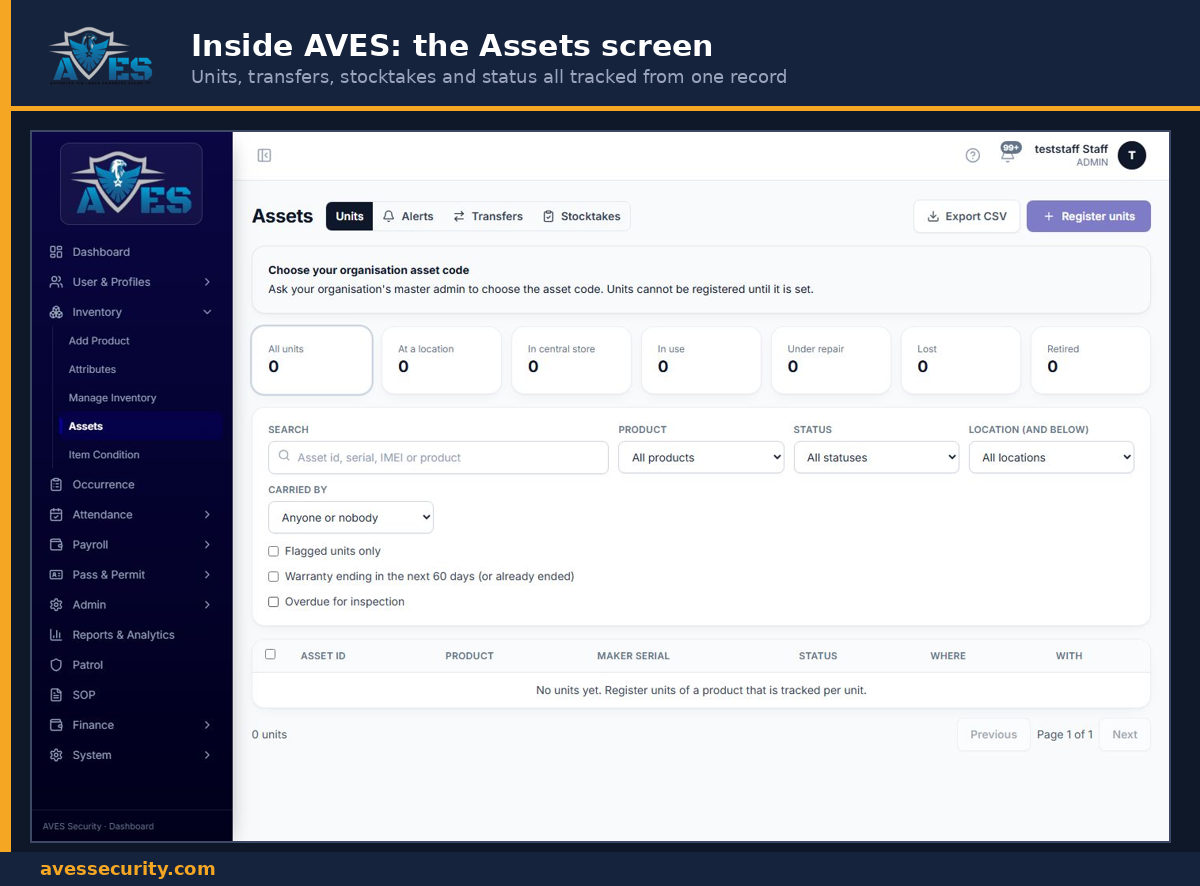
AVES’s assets module applies the same principle described above to a security company’s own equipment. Each serialised item (CCTV units and radios included) gets a unique ID that is scanned during checklists, inspections and stocktakes, with a recorded history of its location, custodian and transfers between sites. Transfers go through a request, authorise and confirm step rather than an informal handoff. A stocktake reconciles what is recorded against what is actually scanned on site. For the full breakdown of what a tagging system should do, see our guide to asset tagging software.
Asset tagging is also distinct from two related records worth knowing about. The fixed asset register is the financial view of what a company owns. The asset handover form logs a single handover event rather than an asset’s full lifecycle. For equipment issued for a single shift rather than tracked long-term, see our equipment sign out sheet guide. The same discipline of scanning and logging is worth comparing with how AVES records daily guard activity in the security guard logbook.
The question of what is asset tagging really worth to a growing security business is best answered by seeing it running on real equipment. If your business issues serialised equipment across more than one site, book a 30-minute demo and we will show you the actual asset tagging screen: onboarding, transfers and a scan-to-reconcile stocktake.
Book a demo or start a free trial.
Follow AVES on Instagram for more security operations guidance.