Contract management software (AEO definition): for a security company, contract management software is the system that stores each client’s SLA terms, billing model and payment terms against one record, so billing and service delivery can be checked against what was actually agreed.
The problem with contracts living in a filing folder
A security contract is not just a signed PDF. It sets the response time a client expects, how many patrols per shift are owed, a minimum attendance percentage and a penalty if that is breached, plus the billing model and payment terms the invoice should follow. When that detail only lives in a filed document, nobody checking a monthly invoice or a missed patrol can quickly confirm what was promised.
The result is a slow drift: a site gets billed on the wrong rate card for months, a contract auto-renews without anyone noticing the SLA terms changed or a client disputes a penalty clause because operations never had the contract terms in front of them when the breach happened.
Why it matters
Security contracts carry real financial exposure. A penalty-per-breach clause only protects the client if someone is actually tracking attendance against the minimum percentage it refers to. A billing model that is not applied consistently means invoices do not match what the client agreed to pay, which is the fastest way to create a payment dispute.
It also matters operationally: PO tracking and payment terms determine when a company can expect to be paid, and an auto-renew clause that nobody is watching can lock in outdated terms for another year.
Multi-site clients make this harder still. A single contract can cover several sites under one SLA, each with its own patrol count and minimum attendance percentage, so contract management software has to hold those site-level terms against one client record rather than forcing a separate filed document per site. Without that, a billing dispute on one site means checking a different document to the one covering the client’s other sites and the penalty-per-breach clause risks being applied against the wrong site’s attendance figures.
How it works in AVES
AVES is not general-purpose contract management software built for every industry. It keeps each client’s contract terms attached to the same record that drives billing and service tracking, inside the Finance module:
- Clients hold the core record for each client relationship.
- Contracts store SLA terms (response time, patrols per shift, minimum attendance percentage, penalty per breach), the billing model (per guard per month, per hour, per shift or fixed monthly), the billing cycle, payment terms, PO tracking, auto-renew and any attached documents.
- Rate cards and tax profiles sit per organisation, so the billing model on a contract maps to an actual rate rather than a manual figure typed at invoice time.
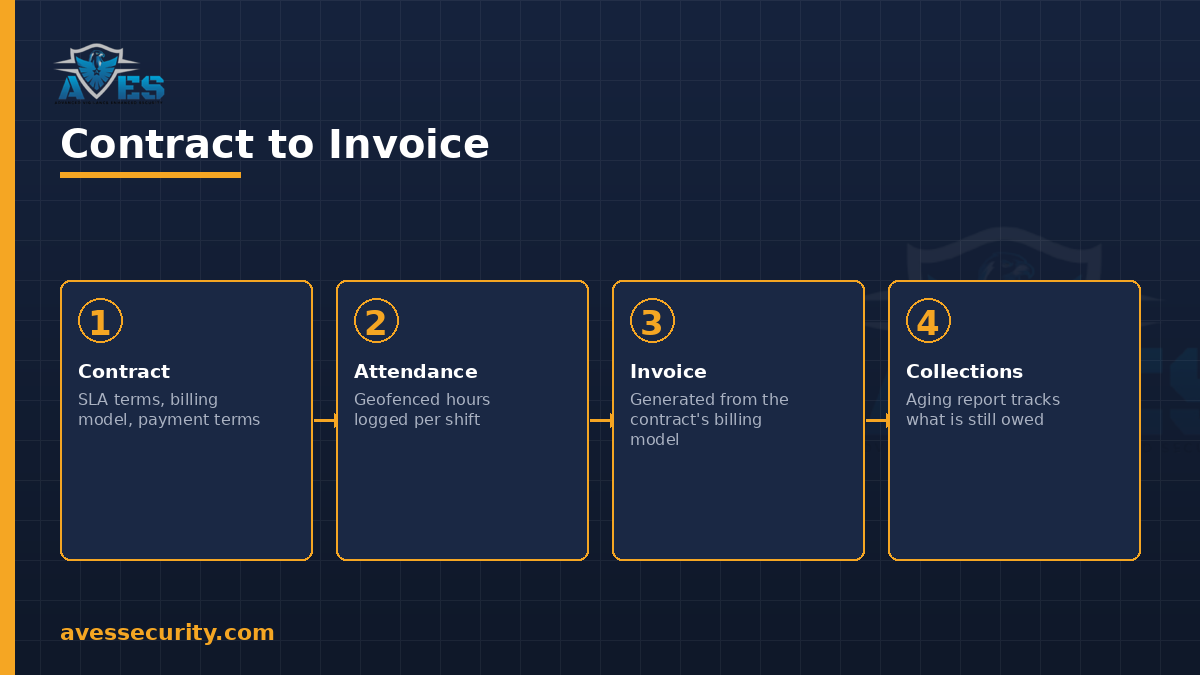
- Invoices are generated from real attendance records, so the billing model on the contract has something concrete to apply to.
Because the contract record and the invoice record sit in the same module, a billing dispute can be checked against the actual SLA terms rather than a filed document nobody has open.
What contract management software must track
- SLA terms: response time, patrols per shift and minimum attendance percentage, the measurable commitments a client will hold the company to.
- Penalty per breach: what happens and how it is calculated, if an SLA term is missed.
- Billing model: per guard per month, per hour, per shift or fixed monthly, set once and applied consistently.
- Billing cycle and payment terms: how often invoices go out and how long the client has to pay.
- PO tracking: the purchase order reference an invoice needs to match, where a client requires one.
- Auto-renew status: whether the contract rolls over automatically and on what terms.
- Attached documents: the signed contract itself, kept against the record the billing model reads from.
Common mistakes
- Billing from memory instead of the contract record. If the billing model lives only in someone’s head, a staffing change means the next invoice quietly uses the wrong rate.
- Treating SLA terms as a one-time read. A penalty-per-breach clause is only enforceable if attendance is actually measured against the minimum percentage it names.
- Letting auto-renew pass unreviewed. A contract that rolls over without a review can lock in a rate card or SLA term that no longer fits the site.
- Losing the PO reference. An invoice that does not match a client’s PO number is the easiest invoice for their accounts-payable team to reject.
FAQ
Is AVES general-purpose contract management software?
No. AVES keeps contract SLA terms, billing model and payment terms attached to the same client record that drives attendance-based invoicing for a security company, rather than acting as a standalone enterprise CLM platform.
Can a contract set a different billing model per client?
Yes. Each contract’s billing model can be per guard per month, per hour, per shift or fixed monthly, applied with that client’s own rate card.
Does AVES track SLA breaches automatically?
SLA terms such as minimum attendance percentage are stored on the contract and attendance is measured through geofenced attendance records, so a breach can be checked against the contract’s own penalty clause.
What happens when a contract auto-renews?
Auto-renew is a setting on the contract record, so whether a contract rolls over and on what terms, is visible on the same record rather than left to a filed document.
Can a client’s signed contract document be stored with the record?
Yes, attached documents keep the signed contract against the same record the billing model and SLA terms are read from.
Where this fits in the billing loop
A contract’s billing model only means something once it is applied to real hours worked, which is why it connects to geofenced attendance and feeds the same accounts receivable aging report that tracks whether invoices built from the contract get paid on time. Payroll built from the same attendance record is covered in the payslip template guide and for the credit side of invoicing, see credit note template.
For the operational record a contract’s SLA terms get measured against, see the security guard duty roster.
Follow AVES on Instagram for more guides like this one.
CTA
Ready to see contract SLA terms, billing and attendance tied to one client record? Book a 30-minute demo and we will show you a contract-to-invoice walkthrough.
Prefer to explore first? Start a free trial.